Christ

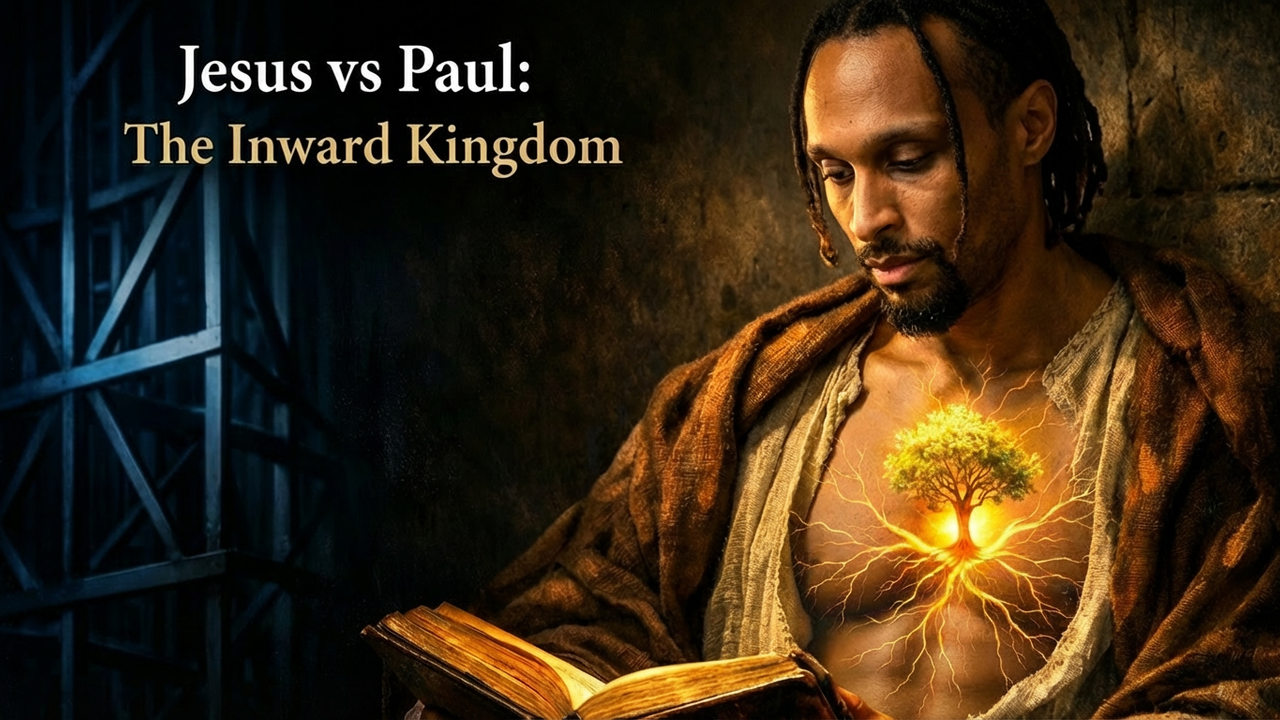
Jesus vs Paul: The Inward Kingdom

The tension at the heart of early Christian thought is not simply historical but ontological: two irreconcilable visions of human transformation and cosmic reign. On one side stands the kingdom proclaimed by the Jesus character as an immediate, inward reality; “within you” (Luke 17:21); a call to devotional repentance, heart renewal, and alignment with the transformative presence of the Hebrew Scriptures. On the other stands Paul’s earlier soteriology, centered on justification by faith in the blood of a cosmic Christ, apart from works of the law (Romans 3:25; 5:9). Evangelical culture has long defaulted to the Pauline lens, rendering inwardness optional and grace primarily forensic. The philosophical question is whether this default can survive scrutiny, or whether centering Jesus’ kingdom philosophy demands a deeper reckoning.

Scot McKnight (2010) correctly frames this crisis in “Jesus vs. Paul.” Any attempt to force Paul’s justification into Jesus’ kingdom mold, or vice versa, requires “bending of corners and squeezing of sides.” Paul barely speaks of the kingdom (fewer than fifteen references), and Jesus barely speaks of justification. The only coherent unity, McKnight argues, lies beneath both: the gospel as Christology, or the saving story of Jesus as the completion of Israel’s narrative. Yet even this harmonization leaves the deeper philosophical divergence untouched.

Barrie Wilson (2014) presses the point further, arguing that the divergence is not interpretive but foundational: two distinct religions. The Jesus Movement (Torah-observant, kingdom-proclaiming, led by James) embodied the religion of the Jesus character—an anti-imperial, messianic Jewish community awaiting the inward and outward breaking in of their God’s reign. Paul’s Christ Movement, born from a private mystical vision rather than historical discipleship, became a religion about the “Christ”: cosmic, dying-and-rising, Torah-free, focused on participation in a savior’s death rather than the teacher’s way of heart renewal. Acts retroactively solders them together; Paul’s own letters reveal the rupture.

The philosophical contradiction becomes sharpest when examined through Paul’s own logic. In 1 Corinthians 15:56 he declares, “The sting of death is sin, and the strength of sin is the law.” Here “sin” is philosophically defined not as moral failure alone but as reliance on any external religious machinery; rituals, ceremonies, traditions, or propositional systems; that claim to produce righteousness. Yet Paul immediately offers precisely such a system: faith in the blood of Christ as the singular transaction granting justification and propitiation. His Christ becomes a new law, a new ritual of mental assent and participatory mysticism. By Paul’s own criterion, this fulfills the definition of “sin” and by nature is wrong to consent to. The strength of this new “law” remains external: belief in a supernatural atonement rather than the internal yielding the Hebrew Scriptures demand.

Contrast this with the prophetic philosophy of the new covenant. Ezekiel 36:26 promises, “A new heart also will I give you, and a new spirit will I put within you: and I will take away the stony heart out of your flesh, and I will give you an heart of flesh.” Jeremiah 31:33 specifies the mechanism: “I will put my law in their inward parts, and write it in their hearts; and will be their God, and they shall be my people.” The newness is not a superior blood ritual or cosmic rescue plan but an inward, relational movement—high inward and mental interaction with Scripture that softens the self from within. This is the philosophical principle of transformation running unbroken from the Hebrew prophets through Jesus’ parables and kingdom proclamation.

If the Jesus character is understood as a historical figure consistent with the Hebrew Scriptures, he cannot coherently preach himself as one’s personal dying-and-rising Savior. Such a message would rupture the very continuity he embodied. The kingdom “within you” (Luke 17:21) and entry through devotional repentance and doing the Father’s will (Matthew 7:21) align perfectly with the inward new covenant. Inserting Paul’s gospel as the interpretive center dissolves that consistency: the new covenant becomes another external law, the reign becomes transactional, and the whisper of ongoing heart renewal is silenced.

Centering Jesus over Paul therefore does not invite legalism; it exposes the deeper grace. When grace is no longer a one-time forensic declaration but the enabling power for the relentless inward work the Jesus character envisioned, transformation becomes essential rather than optional. The kingdom’s demand is more intimate, more demanding, and more truly human precisely because it refuses to let any external religious philosophy—whether Torah, temple, or atonement formula—stand in for the heart’s yielding.

The philosophical path forward is clear: reclaim the new covenant as an enacted philosophy of inwardness. Set aside time to reflect on and retain the character within the Hebrew Scriptures. Open the Hebrew Scriptures and Gospels without systematic overlays. Ask not “What must I believe?” but “What is this doing to my stony places?” Let the words of the scriptures inwardly create you anew. Here grace fuels perseverance, not coverage. Here the reign within bursts outward as justice without ever becoming “works.”

The kingdom of God is within you. The new covenant is written on the heart. Will we dare engage the act that actually fulfills it?

References

McKnight, S. (2010, December). Jesus vs. Paul. Christianity Today.

Wilson, B. (2014). Paul versus Jesus. ResearchGate.

Was Jesus a Rewritten Egyptian Savior?

The story of Jesus in the New Testament does oddly capture attention—a man of compassion, who heals, teaches, dies, and rises again, bringing a message of hope and renewal. Yet older writings from over a century ago reveal something intriguing: many elements in this account seem to mirror ideas and images from Egyptian mythology, as if the Gospel writers drew from a much older stream of human imagination about its divine figure and salvation.

Gerald Massey, in The Historical Jesus and the Mythical-Christ, carefully laid out his case. He separated a possible real person—Jehoshua Ben-Pandira, a teacher mentioned in the Talmud, executed as a sorcerer around 70 BCE or earlier—from the "mythical Christ" described in the Gospels. Massey focused on the virgin birth as one clear link. In Egyptian tradition, this idea appears in temple art long before Christianity. At the Temple of Luxor, built under Pharaoh Amenhotep III in the 18th Dynasty (around 1400 BCE), wall reliefs show a divine conception and birth (something I have already blogged about). The maiden queen Mut-em-ua receives an announcement from the god Thoth (the ibis-headed scribe and herald), then conceives a child who becomes the divine king. These scenes include an annunciation, a miraculous union involving the god Amun, the shaping of the child on a potter's wheel by Khnum, and the birth itself, attended by protective deities.

Massey saw this sequence—annunciation, divine impregnation without ordinary means, shaping of the child, and sacred birth—as a longstanding pattern and blueprint for how the eternal child enters the world through a virgin-like mother (a pattern that cannot arise from ordinary human events but lives in myth and symbol). He argued that the Gospel virgin birth echoes this ancient motif, where the divine enters the world through a pure vessel, untouched by ordinary generation.

Alice Grenfell, in her article "Egyptian Mythology and the Bible" in The Monist, explored other connections, especially around creation and the power of speech. In Genesis, God creates by speaking: "Let there be light," and it happens. Grenfell connected this to the Egyptian idea of maat kheru (or maa kheru), the "true voice" or creative utterance. Gods and the blessed dead wield this power to bring things into existence—light from their eyes, reality from their words. She noted how the goddess Maat, linked to light and truth, represents this creative force. The offering of Maat to a god becomes a ritual of returning reality to its source.

This idea surfaces again in the Gospel of John: "In the beginning was the Word, and the Word was with God... All things were made by him." The Logos as creator through speech feels oddly close to the Egyptian view that naming and speaking aloud turns potential into being. Grenfell even pointed to Joseph's Egyptian name, Zaphnath-paaneah ("The god spoke, and he lives"), as carrying the same tradition of divine voice granting life.

These parallels do not erase the uniqueness of the New Testament account; all of these myths and their sayings carry their own unique essence. Instead, they suggest that when early Christians shaped their story of the Jesus character, they reached for symbols that already carried deep meaning for people familiar with older traditions. The virgin birth, the divine word bringing life, the savior who overcomes death—these motifs had circulated for centuries along the Nile, expressing humanity's hope for something greater than ordinary existence. To re-hash the same mythology in a new way doesn’t make it any more valid or historical, but serves to open our mind to the allegory that has been passed down.

What emerges is a sense of continuity: ancient Egyptians carved their longing for “divine intervention” into stone, and later writers found ways to express a similar longing through the character of Jesus. The story feels both ancient and fresh, rooted in shared human questions about birth, light, and renewal.

Yet these parallels refuse to sit quietly. To what extent did earlier myths shape the telling of the Jesus narrative? If the story emerged from a distinctly Hebrew or Hellenistic Jewish setting, why does it resonate so strongly with motifs far older and geographically distant? What additional strands from Egypt—or other ancient cultures—remain tied to the New Testament? Looking into these questions invites us to see the Gospels not as literal historical reports, but as participants in a much older allegorical dialogue stretching across civilizations. In that light, the Jesus character may function less as a purely biographical construction and more as a literary embodiment of symbolic truths, crafted to convey meaning through the language of myth, theology, and cultural memory.

CLICK: The Myth of the Virgin Birth and Its Allegory Explained

 References

Grenfell, A. (1906). EGYPTIAN MYTHOLOGY AND THE BIBLE. The Monist16(2), 169–200.

Massey, G. (1900). The Historical Jesus and Mythical-Christ.

Sharpe, S. (1863). EGYPTIAN MYTHOLOGY AND EGYPTIAN CHRISTIANITY. In JOHN RUSSELL SMITH. JOHN RUSSELL SMITH.

From Serapis to Christ: How Syncretism Shaped Imperial Religion

History teaches us that religious identity is never static. It is a fluid negotiation of power, culture, and community. In the ancient world, few examples better illustrate this than the State-sanctioned creation and adaptation of gods like Serapis and Jesus the Christ. These figures did not emerge in cultural vacuums. Rather, they were carefully crafted through syncretism—an intricate blending of belief systems—to unify fractured empires and legitimize rulers.

Serapis: The Politics of Invention

When Ptolemy I Soter, a Macedonian general of Alexander the Great, assumed power in Egypt around 305 BC, he faced a unique dilemma: how to govern an empire split between native Egyptians and Hellenistic (Greek) settlers. His solution was Serapis, a deity forged not from faith, but from political necessity. Serapis was a hybrid god, combining elements of the Egyptian Osiris and Apis with Greek gods such as Zeus, Hades, and Asclepius. He had the appearance of a Greek ruler but bore the attributes of Egyptian underworld gods, complete with a grain basket (modius) atop his head symbolizing abundance and fertility (Murphy, 2021).

Ptolemy introduced Serapis not just to unite religious traditions, but to also reframe the State itself. As Dawson (2014) notes, the cult of Serapis allowed Greeks in Alexandria to claim a spiritual stake in their new home while pacifying Egyptians by linking Serapis with their revered Osiris-Apis tradition. Temples like the Serapeum in Memphis bore dual architecture and symbolism, housing statues of both Greek philosophers and Egyptian sphinxes – visual testaments to a calculated fusion of cultures.

Yet, Serapis was not readily accepted by all. Despite state sponsorship, his cult struggled to win widespread Egyptian devotion. Egyptians often saw him as a “counterfeit” version of their own gods, while Greeks viewed him as a legitimizing tool of Ptolemaic rule (Murphy, 2021). His success lay not in winning hearts, but in stabilizing a divided polity.

Constantine: The Syncretist Emperor

Fast forward to the 4th century AD. Constantine the Great stood atop a similarly divided empire, this time between pagans and a growing Christian (pagan Hellenistic Jew) population. Like Ptolemy before him, Constantine saw in religion a powerful tool for imperial unity. But where Ptolemy invented a god, Constantine rebranded a religion.

Though Constantine is often hailed as Christianity’s champion, his policy was less about theology and more about control. Constantine maintained tolerance toward traditional pagan practices while promoting the Christian religion as the new ideological glue of the empire. His edicts did not immediately ban pagan sacrifices, as some scholars have claimed, but instead reflected a careful balancing act between religious communities (Errington, 1988).

To ease the transition, Constantine employed a similar syncretic strategy. Christian holidays were aligned with pagan festivals; most famously, Christmas with Saturnalia. Temples once dedicated to pagan deities were rededicated to Christian saints. Even the Jesus character’s image gradually took on the visual likeness of Roman gods like Sol Invictus, reinforcing familiarity through resemblance.

Syncretism as Statecraft

Both Ptolemy and Constantine used religious syncretism to perform a crucial function: to unite disparate populations under a single cultural umbrella without resorting to outright repression. Their approach was pragmatic, not pious.

For Ptolemy, Serapis offered a symbolic common ground between colonizers and the colonized. For Constantine, the Christian religion provided a unified moral code and institutional framework adaptable to Roman governance. In both cases, religion was not imposed from below by prophets or mystics, but shaped from above by rulers wielding “divine authority” as an extension of political will.

This strategy resonates with modern attempts at multicultural governance. From India’s policy of religious pluralism to the inclusion of interfaith prayers in U.S. civic ceremonies, states continue to use symbolic fusion to forge unity out of diversity. I suppose it is on us to be on the look out for another Constantine or Ptolemy I, and their new Jesus Serapis.

Learn From History

Religious syncretism in antiquity wasn’t merely theological, it was a form of imperial strategy. Serapis and Jesus, though born of different eras, embody the same impulse: to craft religious meaning in the service of social cohesion. One would then think, for example, that the Jesus character would shriek at such a masterful sociopolitical opportunity to rule an empire, seeing as how in John 6:15, when he “perceived that they would come and take him by force, to make him a king, he departed again into a mountain himself alone.” Why, once Constantine takes office, does Jesus change his mind? Whether through the merging of Isis and Demeter or the transformation of Saturnalia into Christmas, empires have always sought to anchor their authority in what is to be thought of as “sacred.”

I believe that we, as we move through our present world, can learn from this history. The blending of “faiths” is not just a practice of the past, it’s a living process, and one that continues to define how we share space, stories, and ultimately, what we revere as supposedly “divine.”

References

Dawson, D. (2014). A Cult of Fusion. Vulcan Historical Review, 18.

Errington, R. M. (1988). Constantine and the Pagans. Greek, Roman and Byzantine Studies, 29(3), 309–314.

Murphy, L. (2021). Beware Greeks Bearing Gods: Serapis as a Cross-Cultural Deity. Amphora, 2, 29–44.