

sin

Jesus vs. Paul: The Law Paul Called “Sin” Is the One Jesus Obeyed

I ended my last blog post with a somewhat bold question: the kingdom of God is within you, the new covenant is written on the heart; will we dare engage the act that actually fulfills it? The act, that is, of letting Scripture soften the stony places from the inside out, without the force of any external religious machinery.

That question does not evaporate in the face of comfortable harmonizations. It sharpens. Because once we press the philosophical divergence between the Jesus character and the apostle Paul into the light of their own words, the tension does not resolve into a tidy “both-and.” It reveals two irreconcilable ontologies of salvation: one that trusts the law of Moses as the living path to heart-alignment with the Deity, and another that declares and defines that very law the engine of “sin” and “death,” to be supplanted by faith in a cosmic, blood-atoning Christ.

Paul’s position is not subtle. He does not just critique legalism; he philosophically dismantles the entire Hebrew apparatus of religious law as a category.

In Romans 3:20 he writes with stoic finality: “Therefore by the deeds of the law there shall no flesh be justified in his sight: for by the law is the knowledge of sin.” The law, for Paul, is not a tutor toward inward renewal but a diagnostic mirror that only accuses. It cannot produce righteousness; it can only expose failure. This is not a pastoral aside. It is the foundational axiom of his soteriology.

The same note sounds in Galatians 5:4: “Christ is become of no effect unto you, whosoever of you are justified by the law; ye are fallen from grace.” Here the logic is mercilessly binary: any attempt to stand before the Deity through observance of religious law severs one from the grace that flows exclusively through the cosmic Christ. There is no middle ground. The law and the crucified-risen Savior are not complementary; they are competitive. Choose one, and the other becomes “of no effect.”

Paul drives the blade deeper into the flesh of traditional law-based religion still in 1 Corinthians 15:56: “The sting of death is sin; and the strength of sin is the law.”

“Sin” is not, in right context, primarily moral lapse in Paul’s framework; it is the very power generated by reliance on any external religious system—Torah, ritual, tradition—that promises to manufacture righteousness. The law, he insists, is the fuel that keeps “sin’s” engine running, which “sin” is a conscience yet governed by the conscience of priest and priesthood by handwritten religious routine. And yet, in the very next breath of his theology, Paul offers precisely such a system: belief in the atoning blood of a cosmic Christ as the singular transaction that justifies (Romans 3:25; 5:9). Hypocritical, no?

“Faith” becomes the new religious law, the new external machinery. Participation in the death-and-resurrection of this Christ; through mental assent and mystical union; replaces the old law’s rituals. By Paul’s own criterion, this new apparatus fulfills his definition of “sin.” The strength of the new “law” remains external: a propositional transaction rather than the internal yielding the prophets demanded. Acts 13:39 seals the replacement program: “And by him all that believe are justified from all things, from which ye could not be justified by the law of Moses.” The law of Moses is not fulfilled; it is declared impotent. The cosmic Christ is not the telos of Israel’s story; he is its philosophical overthrow.

I am not imagining this interpretive quibble; this is blatantly within the New testament text. It is an ontological inversion. Paul’s Christ Movement births a law-based religion about the dying-and-rising Cosmic Savior, detached from the supposedly historical teacher’s “way.” The kingdom Jesus proclaimed—“within you” (Luke 17:21)—shrinks to a future hope or a spiritual metaphor. Justification by faith becomes the whole gospel. Inward heart-work becomes optional piety after the forensic deal is done.

Now set this beside the Jesus character in Matthew 23:2,3: “The scribes and the Pharisees sit in Moses’ seat: All therefore whatsoever they bid you observe, that observe and do; but do not ye after their works: for they say, and do not.”

Here is the stark philosophical counterpoint. Jesus does not abolish the law or declare it powerless to justify. He affirms the very seat of Mosaic authority. The religious law of Moses; Torah as lived, observed, internalized; is to be obeyed. The problem is not the law itself but the hypocritical manner of the Sanhedrin: they teach without doing, they burden without embodying.

Jesus’ critique is surgical. He does not say, “Ignore Moses and trust my blood instead.” He says, in essence: Do what the law commands from the seat of Moses, but do not imitate the externalism of its current custodians. “Salvation,” in this vision, flows through a personal, devotional relationship with the law of Moses itself, the very law Paul will later define as “sin.” The path to the Deity is not a cosmic transaction outside history but an inward alignment with the Scriptures that have always been the Deity’s self-revelation. The kingdom arrives not by escaping the law but by letting its words rewrite the heart from within, exactly as Ezekiel 36:26 and Jeremiah 31:33 envisioned: a new heart, a law written inwardly, relational obedience that softens rather than accuses.

This is not legalism. It is the deeper grace discussed in my previous blog post. Jesus’ endorsement of Moses’ seat preserves the Hebrew Scriptures as living tutor, not dead letter. The law, rightly engaged, becomes the very mechanism of transformation, the “doing the Father’s will” (Matthew 7:21) that opens the kingdom. Paul’s system, by contrast, renders that engagement optional at best, dangerous at worst. Once forensic justification is secured through the cosmic Christ, the law’s ongoing formative power is eclipsed. The inwardness the Jesus character lived and taught becomes a secondary “sanctification” project rather than the ontological core of salvation.

The philosophical contradiction cannot be ignored. Paul’s letters reveal a visionary mystic who encountered a cosmic Christ apart from the supposed historical discipleship of the Jesus Movement. Jesus, consistent with the prophets, embodied the law as the path of heart-renewal. One despises the philosophy of religious law as impotent and accusatory; the other upholds it as the Deity’s chosen instrument, provided the heart—not the priesthood—does the observing. One offers a transaction that silences ongoing inward work; the other demands relentless yielding to the words of Scripture that create anew.

To embody the Jesus character, then, is not to reject grace. It is to reclaim grace as the enabling power for the very inward philosophy the Hebrew Scriptures and the kingdom parables always proclaimed. The new covenant is not a superior blood ritual. It is the law written on the heart, the kingdom within, the personal relationship with the Hebrew Scriptures that Jesus himself supposedly modeled and commanded.

The question remains. Will we dare engage the act that actually fulfills it—opening the Scriptures, letting them do their slow, stony-softening work, refusing any external system (even a Pauline one) to stand in for the heart’s quiet yielding? The kingdom is within. The choice is not between law and grace. It is between two irreconcilable visions of what grace was always meant to accomplish: a strict declaration, or a transformed self. Only one of them keeps faith with the Jesus who sat at a table with the Hebrew Scriptures and declared their reign already among us.
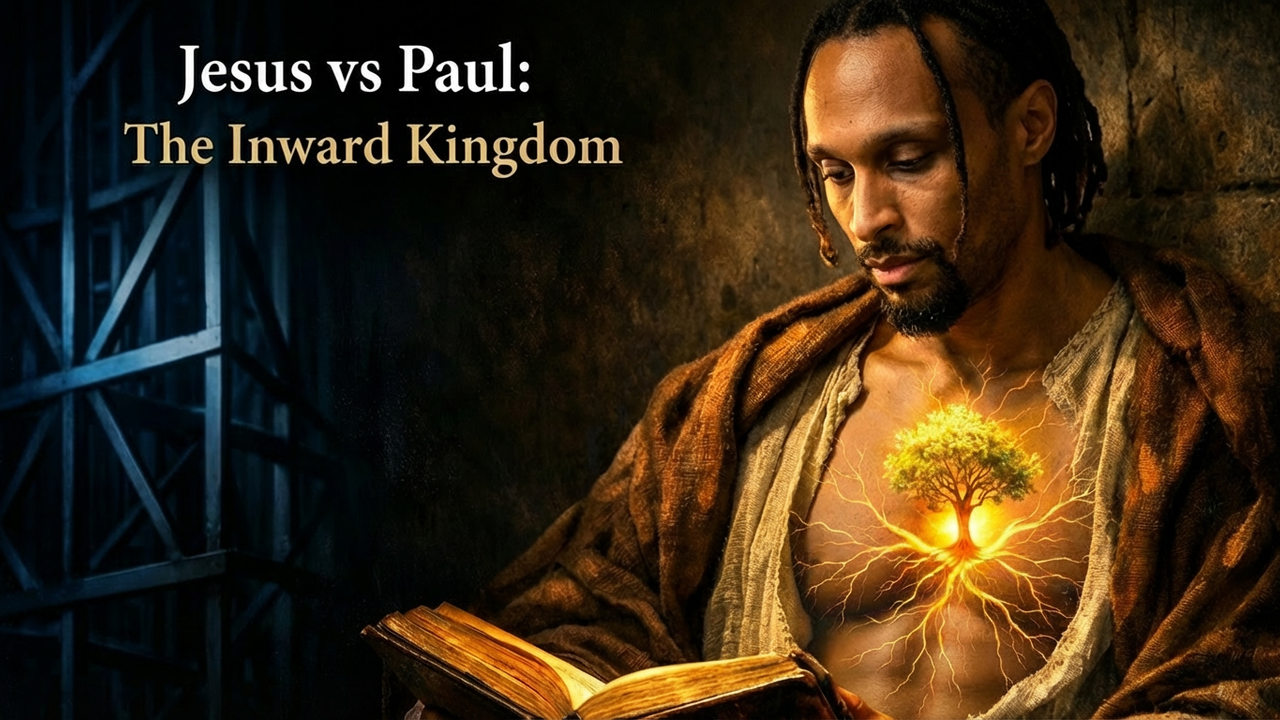
Jesus vs Paul: The Inward Kingdom

The tension at the heart of early Christian thought is not simply historical but ontological: two irreconcilable visions of human transformation and cosmic reign. On one side stands the kingdom proclaimed by the Jesus character as an immediate, inward reality; “within you” (Luke 17:21); a call to devotional repentance, heart renewal, and alignment with the transformative presence of the Hebrew Scriptures. On the other stands Paul’s earlier soteriology, centered on justification by faith in the blood of a cosmic Christ, apart from works of the law (Romans 3:25; 5:9). Evangelical culture has long defaulted to the Pauline lens, rendering inwardness optional and grace primarily forensic. The philosophical question is whether this default can survive scrutiny, or whether centering Jesus’ kingdom philosophy demands a deeper reckoning.

Scot McKnight (2010) correctly frames this crisis in “Jesus vs. Paul.” Any attempt to force Paul’s justification into Jesus’ kingdom mold, or vice versa, requires “bending of corners and squeezing of sides.” Paul barely speaks of the kingdom (fewer than fifteen references), and Jesus barely speaks of justification. The only coherent unity, McKnight argues, lies beneath both: the gospel as Christology, or the saving story of Jesus as the completion of Israel’s narrative. Yet even this harmonization leaves the deeper philosophical divergence untouched.

Barrie Wilson (2014) presses the point further, arguing that the divergence is not interpretive but foundational: two distinct religions. The Jesus Movement (Torah-observant, kingdom-proclaiming, led by James) embodied the religion of the Jesus character—an anti-imperial, messianic Jewish community awaiting the inward and outward breaking in of their God’s reign. Paul’s Christ Movement, born from a private mystical vision rather than historical discipleship, became a religion about the “Christ”: cosmic, dying-and-rising, Torah-free, focused on participation in a savior’s death rather than the teacher’s way of heart renewal. Acts retroactively solders them together; Paul’s own letters reveal the rupture.

The philosophical contradiction becomes sharpest when examined through Paul’s own logic. In 1 Corinthians 15:56 he declares, “The sting of death is sin, and the strength of sin is the law.” Here “sin” is philosophically defined not as moral failure alone but as reliance on any external religious machinery; rituals, ceremonies, traditions, or propositional systems; that claim to produce righteousness. Yet Paul immediately offers precisely such a system: faith in the blood of Christ as the singular transaction granting justification and propitiation. His Christ becomes a new law, a new ritual of mental assent and participatory mysticism. By Paul’s own criterion, this fulfills the definition of “sin” and by nature is wrong to consent to. The strength of this new “law” remains external: belief in a supernatural atonement rather than the internal yielding the Hebrew Scriptures demand.

Contrast this with the prophetic philosophy of the new covenant. Ezekiel 36:26 promises, “A new heart also will I give you, and a new spirit will I put within you: and I will take away the stony heart out of your flesh, and I will give you an heart of flesh.” Jeremiah 31:33 specifies the mechanism: “I will put my law in their inward parts, and write it in their hearts; and will be their God, and they shall be my people.” The newness is not a superior blood ritual or cosmic rescue plan but an inward, relational movement—high inward and mental interaction with Scripture that softens the self from within. This is the philosophical principle of transformation running unbroken from the Hebrew prophets through Jesus’ parables and kingdom proclamation.

If the Jesus character is understood as a historical figure consistent with the Hebrew Scriptures, he cannot coherently preach himself as one’s personal dying-and-rising Savior. Such a message would rupture the very continuity he embodied. The kingdom “within you” (Luke 17:21) and entry through devotional repentance and doing the Father’s will (Matthew 7:21) align perfectly with the inward new covenant. Inserting Paul’s gospel as the interpretive center dissolves that consistency: the new covenant becomes another external law, the reign becomes transactional, and the whisper of ongoing heart renewal is silenced.

Centering Jesus over Paul therefore does not invite legalism; it exposes the deeper grace. When grace is no longer a one-time forensic declaration but the enabling power for the relentless inward work the Jesus character envisioned, transformation becomes essential rather than optional. The kingdom’s demand is more intimate, more demanding, and more truly human precisely because it refuses to let any external religious philosophy—whether Torah, temple, or atonement formula—stand in for the heart’s yielding.

The philosophical path forward is clear: reclaim the new covenant as an enacted philosophy of inwardness. Set aside time to reflect on and retain the character within the Hebrew Scriptures. Open the Hebrew Scriptures and Gospels without systematic overlays. Ask not “What must I believe?” but “What is this doing to my stony places?” Let the words of the scriptures inwardly create you anew. Here grace fuels perseverance, not coverage. Here the reign within bursts outward as justice without ever becoming “works.”

The kingdom of God is within you. The new covenant is written on the heart. Will we dare engage the act that actually fulfills it?

References

McKnight, S. (2010, December). Jesus vs. Paul. Christianity Today.

Wilson, B. (2014). Paul versus Jesus. ResearchGate.

Did Adam’s Sin Bring Death? Rethinking Paul’s Theology vs. the Hebrew Bible

The Bible presents a deep and complex dialogue about sin, consequences, and spiritual death. Romans 6:23 states, "For the wages of sin is death..." while Genesis 2:17 declares, "But of the tree of the knowledge of good and evil, thou shalt not eat of it: for in the day that thou eatest thereof thou shalt surely die." A glaring philosophical issue emerges when we compare these verses: Adam and Eve did not physically die upon eating the fruit, challenging the straightforward notion that “sin” results in immediate physical death or “eternal death.” Instead, their "death" appears to be a death of understanding, aligning with Isaiah 44:18, "...he hath shut their eyes, that they cannot see; and their hearts, that they cannot understand." The “opening of their eyes” was in fact the “closing of their eyes.”

The Nature of Death in Eden

If Adam and Eve’s death was not a physical cessation of life, then what kind of death did they suffer? The text suggests an intellectual and spiritual demise—a blindness of mind and heart. Their eyes were opened (Genesis 3:7), but rather than gaining enlightenment, they perceived their own nakedness (figurative) and felt shame (philosophical). This aligns with Isaiah 44:18, which describes a condition where people are rendered incapable of understanding due to their spiritual impairment.

This interpretation raises a significant challenge to Paul’s assertion in Romans 6:23. If the wages of sin were strictly death, and especially the death of some aspect of self in some weird extraterrestrial “afterlife,” as Paul asserts, then the immediate consequence in Eden should have been death to all aspects of the pair in Eden, which “death” the text does not mention because that is not the mindset behind it. Yet, Adam lived for 930 years (Genesis 5:5). The logical dissonance between Paul’s assertion and the Bible’s narrative suggests that Paul was propagating a prospective theological theory that diverges from the Bible’s original philosophy and account.

Paul’s Theological Deviation from the Hebrew Bible

Ezekiel 18:20 states, "The soul that sinneth, it shall die. The son shall not bear the iniquity of the father..." This passage directly refutes the concept of inherited sin and collective guilt. If Adam and Eve's transgression resulted in spiritual blindness rather than immediate death, then Paul's doctrine of sin leading to universal death appears to be a theological extrapolation rather than a point stating or continuing the Bible’s philosophy.

Paul’s framing of sin and death seems to pivot towards a transactional model of atonement rather than the Hebrew Bible’s focus on personal accountability. Ezekiel makes it clear that one person’s sin does not transfer to another, yet Paul argues for a universal condemnation through Adam’s sin (Romans 5:12). This universal condemnation is nowhere found within the text from Genesis to Malachi. This raises the question: Was Paul redefining biblical justice to fit his theological framework?

The Implications of Paul’s Perspective

Paul’s teaching in Romans shapes much of Christian theory, particularly regarding its perspective on salvation and the necessity of its Christ’s sacrifice. However, if the Bible itself does not establish death as an automatic consequence of sin (whether immediately occurring in the here and now or occurring later beyond the here and now) in the way Paul presents it, then his argument may be built on a theological innovation rather than biblical continuity.

If sin led to intellectual death (and it only did) in Eden rather than physical death, Paul’s statement in Romans 6:23 must be understood either metaphorically or theoretically rather than actually or literally. This perspective fundamentally alters the way the Bible philosophically defines atonement and devotional justice. If the fate of Adam and Eve was a loss of spiritual clarity rather than biological termination (and it was), then Paul’s doctrine of inherited sin and universal condemnation, because it is contrary to the Bible’s narrative and philosophical scope, requires re-examination.

A Divergence

The juxtaposition of Genesis 2:17, Isaiah 44:18, and Ezekiel 18 with Paul’s Romans 6:23 highlights a significant philosophical divergence. While Genesis and Ezekiel emphasize personal responsibility and the consequences of error as a loss of understanding, Paul constructs a universalized doctrine of sin and death that deviates from the Hebrew Bible’s narrative. This raises serious questions: Was Paul reshaping theology to fit a new religious framework? And if so, what are the implications for contemporary Christian thought?

A logical inquiry into Paul’s belief shows that his theology presents a deviation from the biblical text rather than a direct continuation of its teachings. The philosophical issue, then, is whether modern Christian theology should align with Paul’s doctrine, or return to the original biblical perspective on sin and its consequences.