
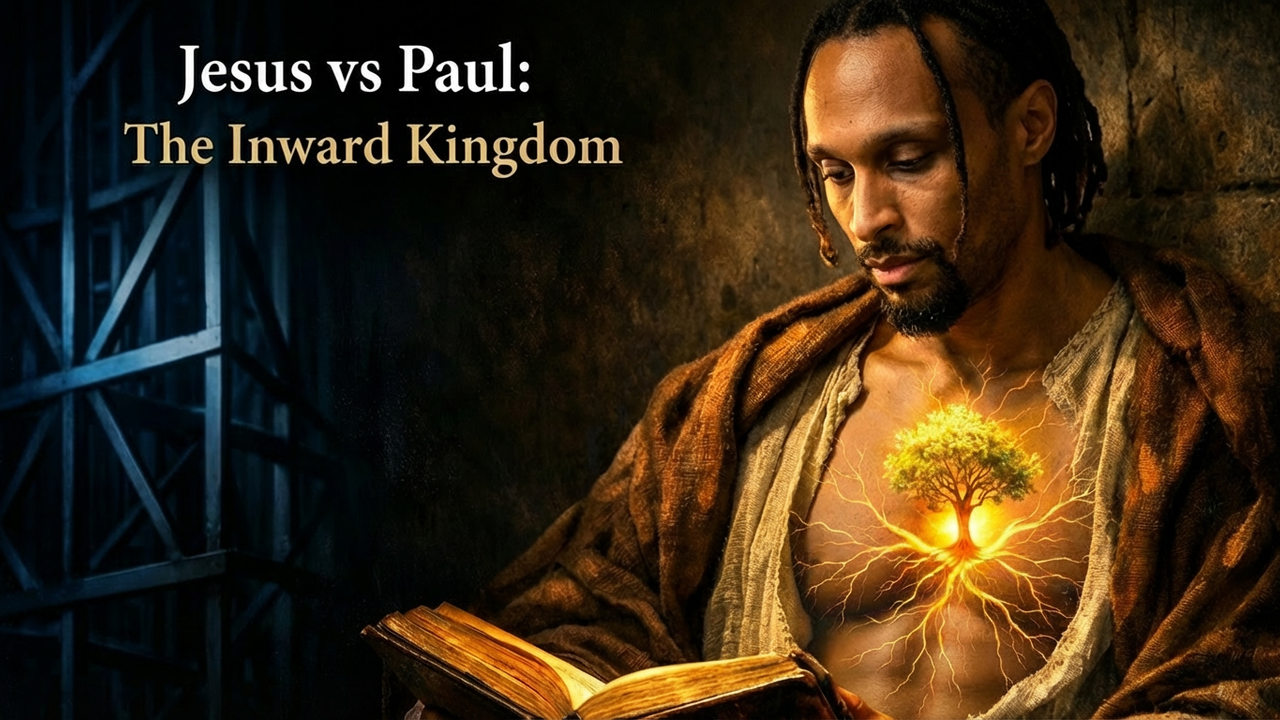
The tension at the heart of early Christian thought is not simply historical but ontological: two irreconcilable visions of human transformation and cosmic reign. On one side stands the kingdom proclaimed by the Jesus character as an immediate, inward reality; “within you” (Luke 17:21); a call to devotional repentance, heart renewal, and alignment with the transformative presence of the Hebrew Scriptures. On the other stands Paul’s earlier soteriology, centered on justification by faith in the blood of a cosmic Christ, apart from works of the law (Romans 3:25; 5:9). Evangelical culture has long defaulted to the Pauline lens, rendering inwardness optional and grace primarily forensic. The philosophical question is whether this default can survive scrutiny, or whether centering Jesus’ kingdom philosophy demands a deeper reckoning.
Scot McKnight (2010) correctly frames this crisis in “Jesus vs. Paul.” Any attempt to force Paul’s justification into Jesus’ kingdom mold, or vice versa, requires “bending of corners and squeezing of sides.” Paul barely speaks of the kingdom (fewer than fifteen references), and Jesus barely speaks of justification. The only coherent unity, McKnight argues, lies beneath both: the gospel as Christology, or the saving story of Jesus as the completion of Israel’s narrative. Yet even this harmonization leaves the deeper philosophical divergence untouched.
Barrie Wilson (2014) presses the point further, arguing that the divergence is not interpretive but foundational: two distinct religions. The Jesus Movement (Torah-observant, kingdom-proclaiming, led by James) embodied the religion of the Jesus character—an anti-imperial, messianic Jewish community awaiting the inward and outward breaking in of their God’s reign. Paul’s Christ Movement, born from a private mystical vision rather than historical discipleship, became a religion about the “Christ”: cosmic, dying-and-rising, Torah-free, focused on participation in a savior’s death rather than the teacher’s way of heart renewal. Acts retroactively solders them together; Paul’s own letters reveal the rupture.
The philosophical contradiction becomes sharpest when examined through Paul’s own logic. In 1 Corinthians 15:56 he declares, “The sting of death is sin, and the strength of sin is the law.” Here “sin” is philosophically defined not as moral failure alone but as reliance on any external religious machinery; rituals, ceremonies, traditions, or propositional systems; that claim to produce righteousness. Yet Paul immediately offers precisely such a system: faith in the blood of Christ as the singular transaction granting justification and propitiation. His Christ becomes a new law, a new ritual of mental assent and participatory mysticism. By Paul’s own criterion, this fulfills the definition of “sin” and by nature is wrong to consent to. The strength of this new “law” remains external: belief in a supernatural atonement rather than the internal yielding the Hebrew Scriptures demand.
Contrast this with the prophetic philosophy of the new covenant. Ezekiel 36:26 promises, “A new heart also will I give you, and a new spirit will I put within you: and I will take away the stony heart out of your flesh, and I will give you an heart of flesh.” Jeremiah 31:33 specifies the mechanism: “I will put my law in their inward parts, and write it in their hearts; and will be their God, and they shall be my people.” The newness is not a superior blood ritual or cosmic rescue plan but an inward, relational movement—high inward and mental interaction with Scripture that softens the self from within. This is the philosophical principle of transformation running unbroken from the Hebrew prophets through Jesus’ parables and kingdom proclamation.
If the Jesus character is understood as a historical figure consistent with the Hebrew Scriptures, he cannot coherently preach himself as one’s personal dying-and-rising Savior. Such a message would rupture the very continuity he embodied. The kingdom “within you” (Luke 17:21) and entry through devotional repentance and doing the Father’s will (Matthew 7:21) align perfectly with the inward new covenant. Inserting Paul’s gospel as the interpretive center dissolves that consistency: the new covenant becomes another external law, the reign becomes transactional, and the whisper of ongoing heart renewal is silenced.
Centering Jesus over Paul therefore does not invite legalism; it exposes the deeper grace. When grace is no longer a one-time forensic declaration but the enabling power for the relentless inward work the Jesus character envisioned, transformation becomes essential rather than optional. The kingdom’s demand is more intimate, more demanding, and more truly human precisely because it refuses to let any external religious philosophy—whether Torah, temple, or atonement formula—stand in for the heart’s yielding.
The philosophical path forward is clear: reclaim the new covenant as an enacted philosophy of inwardness. Set aside time to reflect on and retain the character within the Hebrew Scriptures. Open the Hebrew Scriptures and Gospels without systematic overlays. Ask not “What must I believe?” but “What is this doing to my stony places?” Let the words of the scriptures inwardly create you anew. Here grace fuels perseverance, not coverage. Here the reign within bursts outward as justice without ever becoming “works.”
The kingdom of God is within you. The new covenant is written on the heart. Will we dare engage the act that actually fulfills it?
References
McKnight, S. (2010, December). Jesus vs. Paul. Christianity Today.
Wilson, B. (2014). Paul versus Jesus. ResearchGate.