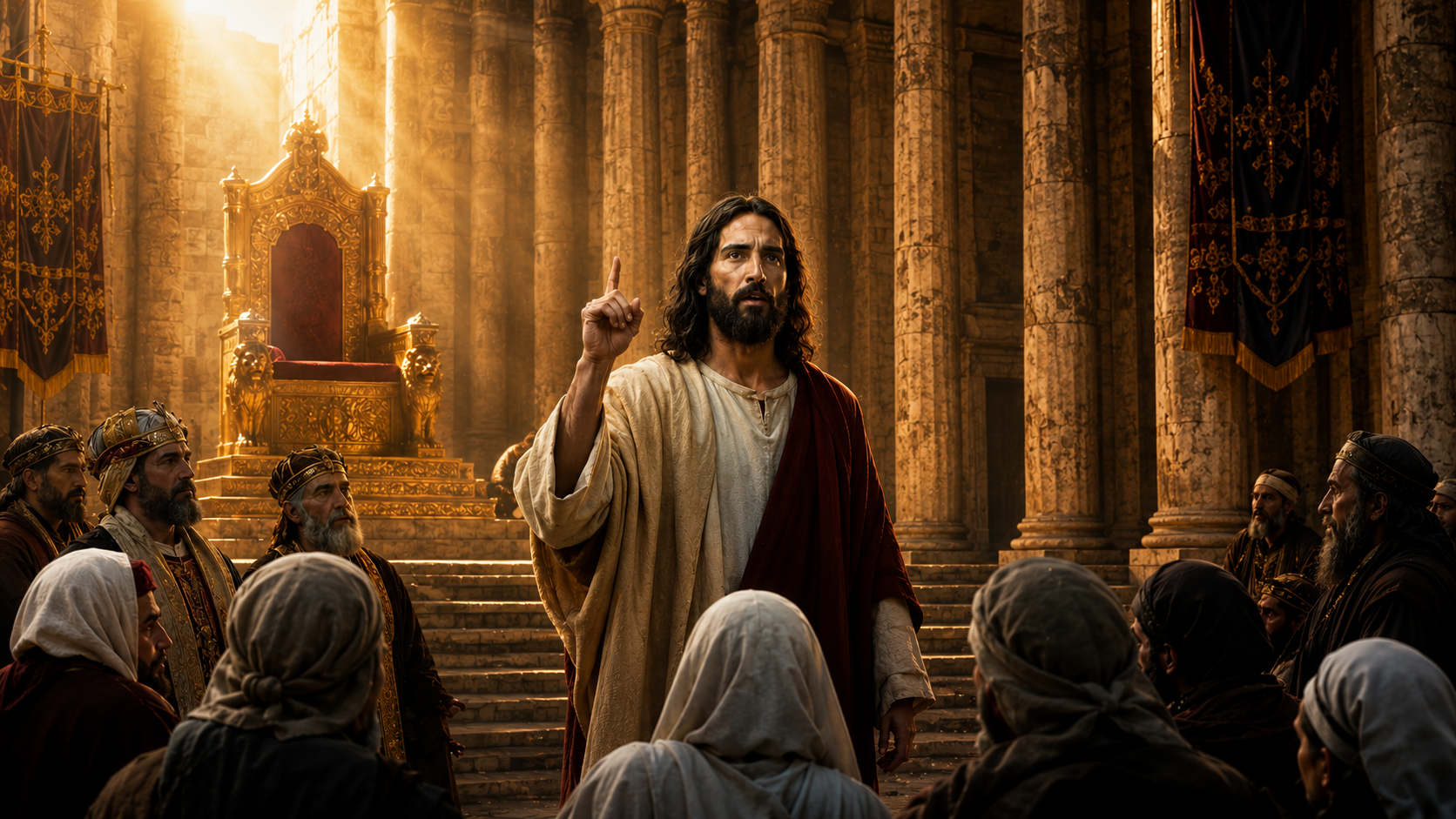
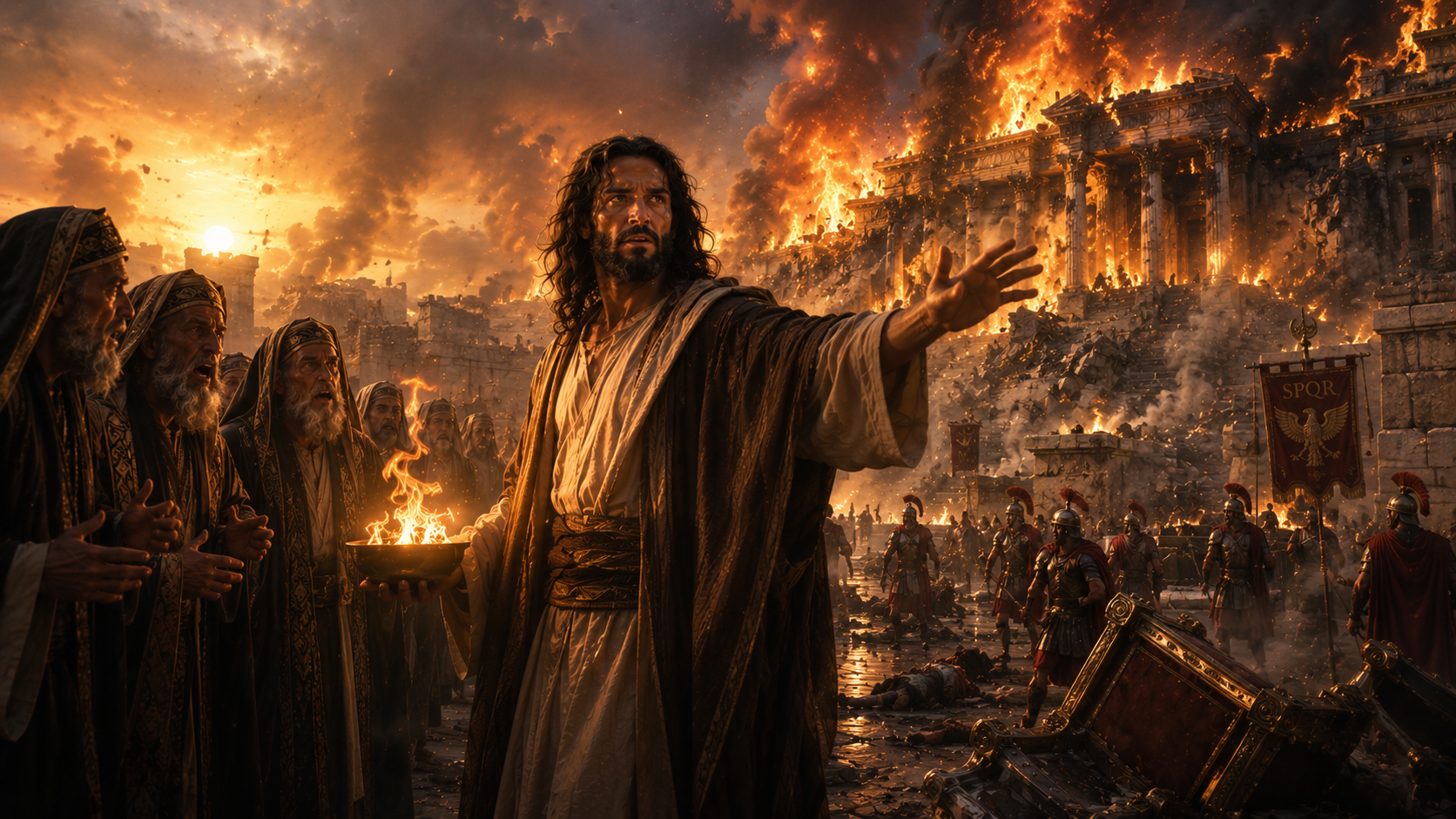
jesus vs paul

What If the Kingdom Within Demands More Than Faith in Blood?

Imagine a gospel that whispers rather than declares, one that invites us into an intimate, ongoing transformation through a relationship with the Bible’s words rather than resting primarily on a singular act of sacrificial assurance.

My previous blog post highlighted a very real tension at the heart of early Christian thought: Jesus proclaimed the kingdom of God as an immediate, inward reality—"within you" (Luke 17:21); a call to devotional repentance, heart renewal founded in Psalm 51:10's cry for a clean heart and right spirit, and active alignment with the will of the Hebrew Scriptures.

In contrast, Paul's earlier letters frame salvation chiefly through faith in Christ's blood as the means of justification and propitiation, apart from works of religious law (Romans 3:25; 5:9). Many religious traditions seek to seamlessly link Paul and Jesus together, noting Paul's own depiction of the kingdom as "righteousness, peace, and joy in the Holy Spirit" (Romans 14:17) or the hidden, mustard-seed-like growth sprouting in believers' hearts (Colossians 1:13). Yet the emphases remain definitely different, especially when we consider Paul's relative silence on Jesus' earthly teachings, parables, or miracles, drawing instead from personal visions and revelations of a risen Christ.

This divergence is not merely historical curiosity; it poses a philosophical challenge to how we understand faith, grace, human becoming, and devotional development. What might it mean if the kingdom's true demand is something deeper and more relentless than a transaction of belief in supernatural or superstitious blood atonement? What if the inward reign the Jesus character described calls us to a continuous, demanding obedience that reshapes the self from within?

As regards to philosophical personal devotion, this perspective shifts the ground beneath our spiritual practices. If the kingdom is an intimate, present reality, then prayer, confession, and discipline become less about securing perpetual coverage from guilt and more about consistent heart examination, quiet devotional repentance, and yielding to the transformative presence of the Hebrew Scriptures.

Allen (n.d.) observes that Paul distances himself from the historical Jesus, rarely quoting or referencing his teachings, and instead relies on revelations from the “risen Lord” (whoever this might be)—suggesting a gospel received not through discipleship to a teacher but through an emancipated spirit. Paul's view of sin as deeply embedded in the flesh, requiring supernatural rescue, contrasts with Jesus' portrayal of human potential for godlike righteousness through volition and inward change. Embracing this inward focus invites a devotion that is relational and perseverant, where grace fuels ongoing alignment rather than merely covering failure.

Salvation and assurance, too, take on new contours in a culture steeped in Pauline justification by faith alone. Prioritizing Jesus' insistence on inward cleanness (as suggested through the parables of Jesus) might appear to edge toward legalism, yet it could actually enrich grace by rendering transformation essential rather than optional.

Vickers (2008) emphasizes that Paul's kingdom is inseparable from redemption through the cross: believers are transferred from the dominion of darkness to the kingdom of the beloved Son (Colossians 1:13), empowered to live worthy lives under Christ's reigning authority. The cross defeats rulers and authorities, granting forgiveness and union with the risen King. Yet Jesus ties kingdom entry to repentance and doing the Father's will (not to himself). Balancing these, we see grace not as a one-time forensic declaration, but as the enabling power for the demanding heart-work Jesus envisioned, ultimately translating to assurance rooted in relational participation with the Bible’s words rather than legal acquittal alone.

Ethically and socially, the inward kingdom bursts outward into justice and mercy. Jesus bound heart renewal to acts of compassion (say, feeding the hungry, loving enemies) as signs of the reign breaking in now. Paul's cross-centered rescue highlights personal deliverance, but Vickers (2008) portrays Paul's kingdom as already/not-yet: the risen Christ's rule empowers ethical conduct and defeats darkness, linking present kingdom life to future consummation. Reclaiming Jesus' gospel emphasis could propel believers toward active, present-world engagement, resisting empire-like forces in ways that celebrate Paul's subtle kingdom-transfer language. Inward change thus becomes the root of outward justice, not “works” earning favor but inevitable fruit of the Spirit's reign.

There appears to be a debate around the logical fusion of the doctrine of Paul and the philosophy of Jesus, but can there be any relative interplay leading to their fusion? Bratton (1929) argues for a synthetic view: Paul aligns with Jesus on God's fatherly love, the kingdom as an ethico-spiritual reality (Romans 14:17 paralleling Matthew's righteousness themes), eschatology drawn from Jewish tradition, and the supreme ethical imperative of love. Divergence appears in Paul's added soteriological layers; sin's profundity and blood atonement; shaped by his context, yet continuity shines in shared spiritual and moral values. Vickers (2008) harmonizes by centering Paul's kingdom on the risen Christ, whose resurrection guarantees believers' future while empowering present life under his rule, bridging to Jesus' mustard-seed imagery. Allen (n.d.) underscores Paul's independence, noting his avoidance of "disciple" language and reliance on revelations over historical tradition.

The honest tension persists: harmonizations abound; Paul's kingdom as Spirit-enabled inward renewal; but the shift from Jesus' direct kingdom proclamation to Paul's cross-focus profoundly molded Christian theory, perhaps broadening its appeal while softening the call to relentless inwardness.

What lingers is a call to deeper examination. What if this "more demanding" kingdom within beckons us toward a faith less preoccupied with securing forgiveness and more consumed with embodying the reign of the Bible’s character in the here and now? Questions like this do stir something genuine within us: perhaps the quiet, intimate demand of Jesus’ inward kingdom holds the key to a faith more alive, more transformative, more truly human. The reign is within; will we dare let it reshape everything?

References

Allen, J. C. (n.d.). The Gospels of Jesus and Paul. [Document source].

Bratton, F. G. (1929). Continuity and divergence in the Jesus-Paul problem. Journal of Biblical Literature, 48(3/4), 149–161.

Vickers, B. (2008). The kingdom of God in Paul’s gospel. Southern Baptist Journal of Theology, 12(1), 52–67.

Why Paul’s Christ and the Gospel Jesus Cannot Be Reconciled

The New Testament presents readers with two strikingly distinct portrayals of the Jesus character. On the one hand, the Paul character offers us a cosmic Christ—an eternal, preexistent divine figure, the agent of creation and redemption for all humanity. On the other hand, the Gospels; particularly the Synoptics; paint a picture of a Jewish prophet, a moral Rabbi embedded in the matrix of first-century Judaism, who heals, teaches, and proclaims the imminent “kingdom of God.” These representations are not just different perspectives; they are radically divergent theological constructs.

The question at the heart of Christian theory thus arises: Can Paul’s cosmic Christ and the Jesus character of the Gospels be reconciled? Should we actually look at the New Testament text, the answer appears to be a resolute no.

Paul’s Cosmic Christ: Beyond History and Flesh

Paul’s letters, particularly Colossians 1:13–20, present his Christ as the agent of creation and the sustainer of all things. In this view, his Christ is not merely a moral teacher, but the very Logos, the rational, divine principle that orders the Greek universe. Paul’s Christ is "before all things" and in him "all things hold together" (Col. 1:17). This Cosmic Christ is not merely divine in function but in essence: he is the full embodiment of Deity, through whom the reconciliation of all things, both heavenly and earthly, is achieved by blood on his cross​.

Ebenezer Fai (2022) highlights that Paul’s emphasis in Colossians emerges not from biographical reflection on a historical man named “Jesus,” but from a theological need to combat Gnostic heresies and affirm cosmic supremacy​. Paul’s Jesus is a being whose existence precedes the incarnation, whose work of salvation is only metaphysical, and whose authority is cosmic, universal, and eternal.

The Gospel Jesus: The Scripted Rabbi

In contrast, the Gospels; especially the Synoptics; do not concern themselves with cosmic metaphysics. They present a man situated in a specific cultural and religious context. The Jesus character is of or from Nazareth, a Galilean Jew, engaging with Pharisees, healing lepers, and preaching the ethical imperatives of love, forgiveness, and justice.

Whereas Paul emphasizes the Jesus character’s crucifixion and resurrection as a metaphysical event, the Gospels center on Jesus’ life: his teachings, parables, compassion, and confrontation with religious authorities. This version of Jesus observes Jewish law (albeit sometimes critically), engages with the marginalized, and rarely speaks of himself in cosmic or divine terms. His favorite self-designation, "Son of Man," evokes prophetic imagery of him as a supporter of a remote mythological figure rather than ontological divinity.

The Jesus of the Gospels is particular, for he is bound to the socio-political and religious fabric of Second Temple Judaism. Paul’s Christ, on the other hand, is universal, being a cosmic archetype more reminiscent of a Hellenistic deity than Hebrew prophet.

Philosophical Disparity: Logos vs. Narrative

Philosophically, these two Christ characters appeal to different metaphysical traditions. Paul's Christ emerges from a Platonic schema, aligning with the Logos doctrine who is, in Greek and Hellenistic Judaism’s literature, a preexistent Word mediating between the transcendent God and material creation. This idea would later crystallize in Johannine theology and be formalized in Neoplatonic Christianity, as seen in the works of Augustine and Origen.

In contrast, the Gospel Jesus reflects more of an Aristotelian and ethical tradition, in that he is concerned with praxis, not metaphysics. His parables are moral, his miracles restorative, his teachings embedded in community life which, to the audience, forces a link between notable figures like Elijah and Elisha. His “kingdom” is both near and ethical, not cosmic and absolute.

Gnosticism and the Veiled Christ

Murphy (2011) adds a fascinating layer to this tension, revealing that Paul’s theology fits neatly into the framework of a mystery religion, where his Christ is a symbolic figure guiding initiates into spiritual transformation, not a biographical teacher from Galilee​. Paul’s Christ speaks to inner divinity and mystical rebirth: “We died with Christ... and now our life is hidden with Christ in God” (Colossians 3:3). The supposed Jesus of history is deliberately obscured, even discarded, in favor of a higher, esoteric truth​.

This idea is not foreign to early Christianity. The Gnostic gospels present the Jesus character not as a crucified savior but a revealer of hidden knowledge (gnosis). Gnostic communities viewed the Christ character as an immaterial guide to enlightenment rather than a sacrificial lamb​. This really aligns with Paul’s mystical language and esoteric symbolism.

The Church's Solution: Synthetic Christology

The early Church, recognizing this rift, sought to synthesize the two through creeds and councils. The Council of Nicaea (325 CE) and Chalcedon (451 CE) declared Christ to be fully God and fully man, attempting to harmonize Paul's Logos Christ with the Gospel's version of the Jesus character. But such reconciliation was dogmatic, not organic.

As Murphy (2011) argues, these decisions were less about theological integrity and more about institutional control. The Gospel Jesus, with his ethical teachings and radical inclusivity, was threatening to a budding ecclesiastical hierarchy. The cosmic Christ, distant and abstract, was more malleable and less politically dangerous​.

A Disunion That Challenges Christianity

Theologically, Paul’s Christ and the Gospel Jesus are not just different interpretations of the same figure; they are different figures. One is an eternal metaphysical being; the other is a figure scripted to appear as a human prophet. One is rooted in Hellenistic mysticism; the other in Jewish ethics. One speaks of justification through faith; the other of righteousness through love and mercy.

Thus, the union is impossible, and not for lack of trying, but because the two are fundamentally irreconcilable. Christianity has survived by layering these incompatible Christ characters into one synthetic narrative. Yet this synthesis (if we would just look at the New Testament text) strains under the weight of its contradictions, as evidenced by modern theological fractures between evangelical, mystical, liberal, and historical-critical Christianities.

To ask whether Christianity is about belief in Paul’s cosmic Christ or following the Gospel Jesus is not merely a theological question, but something actually challenging the rationale of the individual asking the question. As we move further into the 21st century, perhaps it's time to stop forcing a reconciliation and start telling the truth: Christianity was always a tale of two Jesuses.

 Resources:

Fai, E., Merrill C. Tenney, Mark Allan Powel, Carson, D. A., Dunnett, W. M., McCain, D., Gundry, R., Keener, C. S., Hendricksen, W., Falwell, J., Brown, R. E., Akintola, S. O., & Guthrie, D. (2022). The Cosmic Christ: An Exegesis of Colossians 1:13-20 and its implications for the Twenty-First Century Church. In The American Journal of Biblical Theology (Vol. 23, Issue 33).

Loubser, J. A. (1993). Orality and Pauline ‘Christology’: Some Hermeneutical Implications. Scriptura: Journal for Biblical, Theological and Contextual Hermeneutics47, 25-51. 

Murphy, D. (2011). Jesus Potter Harry Christ. Holyblasphemy press

Paul’s Cosmic Christ vs. the Gospel Jesus: How Early Christianity Reconciled Two Different Versions of Jesus

The tension between Paul’s cosmic Christ and the Jesus character of the Gospels is evident. Paul presents a Christ who is a divine intermediary and a universal redeemer, while the Gospels offer a Jewish teacher deeply engaged in ethics, law, and community. This divergence raises some questions: How did early Christianity bridge this theological gap? Did early church councils and later theological traditions attempt to reconcile these differing portrayals, or did they prioritize Paul’s vision over the Gospel narratives?

By examining early Christological debates, the influence of Hellenistic thought, and modern theological trends, we can explore how Christianity negotiated the relationship between these two representations of Jesus.

The Role of Early Church Councils in Shaping Christology

One of the primary mechanisms for reconciling Paul’s cosmic Christ with the Gospel Jesus was the early church councils, particularly those of Nicaea (325 CE) and Chalcedon (451 CE). These councils sought to define the nature of the Christ character amid theological disputes that had emerged within the Christian community. Tillich’s (1972) A History of Christian Thought explores how such councils did not simply adopt Paul’s theology outright, but worked to integrate his Christological vision with the traditions preserved in the Gospel narratives. The Nicene Creed, for example, emphasized the Christ character’s divine nature and preexistence, reflecting Pauline themes, while also affirming the narrative of his incarnation and literary role as the Son of God, bridging the gap between the cosmic Christ and the Gospel Jesus.

The Synthesis of Pauline and Gospel Christology in Later Traditions

The works of Augustine provide another lens through which Christianity synthesized these two portraits of Jesus. As Lupi (2002) discusses in Saint Augustine's Doctrine on Grace, Augustine heavily drew upon Paul’s theological framework, particularly in his doctrines of grace, original sin, and redemption. However, Augustine did not reject the Gospel Jesus; instead, he integrated the ethical teachings of the Jesus character within his broader soteriological framework, arguing that the ministry of the Gospel Jesus was essential but secondary to his redemptive function. This synthesis found expression in post-Nicene traditions, where Jesus' humanity was affirmed but always within the greater context of Pauline salvation theology.

Hellenistic Philosophy: Bridging Theology and History

The philosophical traditions of Hellenism played a critical role in shaping early Christian theory and reconciling Paul’s cosmic Christ with the Gospel Jesus. In Taylor’s (2003) Paul and the Historical Jesus Quest, Hellenistic philosophical thought, particularly Platonism and Stoicism, provided the conceptual framework for articulating the Jesus character’s dual nature as both divine and human. Paul’s writings, which emphasize Christ as the divine Logos and a cosmic mediator, align with Platonic notions of an abstract, transcendent reality underlying the material world. The Gospel narratives, by contrast, present a more tangible, human Jesus, which resonated with the Aristotelian and Stoic traditions that emphasized practical ethics and virtue.

One of the key ways that Hellenistic thought influenced early Christian theology was through the doctrine of the Logos, which had its roots in Stoic and Middle Platonic traditions. Philo of Alexandria, a Jewish-Hellenistic philosopher, had already conceptualized the Logos as a divine intermediary between God the Father and the world, a notion that early Christian thinkers adapted to describe their Christ. The Gospel of John explicitly refers to Jesus as the Logos (Word) (John 1:1), reflecting an attempt to synthesize Jewish theological concepts with Greek philosophical ideas.

Tillich (1972) further explains how early Christian theologians, such as Clement of Alexandria and Origen, built upon these philosophical traditions to construct a Christology that harmonized the Pauline cosmic Christ with the Jesus character. Clement saw the Jesus character as the ultimate teacher of divine wisdom, merging the rational structure of Greek philosophy with Christian revelation. Origen, in turn, developed a theological system in which the Jesus character’s incarnation was seen as a bridge between the material and the divine, enabling human souls to ascend toward God’s ultimate truth.

Moreover, Augustine, whose theological works were deeply influenced by Neoplatonism, provided another avenue for integrating Hellenistic thought with Christian doctrine. As Lupi (2002) discusses, Augustine adopted the Platonic idea that the physical world is a mere shadow of a higher, spiritual reality. He interpreted the Jesus character as the ultimate source of divine illumination, whose role was not just to teach ethical truths but to provide a metaphysical path to salvation. This philosophical interpretation allowed for a seamless transition between the Gospel’s depiction of Jesus as a teacher and Paul’s portrayal of Christ as a cosmic redeemer.

We, in 2025, have no idea how Hellenistic philosophy offered early Christian theologians a way to reconcile Paul’s emphasis on the Jesus character’s divine nature with the Gospel’s portrayal of Jesus as a seemingly historical figure. By framing Jesus as the Logos, the divine wisdom made flesh, Christianity was able to present a Christology that was both philosophically sophisticated and theologically cohesive. This synthesis helped Christian theory appeal to both Jewish (Hellenistic Jews) and Greco-Roman (pagan) audiences, ensuring its doctrinal survival and expansion in the ancient world.

Pauline or Gospel Jesus?

Even today we can see the strange and persistent tension between Paul’s Christ and the Gospel Jesus. Some Christian traditions, particularly within Protestantism, emphasize justification by faith and the Christ character’s atoning sacrifice, echoing Pauline theology. Others, especially in contemporary liberal theology, focus on the ethical teachings of the Jesus character, aligning more closely with the Gospel narratives. As Tillich (1972) notes, modern Christianity continues to struggle with this dual identity, reflecting an ongoing negotiation between theological necessity and a forced historical tradition.

The Concern

Early Christianity did not so much resolve the tension between Paul and the Gospels as it absorbed both into a complex theological framework. The church councils prioritized Paul’s vision but integrated the Gospel narratives; theological traditions like those of Augustine synthesized both perspectives; and Hellenistic philosophy provided the intellectual scaffolding to bridge the theological and historical Jesus. What we see today of Christianity remains shaped by this synthesis, with different traditions leaning toward either the cosmic Christ of Paul or the ethical Jesus of the Gospels. The question of whether Christianity is primarily about faith in the divine Christ or the teachings of the Gospel Jesus is a question of concern because, with the Bible (in Psalm 51:10) defining its goal according to the saying, “Create in me a clean heart, O God; and renew a right spirit within me,” with Christian theory ultimately transitioning away from this goal in unrealistic terms for the growth and wellbeing of the psychological and inward dimensions of our being, we need to sincerely think about where we are spending our energy.

References:

Lupi, J. (2002). Saint Augustine's doctrine on grace (1).

Taylor, N. (2003). Paul and the historical Jesus quest. Neotestamentica37(1), 105-126.

Tillich, P. (1972). A history of Christian thought, from its Judaic and Hellenistic origins to existentialism. Simon and Schuster.