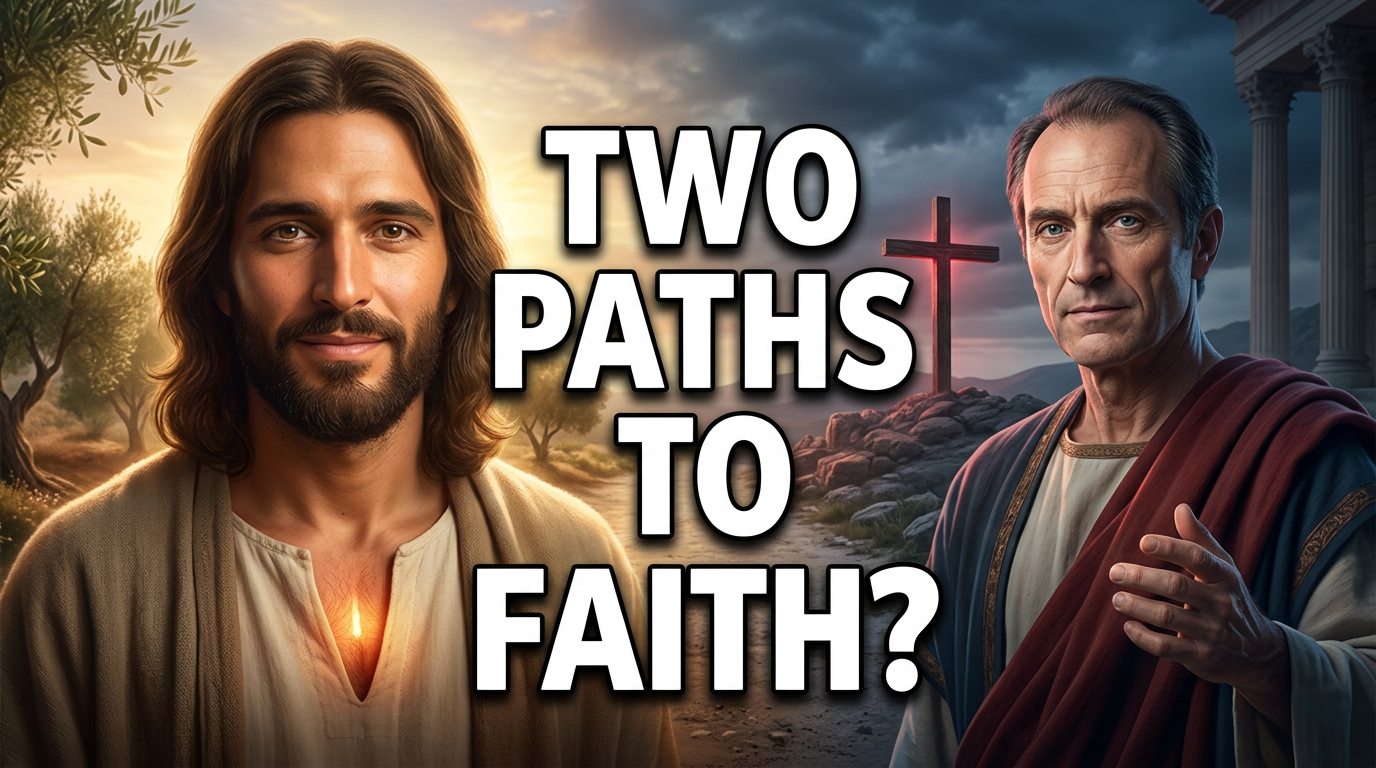
In my last blog post, we ended with a question: the kingdom of God is within you, the new covenant is written on the heart; will we dare engage the act that actually fulfills it? That act, I suggested, is the quiet, relentless work of letting Scripture soften the stony places from the inside out, without the scaffolding of any external religious machinery. The question does not dissolve when we turn the page. It cuts deeper. Because once we place the Jesus of the Gospels beside the Paul of the Epistles; not as harmonious teammates (because they are not) but as two distinct philosophical voices; the divergence refuses to harmonize. It becomes an ontological fork in the road of “salvation” itself.
Consider, for a moment, the spare and luminous command Jesus offers in Mark 11:22. A fig tree has withered at his word; the disciples marvel. Jesus does not pivot to a theory of atonement or a cosmic transaction. He answers with elemental directness: Have faith in God. Not "faith in my forthcoming death", not "faith in a blood ritual that will justify you", not "faith in the machinery of a new priesthood.” Simply put, "have faith in God".
The Greek is even more intimate: echo pistis theos—possess, hold, inhabit the very trust that belongs to “God.” The object of faith is the Deity itself, unmediated, unfiltered. In that moment the kingdom is not a future reward earned by correct belief about a cosmic event; it is the present reality that faith in God (theos) unlocks from within. The mountain of impossibility moves because the heart has aligned itself with the living Source, not because a forensic transaction has been notarized in “heaven.”
Set this beside Paul’s formulation in Romans 3:25, and the philosophical air changes temperature. “Whom God hath set forth to be a propitiation through faith in his blood,” Paul writes, “to declare his righteousness for the remission of sins that are past, through the forbearance of God.”
Here the object of faith has shifted. It is no longer God in the raw, immediate sense Jesus commanded. Faith is now channeled through a precise mechanism: the blood of a cosmic Christ, displayed as public propitiation. The Greek hilastērion (a propitiation) carries the weight of an altar, a mercy seat, a transaction that satisfies “divine justice.” Righteousness is “declared,” not grown. Sins are “remitted” not by the slow softening of the heart through Scripture, but by the forbearance that flows exclusively from this singular, once-for-all offering. The kingdom that Jesus located "within" has been subtly relocated; it now orbits a historical-cosmic axis whose center is the cross.
The divergence is not semantic. It is structural. Jesus’ faith is participatory and immediate: trust God, and the kingdom (already inside you) awakens like yeast in dough (Luke 17:21). Paul’s faith is referential and mediatory: trust the blood-event, and the cosmic Christ becomes the sole valid object of affection. Hebrews 10:10, written in the Pauline stream, makes the transaction explicit: “By the which will we are sanctified through the offering of the body of Jesus Christ once for all.” Sanctification itself, the very word that should evoke the inward engraving of the law on the heart, has been outsourced to an external, completed act. The body offered on the cosmic altar does the heavy lifting. The believer’s role is to assent, to appropriate, to rest in the finished work. The kingdom within is thereby eclipsed by the Christ without. What Jesus presented as an ever-present inner reality becomes, in Paul, a future hope or a positional status secured by right belief about a blood transaction.
Philosophically, this is no small inversion. The Jesus character invites the soul to stand naked before the Deity and say, with the Hebrew prophets, “Write your law on my heart; let these words dwell in me richly.” The path is relational, devotional, ongoing, an internal alchemy in which the words of Torah and Prophets become the very instruments of transformation.
Paul, by contrast, presents a system in which the law has already been declared powerless to produce that transformation; its only remaining function is to accuse until the blood of his Christ silences the accusation. Faith is no longer the direct gaze of the heart toward God. It is the mental and mystical embrace of a cosmic drama whose climax occurred outside history, outside the self, once for all. The kingdom that the Jesus character insisted was already within is quietly postponed or spiritualized into a metaphor for the church’s possession of forensic justification.
This is not to deny the beauty or power many have found in Paul’s vision. It is simply to refuse the comfortable harmonization that pretends the two ontologies are the same path viewed from different angles. One voice says: Have faith "in God" and the kingdom is already here, softening you from the inside. The other says: Have faith "in his blood" and the cosmic offering sanctifies you once for all, rendering further inward law-work secondary at best. The first trusts the Hebrew Scriptures as living tutor; the second redefines them as a diagnostic mirror that can only condemn until a superior transaction intervenes. The first keeps the new covenant exactly where Jeremiah and Ezekiel placed it—on the heart. The second relocates the covenant’s power to an altar outside the self.
So the original question returns, sharper now, like a blade turned toward the light. If the kingdom is truly within, if the new covenant is the law written on the heart, will we dare let Scripture do its softening work without the machinery of any external propitiation? Or will we rest in the safer, more dramatic transaction Paul so powerfully proclaimed: a cosmic Christ whose blood mysteriously becomes the new and final machinery?
The choice is not between “grace” and “works.” It is between two irreconcilable visions of what grace "is": an immediate, inward alignment with the living God, or a completed cosmic transaction to which the heart must assent. The words of the Jesus character still hover, unsoftened by centuries of harmonization: Have faith in God. The “kingdom” is within you.