

kingdom of god is within

Let Scripture Transform You From Within

In my previous blog post, we left an inquiry hanging in the air: two distinct voices, two visions of grace, two fundamentally different placements for the kingdom. Jesus says the kingdom is within and invites unmediated trust in God. Paul reframes the drama around a completed cosmic transaction centered on “cosmic blood.” The question refuses to politely go away: will we dare experiment with the inward path the Hebrew Scriptures encourage, or will the gravitational pull of the later pagan Pauline system keep winning by default?

This post is not another round of contrast. It is an experiment. What does it actually look like, day after day, to let Scripture soften the stony heart of our devotional conversation without leaning on the scaffolding of propitiation language, imputed righteousness, or “finished work” declarations as the primary engine?

The Machinery We’re Tempted to Keep

Most of us professing relation to the Bible were handed a system in which the heavy lifting is already done. The cross is the altar; faith is assent to that altar; assurance comes from believing the transaction was accepted. There is real comfort in it. When conscience accuses or life collapses, the reflex is swift: “It is finished. I rest in His blood.” Many have found genuine relief there.

But notice what this reflex quietly displaces. The new covenant promise in Jeremiah 31 and Ezekiel 36 is not primarily about a legal declaration. It is about transformation by inscription: “I will put my law in their minds and write it on their hearts… I will give you a new heart and put a new spirit in you; I will remove from you your heart of stone.” The mechanism is internal re-writing. The tutor is the Scriptures itself, absorbed, wrestled with, hidden in the heart until it begins to reshape desire.

Paul’s genius was to give tormented consciences a place to stand outside the self. The genius of the Jesus character (and the prophets before him) was to insist the only lasting solution is inside the self, remade by God. The tension cannot be waved away with “both/and” until we have honestly let the Scriptures work long enough to see what fruit it bears.

The Quiet Practice

This is not mysticism without content. It is stubbornly textual.

You take the Bible’s words; especially the words of Torah, Prophets, Psalms; and you let them internally dwell. Not as ammunition for doctrine. Not primarily as promises to claim. But as living instruments. You read slowly. You repeat. You carry a single sentence for days. You research the language and the context of that sentence. You let it accuse, comfort, expand, and narrow you. You argue with it. You let it argue with you.

Psalm 119 is embarrassingly blunt about this process. The psalmist does not say, “I rest in the finished work.” He says the word revives, strengthens, enlarges the heart, turns feet from evil, makes wise the simple. He hides it that he might not err. He meditates on it all day. This is the inward alchemy the new covenant envisions.

The authors of the gospels script Jesus doing the same. “The words I have spoken to you, they are full of the Spirit and life” (John 6:63). Not “my forthcoming death will be full of Spirit and life.” The words. The Sermon on the Mount is not a new law to make us feel helpless so we flee to the cross. It is a description of the heart that has already begun to be softened. The Beatitudes are not entrance requirements; they are observations of what the “kingdom” looks like when it actually takes root within.

Try it for seven days without rushing to the interpretive grid that turns every command into “law” and every comfort into “gospel.” Just sit with the Bible’s words. Let the discomfort come. Let the hunger come. Let the small moments of alignment come. This is the yeast working.

What Softening Actually Feels Like

It is rarely dramatic. More often it is the slow erosion of old spiritual defenses. A sharper devotional conscience that no longer needs external accusation. A wider compassion that does not require emotional manipulation. A quieter confidence that does not need, because the relationship is becoming real, constant reassurance of “positional” acceptance.

You will still fail. The difference is that failure is no longer proof that the transaction might not have “taken.” It is simply more data for the words to work on. Repentance becomes less theatrical, better defined, and more surgical, turning again toward the light that is already shining inside the house.

The mountain-moving faith that the Jesus character spoke of is not optimism plus correct doctrine about atonement. It is the heart that has grown so congruent with the character of God that obstacles are seen differently. That congruence is not instant. It is formed by the words becoming flesh in us.

Two Honest Objections

Some will say this slides toward works-righteousness. Fair concern. The prophets and the Jesus character themselves knew the human heart’s capacity for self-deception. That is why the constant return to Scripture is essential; the words judge the heart more deeply than any system of imputation can. The safeguard is not a legal fiction but immersion in the words that expose and heal simultaneously.

Others will worry we are diminishing the cross. Not at all. The cross stands as a figurative illustration demonstrating the character of that cross’ Deity, which character is self-giving love to the end. But demonstration is not the same as substitutionary machinery that does the softening for us. The cross can be the supreme revelation that empowers the inward work rather than replacing it.

The Kingdom That Refuses to Stay Postponed

The Jesus of the Gospels keeps refusing to locate the kingdom primarily in a future age or a heavenly ledger. It is like a seed, treasure, yeast, light; something that operates from within the present reality of a surrendered devotional life. Paul’s letters often breathe a different atmosphere: “already/not yet” tilted heavily toward the “not yet,” with the cross as the “down-payment.”

We do not have to solve the apostolic tension before we obey the clearer voice. The kingdom is within you. The words are spirit and life. The heart of stone is being replaced, one honest meditation and reflection on the Scriptures at a time.

The question from the last post remains, but now it has teeth in daily life: Will we dare the slow, un-dramatic work of letting the Bible’s words dwell richly until they change us from the inside? Or will we keep reaching for the more reassuring yet unrealistic machinery?

The Kingdom Within: Faith in God, or Faith in a Cosmic Christ?

In my last blog post, we ended with a question: the kingdom of God is within you, the new covenant is written on the heart; will we dare engage the act that actually fulfills it? That act, I suggested, is the quiet, relentless work of letting Scripture soften the stony places from the inside out, without the scaffolding of any external religious machinery. The question does not dissolve when we turn the page. It cuts deeper. Because once we place the Jesus of the Gospels beside the Paul of the Epistles; not as harmonious teammates (because they are not) but as two distinct philosophical voices; the divergence refuses to harmonize. It becomes an ontological fork in the road of “salvation” itself.

Consider, for a moment, the spare and luminous command Jesus offers in Mark 11:22. A fig tree has withered at his word; the disciples marvel. Jesus does not pivot to a theory of atonement or a cosmic transaction. He answers with elemental directness: Have faith in God. Not "faith in my forthcoming death", not "faith in a blood ritual that will justify you", not "faith in the machinery of a new priesthood.” Simply put, "have faith in God".

The Greek is even more intimate: echo pistis theos—possess, hold, inhabit the very trust that belongs to “God.” The object of faith is the Deity itself, unmediated, unfiltered. In that moment the kingdom is not a future reward earned by correct belief about a cosmic event; it is the present reality that faith in God (theos) unlocks from within. The mountain of impossibility moves because the heart has aligned itself with the living Source, not because a forensic transaction has been notarized in “heaven.”

Set this beside Paul’s formulation in Romans 3:25, and the philosophical air changes temperature. “Whom God hath set forth to be a propitiation through faith in his blood,” Paul writes, “to declare his righteousness for the remission of sins that are past, through the forbearance of God.”

Here the object of faith has shifted. It is no longer God in the raw, immediate sense Jesus commanded. Faith is now channeled through a precise mechanism: the blood of a cosmic Christ, displayed as public propitiation. The Greek hilastērion (a propitiation) carries the weight of an altar, a mercy seat, a transaction that satisfies “divine justice.” Righteousness is “declared,” not grown. Sins are “remitted” not by the slow softening of the heart through Scripture, but by the forbearance that flows exclusively from this singular, once-for-all offering. The kingdom that Jesus located "within" has been subtly relocated; it now orbits a historical-cosmic axis whose center is the cross.

The divergence is not semantic. It is structural. Jesus’ faith is participatory and immediate: trust God, and the kingdom (already inside you) awakens like yeast in dough (Luke 17:21). Paul’s faith is referential and mediatory: trust the blood-event, and the cosmic Christ becomes the sole valid object of affection. Hebrews 10:10, written in the Pauline stream, makes the transaction explicit: “By the which will we are sanctified through the offering of the body of Jesus Christ once for all.” Sanctification itself, the very word that should evoke the inward engraving of the law on the heart, has been outsourced to an external, completed act. The body offered on the cosmic altar does the heavy lifting. The believer’s role is to assent, to appropriate, to rest in the finished work. The kingdom within is thereby eclipsed by the Christ without. What Jesus presented as an ever-present inner reality becomes, in Paul, a future hope or a positional status secured by right belief about a blood transaction.

Philosophically, this is no small inversion. The Jesus character invites the soul to stand naked before the Deity and say, with the Hebrew prophets, “Write your law on my heart; let these words dwell in me richly.” The path is relational, devotional, ongoing, an internal alchemy in which the words of Torah and Prophets become the very instruments of transformation.

Paul, by contrast, presents a system in which the law has already been declared powerless to produce that transformation; its only remaining function is to accuse until the blood of his Christ silences the accusation. Faith is no longer the direct gaze of the heart toward God. It is the mental and mystical embrace of a cosmic drama whose climax occurred outside history, outside the self, once for all. The kingdom that the Jesus character insisted was already within is quietly postponed or spiritualized into a metaphor for the church’s possession of forensic justification.

This is not to deny the beauty or power many have found in Paul’s vision. It is simply to refuse the comfortable harmonization that pretends the two ontologies are the same path viewed from different angles. One voice says: Have faith "in God" and the kingdom is already here, softening you from the inside. The other says: Have faith "in his blood" and the cosmic offering sanctifies you once for all, rendering further inward law-work secondary at best. The first trusts the Hebrew Scriptures as living tutor; the second redefines them as a diagnostic mirror that can only condemn until a superior transaction intervenes. The first keeps the new covenant exactly where Jeremiah and Ezekiel placed it—on the heart. The second relocates the covenant’s power to an altar outside the self.

So the original question returns, sharper now, like a blade turned toward the light. If the kingdom is truly within, if the new covenant is the law written on the heart, will we dare let Scripture do its softening work without the machinery of any external propitiation? Or will we rest in the safer, more dramatic transaction Paul so powerfully proclaimed: a cosmic Christ whose blood mysteriously becomes the new and final machinery?

The choice is not between “grace” and “works.” It is between two irreconcilable visions of what grace "is": an immediate, inward alignment with the living God, or a completed cosmic transaction to which the heart must assent. The words of the Jesus character still hover, unsoftened by centuries of harmonization: Have faith in God. The “kingdom” is within you.

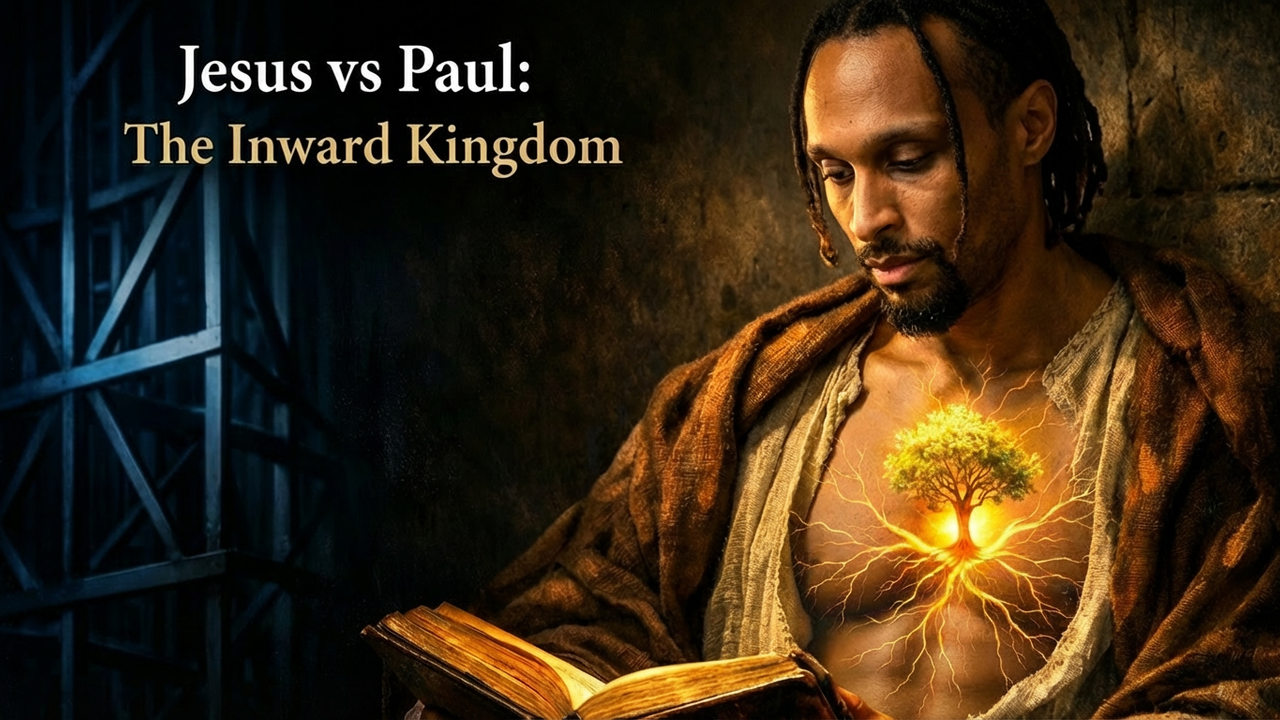
Jesus vs Paul: The Inward Kingdom

The tension at the heart of early Christian thought is not simply historical but ontological: two irreconcilable visions of human transformation and cosmic reign. On one side stands the kingdom proclaimed by the Jesus character as an immediate, inward reality; “within you” (Luke 17:21); a call to devotional repentance, heart renewal, and alignment with the transformative presence of the Hebrew Scriptures. On the other stands Paul’s earlier soteriology, centered on justification by faith in the blood of a cosmic Christ, apart from works of the law (Romans 3:25; 5:9). Evangelical culture has long defaulted to the Pauline lens, rendering inwardness optional and grace primarily forensic. The philosophical question is whether this default can survive scrutiny, or whether centering Jesus’ kingdom philosophy demands a deeper reckoning.

Scot McKnight (2010) correctly frames this crisis in “Jesus vs. Paul.” Any attempt to force Paul’s justification into Jesus’ kingdom mold, or vice versa, requires “bending of corners and squeezing of sides.” Paul barely speaks of the kingdom (fewer than fifteen references), and Jesus barely speaks of justification. The only coherent unity, McKnight argues, lies beneath both: the gospel as Christology, or the saving story of Jesus as the completion of Israel’s narrative. Yet even this harmonization leaves the deeper philosophical divergence untouched.

Barrie Wilson (2014) presses the point further, arguing that the divergence is not interpretive but foundational: two distinct religions. The Jesus Movement (Torah-observant, kingdom-proclaiming, led by James) embodied the religion of the Jesus character—an anti-imperial, messianic Jewish community awaiting the inward and outward breaking in of their God’s reign. Paul’s Christ Movement, born from a private mystical vision rather than historical discipleship, became a religion about the “Christ”: cosmic, dying-and-rising, Torah-free, focused on participation in a savior’s death rather than the teacher’s way of heart renewal. Acts retroactively solders them together; Paul’s own letters reveal the rupture.

The philosophical contradiction becomes sharpest when examined through Paul’s own logic. In 1 Corinthians 15:56 he declares, “The sting of death is sin, and the strength of sin is the law.” Here “sin” is philosophically defined not as moral failure alone but as reliance on any external religious machinery; rituals, ceremonies, traditions, or propositional systems; that claim to produce righteousness. Yet Paul immediately offers precisely such a system: faith in the blood of Christ as the singular transaction granting justification and propitiation. His Christ becomes a new law, a new ritual of mental assent and participatory mysticism. By Paul’s own criterion, this fulfills the definition of “sin” and by nature is wrong to consent to. The strength of this new “law” remains external: belief in a supernatural atonement rather than the internal yielding the Hebrew Scriptures demand.

Contrast this with the prophetic philosophy of the new covenant. Ezekiel 36:26 promises, “A new heart also will I give you, and a new spirit will I put within you: and I will take away the stony heart out of your flesh, and I will give you an heart of flesh.” Jeremiah 31:33 specifies the mechanism: “I will put my law in their inward parts, and write it in their hearts; and will be their God, and they shall be my people.” The newness is not a superior blood ritual or cosmic rescue plan but an inward, relational movement—high inward and mental interaction with Scripture that softens the self from within. This is the philosophical principle of transformation running unbroken from the Hebrew prophets through Jesus’ parables and kingdom proclamation.

If the Jesus character is understood as a historical figure consistent with the Hebrew Scriptures, he cannot coherently preach himself as one’s personal dying-and-rising Savior. Such a message would rupture the very continuity he embodied. The kingdom “within you” (Luke 17:21) and entry through devotional repentance and doing the Father’s will (Matthew 7:21) align perfectly with the inward new covenant. Inserting Paul’s gospel as the interpretive center dissolves that consistency: the new covenant becomes another external law, the reign becomes transactional, and the whisper of ongoing heart renewal is silenced.

Centering Jesus over Paul therefore does not invite legalism; it exposes the deeper grace. When grace is no longer a one-time forensic declaration but the enabling power for the relentless inward work the Jesus character envisioned, transformation becomes essential rather than optional. The kingdom’s demand is more intimate, more demanding, and more truly human precisely because it refuses to let any external religious philosophy—whether Torah, temple, or atonement formula—stand in for the heart’s yielding.

The philosophical path forward is clear: reclaim the new covenant as an enacted philosophy of inwardness. Set aside time to reflect on and retain the character within the Hebrew Scriptures. Open the Hebrew Scriptures and Gospels without systematic overlays. Ask not “What must I believe?” but “What is this doing to my stony places?” Let the words of the scriptures inwardly create you anew. Here grace fuels perseverance, not coverage. Here the reign within bursts outward as justice without ever becoming “works.”

The kingdom of God is within you. The new covenant is written on the heart. Will we dare engage the act that actually fulfills it?

References

McKnight, S. (2010, December). Jesus vs. Paul. Christianity Today.

Wilson, B. (2014). Paul versus Jesus. ResearchGate.