jesus of history

The Kingdom of God Is Within You: Why the Cross Silenced Jesus' Awakening

The cross was no accident, but a literary and a philosophical inevitability – a silencing born of the radical wisdom Jesus would have proclaimed. In the Gospel according to Luke, when the Pharisees demanded observable signs of the kingdom's arrival, Jesus answered plainly:

The kingdom of God cometh not with observation: Neither shall they say, Lo here! or, lo there! for, behold, the kingdom of God is within you. (Luke 17:20,21)

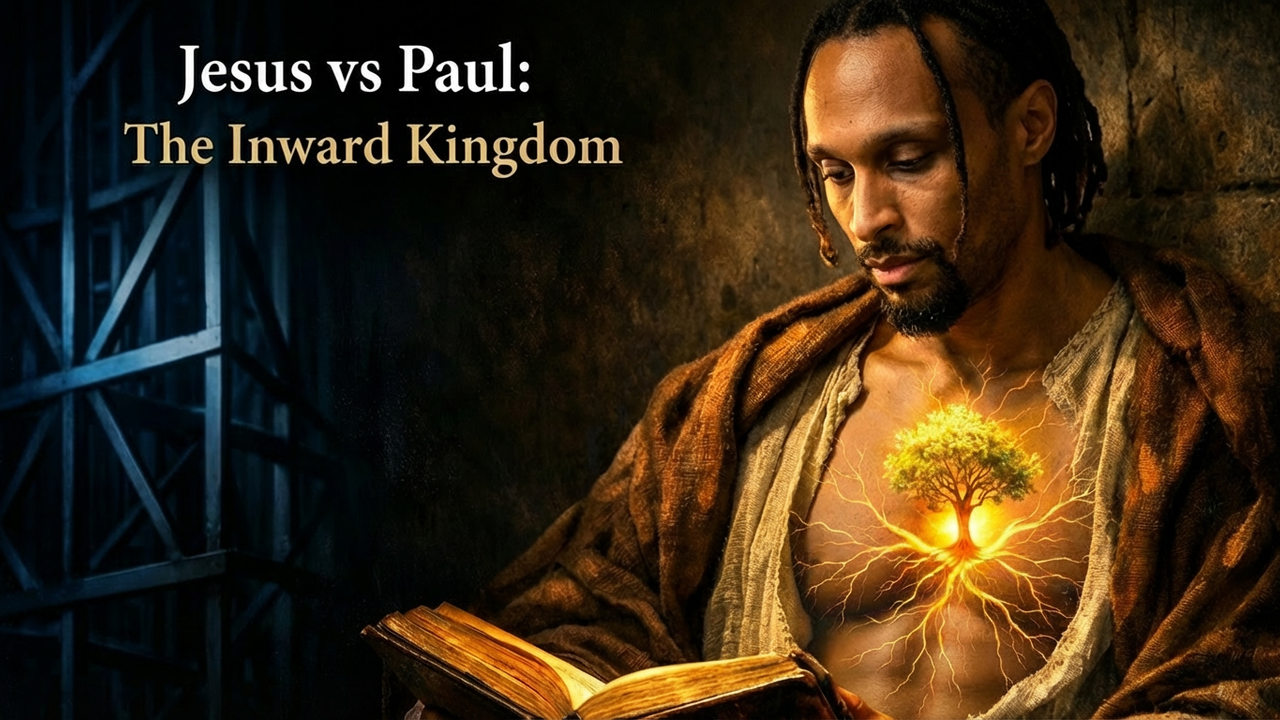
This declaration shifts the entire horizon of devotion. The “kingdom” referenced is not a spectacle to be pointed at, not a literal territory or visible empire awaiting conquest. It is an inward reality, a present and transformative experience unfolding within the devotional conversation – in the mind, the heart, the depths of consciousness.

This inward emphasis echoes deeply in the Hebrew Scriptures Jesus knew so intimately. In Psalm 51, David, confronted with the weight of his own error, cries out for inner renewal:

Behold, thou desirest truth in the inward parts: and in the hidden part thou shalt make me to know wisdom. (Psalm 51:6)

And further:

Create in me a clean heart, O God; and renew a right spirit within me. (Psalm 51:10)

The psalm exalts the creation of the inward person; the hidden personal and devotional self where truth from within the scriptures takes root and wisdom is imparted in secret places. The encounter with wisdom’s mercy is profoundly personal: a re-creation through contrition, where the concealed depths become the site of instruction and cleansing. Jesus, rooted in this tradition, radicalizes it. The kingdom breaks in not through outward signs or apocalyptic drama alone, but through this inner awakening, even though the purification of the heart, the renewal of the spirit, and the discovery of the reign of the Bible’s wisdom already accessible within.

Levine (2006) illuminates how thoroughly Hebrew this proclamation remains. Jesus argued from Torah, drew on the prophets, and addressed his fellow Hebrews with a call to covenantal depth rather than mere external conformity. His boundary-crossing inclusion of sinners and outcasts arose from a kingdom manifesting inwardly, through hearts receptive to mercy and compassion. To strip this vision of its Hebrew matrix in later interpretations is to obscure the scandal of a Hellenistic Jewish Jesus whose teaching centered internal devotion over institutional dominance (Levine, 2006).

Sanders (1985) situates Jesus within the eschatological hopes of Judaism, yet highlights how his announcement of the kingdom to the wicked; without demanding prior restitution or ritual purity; upended conventional expectations of external restoration. By pointing to a kingdom that begins in present inner responses and transformed relationships, Jesus made it immediate rather than deferred. The cross emerges as the violent rejection of this nearness: empires and authorities could endure visions of future upheaval, but not a reign that erodes hierarchies by awakening within individuals, dissolving borders of exclusion (Sanders, 1985).

Boyarin (2004) uncovers the once-fluid theological landscape where ideas of divine mediation; such as the Logos or Memra; circulated across Jewish thought without strict partitions. The Johannine prologue, read as a Hellenistic Jewish midrash on creation, reveals a Logos bridging divine and human inwardly. Yet as communities later enforced boundaries through heresiology, this shared possibility was partitioned: crucified in discourse, claimed as Christian orthodoxy or branded Jewish heresy. The individual we would term “Jesus” embodied an awakening that refused such borders, where the presence of wisdom indwells the person, resonating with Psalm 51's inward truth and Luke's kingdom within (Boyarin, 2004).

Philosophically, the cross had to silence this vision because an inward kingdom undermines every external claim to authority. If God's reign is devotional and mental; encountered through scripture's hidden wisdom, personal repentance, and renewed consciousness; no institution, empire, or border can monopolize it. The awakening this Jesus lived invited discovery of wise rule in the inward parts of the devotional character, where truth and a right spirit become the sole authentic sovereignty.

SO, what if the crucifixion was the necessary cost of such revelation? Not a transactional atonement in blood (because it was not), but the reflexive suppression of a light that turns devotion inward, from control toward liberating freedom. Holding Luke 17:20,21 alongside Psalm 51:6 and 51:10 confronts us with our own defenses: which outward structures do we cling to, lest we face the vulnerability of inner awakening? The silenced vision endures as invitation, in that one is encouraged to allow the kingdom to unfold within, where the renewal of the hidden heart reigns supreme.

References

Boyarin, D. (2004). Border lines: The partition of Judaeo-Christianity. University of Pennsylvania Press.

Levine, A.-J. (2006). The misunderstood Jew: The church and the scandal of the Jewish Jesus. HarperCollins.

Sanders, E. P. (1985). Jesus and Judaism. Fortress Press.

Why The Jesus Who Awakened Israel Had To Die

The Jesus who awakened Israel had to die, and not merely because political authorities saw him as a threat, but because the radical vision he embodied (the renewal of the devotional conscience) struck at the foundations of how covenant faithfulness, law, and God’s identity were negotiated in his time. His message carried a sort of immediacy and an inner certainty that bypassed the anxious deliberations of contemporary Hellenistic Judaism, destabilizing structures that would later harden into institutional forms. In the end, that vision proved too disruptive to survive intact once emerging religious authorities—both Jewish and Christian—sought to draw firm borders and reassert control.

The Jesus character that we are presented with lived and taught deeply within Hellenistic Judaism, yet his approach to the covenant set him apart in an interesting way. In the diverse Judaisms of the first century, a central activity revolved around what Tom Holmén calls "covenant path searching"; the ongoing effort to discern precisely how to remain faithful to God's covenant through debates over law, purity, and practice (Holmén, 2004). Groups across the spectrum, from Pharisees to Essenes, engaged in this searching, interpreting Torah to ensure loyalty amid Roman occupation and internal divisions. Jesus, however, appears to have refrained from such activity. He did not join in the meticulous halakhic deliberations or anxious boundary-drawing that defined covenant loyalty for so many. Instead, his words suggested an eschatological immediacy: the “kingdom of God” was breaking in now, rendering exhaustive path searching unnecessary. This echoes prophetic promises of a new covenant where God's will would be known inwardly, making external quests for fidelity obsolete (Holmén, 2004). Far from antinomianism or detachment from Judaism, Jesus' stance reflected a profound trust in an imminent inward renewal that would transform obedience from laborious interpretation into direct, heartfelt alignment.

This covenant perspective intersects powerfully with Jesus' attitude toward the Law itself. As William Loader demonstrates in his interesting analysis of Gospel traditions, Jesus did not set out to abolish Torah but engaged it incidentally, often intensifying its ethical demands while subordinating ritual details to mercy and justice (Loader, 2011).

In Q material (reflected in Matthew and Luke), Jesus affirms the Law's validity; down to its smallest details; yet prioritizes love, forgiveness, and inner transformation over exhaustive observance. He critiques practices that burden people without addressing the heart, yet never launches a systematic rejection of Torah. Loader notes that Jesus' conflicts arise not from deliberate confrontation but from his authority clashing with scribal interpretations, as seen in healings or forgiveness declarations that imply God's direct action breaking through established norms. This approach awakened Israel to a kingdom already arriving and yet even present within them, where the Law's purpose—relationship with God—was fulfilled in radical compassion rather than in endless interpretive safeguards.

Yet this awakening threatened the very structures that sustained Jewish identity under empire. By proclaiming forgiveness without temple mediation, associating with the impure without ritual correction, and announcing God's internal reign as present reality, Jesus destabilized the covenantal framework that required constant negotiation and institutional guardianship. His vision implied that God was acting decisively now, bypassing intermediaries and debates. Such immediacy could not coexist easily with systems built on controlled interpretation and boundary maintenance.

The authorities—whether temple elites fearing unrest or Roman powers preserving order—recognized the danger. Crucifixion, as Martin Hengel shows, was Rome's ultimate tool of humiliation and deterrence, reserved for slaves, rebels, and those who threatened imperial stability (Hengel, 1977). It was not just execution; it was a public spectacle designed to strip dignity, deny burial, and broadcast the foolishness of resistance. A messianic figure dying this shameful death inverted every expectation: no crucified hero or god existed in Greco-Roman mythology to redeem the symbol. The message of a crucified savior was thus "folly to Gentiles" and a "stumbling block" to Jews (1 Cor 1:23), precisely because it exposed the brutality beneath pious order and challenged any religion content with managed faithfulness rather than transformative encounter.

The necessity of Jesus' death becomes clearest when we consider how his vision was later contained. As Daniel Boyarin argues, the parting of ways between Judaism and Christianity was not inevitable but constructed through deliberate "border-making" by heresiologists on both sides (Boyarin, 2004). In late antiquity, fluid boundaries; shared beliefs in divine intermediaries (like Logos or Memra), overlapping practices; gave way to rigid definitions. Rabbinic authorities emphasized apostolic-like succession and exclusion of minim (heretics), while Christian leaders crucified the Logos theology that had once thrived in Hellenistic Jewish contexts, redefining it as exclusively Christian. Institutional religion reasserted itself by partitioning what had been porous: what was once a vibrant, contested Judaism became two separate entities, each claiming orthodoxy and policing its edges. Jesus' eschatological immediacy—where covenant loyalty flows from inner knowledge rather than path searching—threatened this partition. It invited a living relationship with God that no institution could fully control or codify. Once borders were drawn, the raw, destabilizing power of his message had to be domesticated: turned into doctrine, ritual, and hierarchy.

The possible Jesus of reality awakened Israel to a kingdom (experience) that arrived not through perfected law-keeping or imperial triumph, but through vulnerable love and devotional reflection that embraced every conversation without condition. That vision confronted the human need for control, exposed the violence upholding religious and political order, and destabilized every attempt to manage divine presence. Neither he nor his voice could not survive intact because institutions—ancient and modern—thrive on definition, exclusion, and mediation. The one who proclaimed the living God’s internal reign as intimate and immediate had to die, lest the structures he threatened collapse entirely. Yet in dying shamefully, he revealed their ignorance, and invited a faithfulness no border can contain, his philosophy becoming more eternal than himself, yet eventually finding itself confused for the man.

References

Boyarin, D. (2004). Border lines: The partition of Judaeo-Christianity. University of Pennsylvania Press.

Hengel, M. (1977). Crucifixion in the ancient world and the folly of the message of the cross (J. Bowden, Trans.). Fortress Press. (Original work published 1976)

Holmén, T. (2004). Jesus, Judaism and the covenant. Journal for the Study of the Historical Jesus, 2(1), 3–27.

Loader, W. (2011). Jesus and the Law. Handbook for the Study of the Historical Jesus4, 2745-2772.

If Jesus Was Not Preaching Christianity, What Was He Actually Doing?

In the quiet hills of Galilee, a teacher of Hebrew religious philosophy gathers crowds by the sea, speaking of a kingdom not built by human hands but breaking forth like dawn within the human heart. He quotes the ancient prophets, restores vision to minds, and challenges the priesthood; not to overthrow the faith of his ancestors, but to awaken it from within.

What if the Jesus we think we understand was not founding a new religion called “Christianity,” but calling his people back to the deepest promise of their own covenant with their Deity?

The imagined historical Jesus was deeply embedded in the age’s Hellenistic Judaism, but what he taught diverged in fascinating ways from the dominant religious currents of his time (and from the Christianity that later falsely developed around his memory). When actually comprehending the character beyond and yet hidden within the Jesus character, one finds that he operated firmly within Hebrew covenantal and Torah frameworks, yet with a distinctive emphasis that prioritized inner transformation over ritualistic debates.

Thomas Kazen carefully traces how Jesus engaged the Torah (the sacred instruction of Israel) not as an unyielding legal code demanding endless refinement, but as living guidance that points toward mercy, justice, and inner rightness (Kazen, n.d.). In the Gospels, Jesus affirms the Torah’s enduring place while consistently elevating its “weightier matters” over ritual details. His disputes with religious leaders were not attempts to abolish the law, but prophetic calls to embody its true spirit in an age when legal interpretation was still fluid and open to renewal.

Tom Holmén sharpens this picture by turning our attention to the covenant itself (the foundational belief in the Hebrew God’s unique relationship with Israel that both unified and divided its communities in the first century) (Holmén, 2004). Across the diverse “Judaisms” of the time, people engaged in fervent “covenant path searching,” debating how best to remain faithful through observance and practice. Strikingly, Jesus stands apart from this anxious quest. He does not join the widespread effort to define covenant loyalty through competing halakic frameworks. Instead, Holmén suggests, Jesus embodies the eschatological vision of prophets like Jeremiah: a coming covenant in which his God’s will is written directly on the heart, making external striving unnecessary; an inner knowing that renders the search for the right path obsolete.

Here the insights of Kazen and Holmén begin to resonate as one voice: the imagined historical Jesus interprets the Torah prophetically and steps back from covenantal debates not out of indifference, but because he lives and teaches as though the promised renewal has already begun.

In my book, “The Dawn of Devotion,” I carry the harmony of Kazen and Holmén into bolder, philosophical territory (Jackson, 2024). I dissect the story of Jesus as the dramatic enactment of a devotional shift: the crucifixion not as a literal payment for sin, but as the symbolic death to an “old conversation” (a mindset chained to external ordinances and handwritten rules). In its place rises “Immanuel,” the philosophy of “God-with-us” as an inward reality, a wisdom that purges the conscience and liberates from the very strength of sin that external law unwittingly amplifies. This, I do argue and prove from the scriptures, fulfills the ancient promise of a law no longer imposed from without, but alive within the personal and the devotional spirit.

When observing the imagined historical Jesus from a purely philosophical point of view, a quiet yet meaningful dialogue emerges. Kazen shows us a Jesus who honors the Torah yet prioritizes its heart. Holmén reveals a teacher who bypasses the era’s covenantal anxieties because he trusts the prophetic future breaking into the present. I dare us to see the cross itself as the sacrifice of an outdated religious mindset, making way for direct, transformative communion with the living God.

The mindful revelation that emerges is both simple and revolutionary: the Jesus we imagine (but are falsely unaware of) was not preaching the birth of Christianity as a separate faith. He was renewing Hebrew religious philosophy from its deepest roots, proclaiming that the long-awaited “kingdom” arrives not through perfected observance or institutional reform, but through hearts transformed by God’s own presence. His message was not “leave the old behind,” but “enter the old more deeply, for its fulfillment is here.”

What if the real revolution was not starting a new religion, but awakening an ancient one to its own radical promise without religion? Maybe perhaps the truest inheritance “Jesus” left is not a new religion to defend, but an ancient invitation renewed: to let go of anxious religious striving and trust the quiet voice writing love, mercy, and justice on the soul of one’s devotional conscience.

References

Holmén, T. (2004). Jesus, Judaism and the covenant. Journal for the Study of the Historical Jesus, 2(1), 3–27.

Jackson, L., Jr. (2024). The Dawn of Devotion: A Sacrifice for Devotional Evolution. Brilliant Publishing, LLC.

Kazen, T. (n.d.). Jesus’ interpretation of the Torah [Pre-publication English version]. Manuscript for Jesus Handbuch.