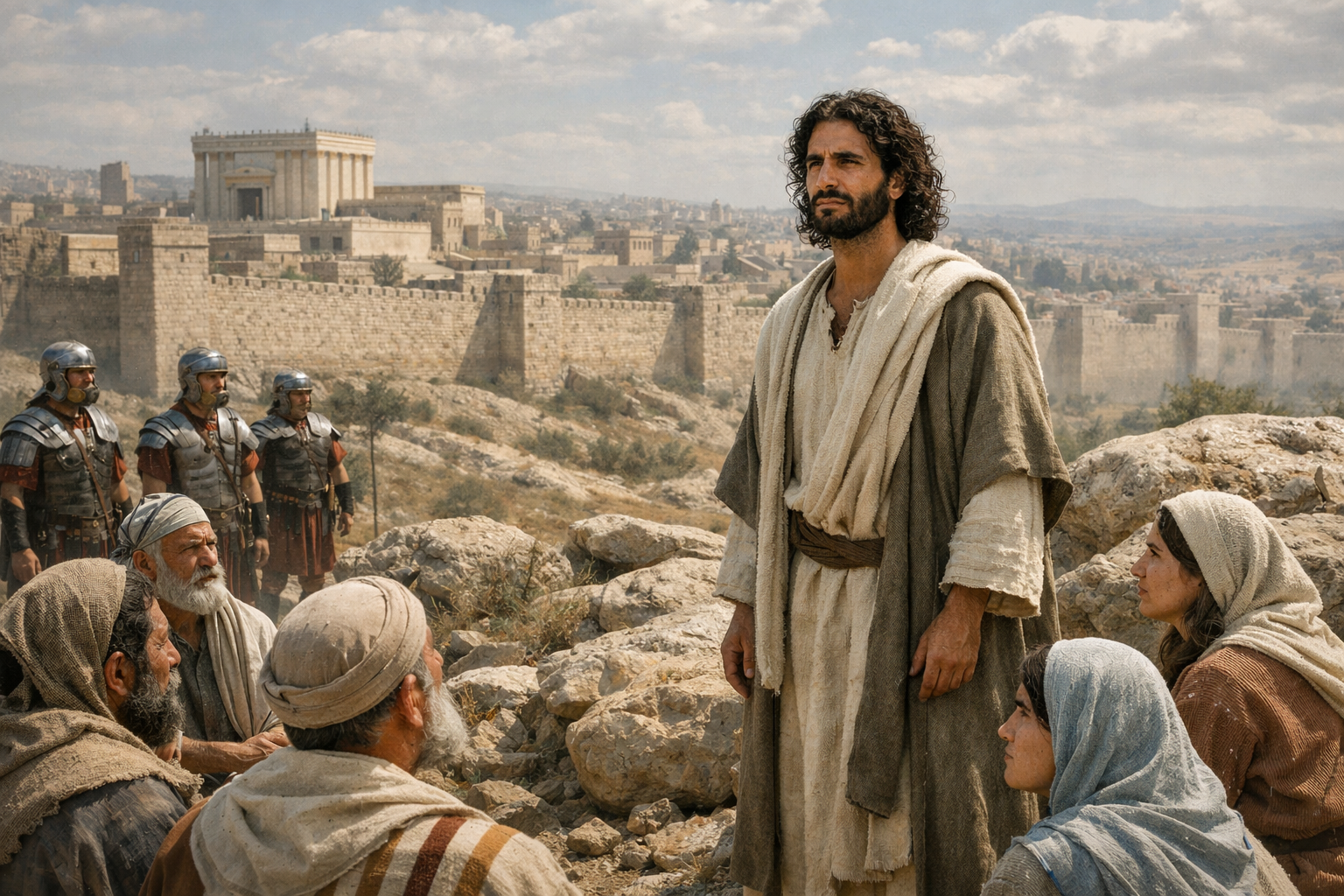
The Jesus who awakened Israel had to die, and not merely because political authorities saw him as a threat, but because the radical vision he embodied (the renewal of the devotional conscience) struck at the foundations of how covenant faithfulness, law, and God’s identity were negotiated in his time. His message carried a sort of immediacy and an inner certainty that bypassed the anxious deliberations of contemporary Hellenistic Judaism, destabilizing structures that would later harden into institutional forms. In the end, that vision proved too disruptive to survive intact once emerging religious authorities—both Jewish and Christian—sought to draw firm borders and reassert control.
The Jesus character that we are presented with lived and taught deeply within Hellenistic Judaism, yet his approach to the covenant set him apart in an interesting way. In the diverse Judaisms of the first century, a central activity revolved around what Tom Holmén calls "covenant path searching"; the ongoing effort to discern precisely how to remain faithful to God's covenant through debates over law, purity, and practice (Holmén, 2004). Groups across the spectrum, from Pharisees to Essenes, engaged in this searching, interpreting Torah to ensure loyalty amid Roman occupation and internal divisions. Jesus, however, appears to have refrained from such activity. He did not join in the meticulous halakhic deliberations or anxious boundary-drawing that defined covenant loyalty for so many. Instead, his words suggested an eschatological immediacy: the “kingdom of God” was breaking in now, rendering exhaustive path searching unnecessary. This echoes prophetic promises of a new covenant where God's will would be known inwardly, making external quests for fidelity obsolete (Holmén, 2004). Far from antinomianism or detachment from Judaism, Jesus' stance reflected a profound trust in an imminent inward renewal that would transform obedience from laborious interpretation into direct, heartfelt alignment.
This covenant perspective intersects powerfully with Jesus' attitude toward the Law itself. As William Loader demonstrates in his interesting analysis of Gospel traditions, Jesus did not set out to abolish Torah but engaged it incidentally, often intensifying its ethical demands while subordinating ritual details to mercy and justice (Loader, 2011).
In Q material (reflected in Matthew and Luke), Jesus affirms the Law's validity; down to its smallest details; yet prioritizes love, forgiveness, and inner transformation over exhaustive observance. He critiques practices that burden people without addressing the heart, yet never launches a systematic rejection of Torah. Loader notes that Jesus' conflicts arise not from deliberate confrontation but from his authority clashing with scribal interpretations, as seen in healings or forgiveness declarations that imply God's direct action breaking through established norms. This approach awakened Israel to a kingdom already arriving and yet even present within them, where the Law's purpose—relationship with God—was fulfilled in radical compassion rather than in endless interpretive safeguards.
Yet this awakening threatened the very structures that sustained Jewish identity under empire. By proclaiming forgiveness without temple mediation, associating with the impure without ritual correction, and announcing God's internal reign as present reality, Jesus destabilized the covenantal framework that required constant negotiation and institutional guardianship. His vision implied that God was acting decisively now, bypassing intermediaries and debates. Such immediacy could not coexist easily with systems built on controlled interpretation and boundary maintenance.
The authorities—whether temple elites fearing unrest or Roman powers preserving order—recognized the danger. Crucifixion, as Martin Hengel shows, was Rome's ultimate tool of humiliation and deterrence, reserved for slaves, rebels, and those who threatened imperial stability (Hengel, 1977). It was not just execution; it was a public spectacle designed to strip dignity, deny burial, and broadcast the foolishness of resistance. A messianic figure dying this shameful death inverted every expectation: no crucified hero or god existed in Greco-Roman mythology to redeem the symbol. The message of a crucified savior was thus "folly to Gentiles" and a "stumbling block" to Jews (1 Cor 1:23), precisely because it exposed the brutality beneath pious order and challenged any religion content with managed faithfulness rather than transformative encounter.
The necessity of Jesus' death becomes clearest when we consider how his vision was later contained. As Daniel Boyarin argues, the parting of ways between Judaism and Christianity was not inevitable but constructed through deliberate "border-making" by heresiologists on both sides (Boyarin, 2004). In late antiquity, fluid boundaries; shared beliefs in divine intermediaries (like Logos or Memra), overlapping practices; gave way to rigid definitions. Rabbinic authorities emphasized apostolic-like succession and exclusion of minim (heretics), while Christian leaders crucified the Logos theology that had once thrived in Hellenistic Jewish contexts, redefining it as exclusively Christian. Institutional religion reasserted itself by partitioning what had been porous: what was once a vibrant, contested Judaism became two separate entities, each claiming orthodoxy and policing its edges. Jesus' eschatological immediacy—where covenant loyalty flows from inner knowledge rather than path searching—threatened this partition. It invited a living relationship with God that no institution could fully control or codify. Once borders were drawn, the raw, destabilizing power of his message had to be domesticated: turned into doctrine, ritual, and hierarchy.
The possible Jesus of reality awakened Israel to a kingdom (experience) that arrived not through perfected law-keeping or imperial triumph, but through vulnerable love and devotional reflection that embraced every conversation without condition. That vision confronted the human need for control, exposed the violence upholding religious and political order, and destabilized every attempt to manage divine presence. Neither he nor his voice could not survive intact because institutions—ancient and modern—thrive on definition, exclusion, and mediation. The one who proclaimed the living God’s internal reign as intimate and immediate had to die, lest the structures he threatened collapse entirely. Yet in dying shamefully, he revealed their ignorance, and invited a faithfulness no border can contain, his philosophy becoming more eternal than himself, yet eventually finding itself confused for the man.
References
Boyarin, D. (2004). Border lines: The partition of Judaeo-Christianity. University of Pennsylvania Press.
Hengel, M. (1977). Crucifixion in the ancient world and the folly of the message of the cross (J. Bowden, Trans.). Fortress Press. (Original work published 1976)
Holmén, T. (2004). Jesus, Judaism and the covenant. Journal for the Study of the Historical Jesus, 2(1), 3–27.
Loader, W. (2011). Jesus and the Law. Handbook for the Study of the Historical Jesus, 4, 2745-2772.