
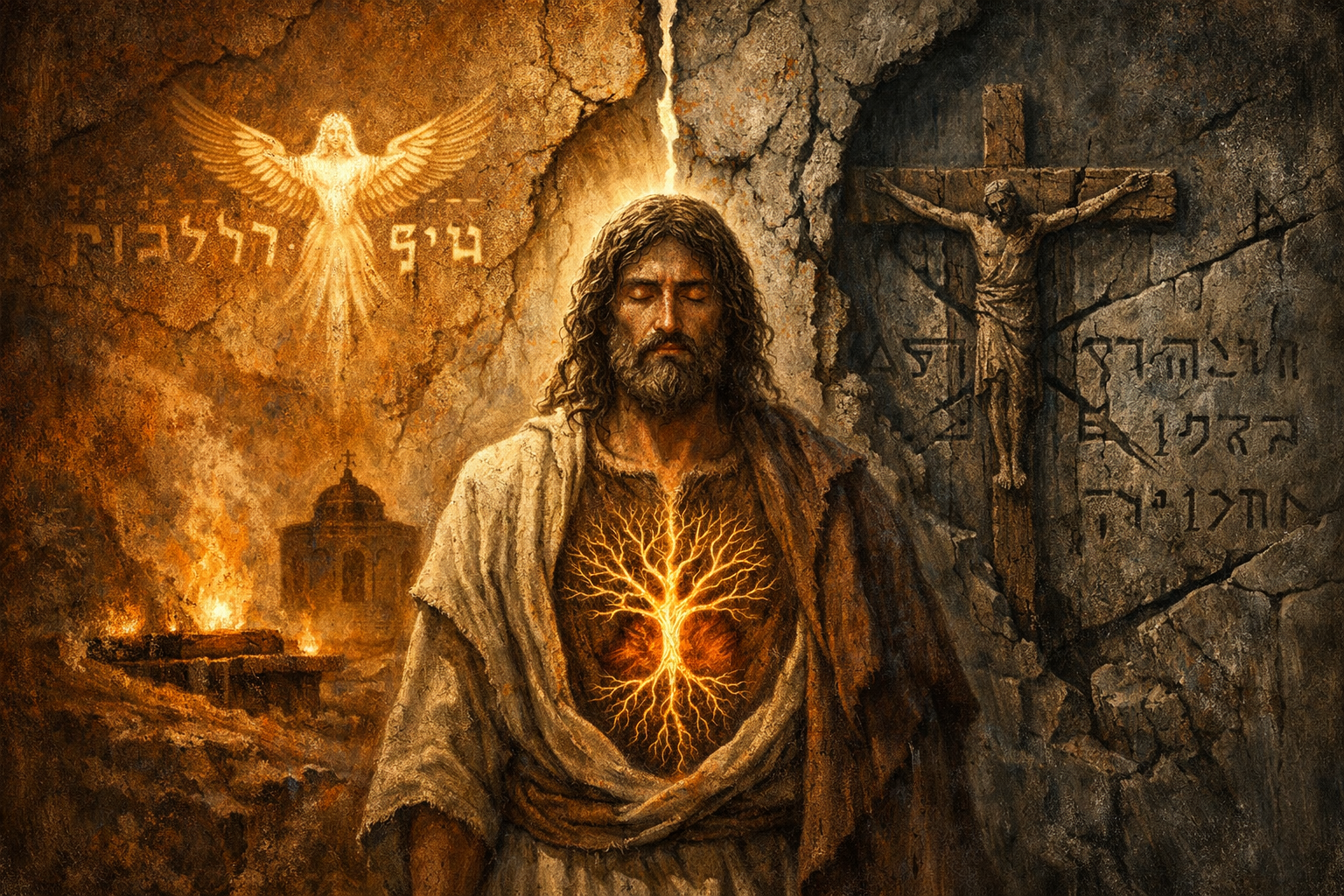
The cross was no accident, but a literary and a philosophical inevitability – a silencing born of the radical wisdom Jesus would have proclaimed. In the Gospel according to Luke, when the Pharisees demanded observable signs of the kingdom's arrival, Jesus answered plainly:
The kingdom of God cometh not with observation: Neither shall they say, Lo here! or, lo there! for, behold, the kingdom of God is within you. (Luke 17:20,21)
This declaration shifts the entire horizon of devotion. The “kingdom” referenced is not a spectacle to be pointed at, not a literal territory or visible empire awaiting conquest. It is an inward reality, a present and transformative experience unfolding within the devotional conversation – in the mind, the heart, the depths of consciousness.
This inward emphasis echoes deeply in the Hebrew Scriptures Jesus knew so intimately. In Psalm 51, David, confronted with the weight of his own error, cries out for inner renewal:
Behold, thou desirest truth in the inward parts: and in the hidden part thou shalt make me to know wisdom. (Psalm 51:6)
And further:
Create in me a clean heart, O God; and renew a right spirit within me. (Psalm 51:10)
The psalm exalts the creation of the inward person; the hidden personal and devotional self where truth from within the scriptures takes root and wisdom is imparted in secret places. The encounter with wisdom’s mercy is profoundly personal: a re-creation through contrition, where the concealed depths become the site of instruction and cleansing. Jesus, rooted in this tradition, radicalizes it. The kingdom breaks in not through outward signs or apocalyptic drama alone, but through this inner awakening, even though the purification of the heart, the renewal of the spirit, and the discovery of the reign of the Bible’s wisdom already accessible within.
Levine (2006) illuminates how thoroughly Hebrew this proclamation remains. Jesus argued from Torah, drew on the prophets, and addressed his fellow Hebrews with a call to covenantal depth rather than mere external conformity. His boundary-crossing inclusion of sinners and outcasts arose from a kingdom manifesting inwardly, through hearts receptive to mercy and compassion. To strip this vision of its Hebrew matrix in later interpretations is to obscure the scandal of a Hellenistic Jewish Jesus whose teaching centered internal devotion over institutional dominance (Levine, 2006).
Sanders (1985) situates Jesus within the eschatological hopes of Judaism, yet highlights how his announcement of the kingdom to the wicked; without demanding prior restitution or ritual purity; upended conventional expectations of external restoration. By pointing to a kingdom that begins in present inner responses and transformed relationships, Jesus made it immediate rather than deferred. The cross emerges as the violent rejection of this nearness: empires and authorities could endure visions of future upheaval, but not a reign that erodes hierarchies by awakening within individuals, dissolving borders of exclusion (Sanders, 1985).
Boyarin (2004) uncovers the once-fluid theological landscape where ideas of divine mediation; such as the Logos or Memra; circulated across Jewish thought without strict partitions. The Johannine prologue, read as a Hellenistic Jewish midrash on creation, reveals a Logos bridging divine and human inwardly. Yet as communities later enforced boundaries through heresiology, this shared possibility was partitioned: crucified in discourse, claimed as Christian orthodoxy or branded Jewish heresy. The individual we would term “Jesus” embodied an awakening that refused such borders, where the presence of wisdom indwells the person, resonating with Psalm 51's inward truth and Luke's kingdom within (Boyarin, 2004).
Philosophically, the cross had to silence this vision because an inward kingdom undermines every external claim to authority. If God's reign is devotional and mental; encountered through scripture's hidden wisdom, personal repentance, and renewed consciousness; no institution, empire, or border can monopolize it. The awakening this Jesus lived invited discovery of wise rule in the inward parts of the devotional character, where truth and a right spirit become the sole authentic sovereignty.
SO, what if the crucifixion was the necessary cost of such revelation? Not a transactional atonement in blood (because it was not), but the reflexive suppression of a light that turns devotion inward, from control toward liberating freedom. Holding Luke 17:20,21 alongside Psalm 51:6 and 51:10 confronts us with our own defenses: which outward structures do we cling to, lest we face the vulnerability of inner awakening? The silenced vision endures as invitation, in that one is encouraged to allow the kingdom to unfold within, where the renewal of the hidden heart reigns supreme.
References
Boyarin, D. (2004). Border lines: The partition of Judaeo-Christianity. University of Pennsylvania Press.
Levine, A.-J. (2006). The misunderstood Jew: The church and the scandal of the Jewish Jesus. HarperCollins.
Sanders, E. P. (1985). Jesus and Judaism. Fortress Press.