
dawn of devotion

If Jesus Was Not Preaching Christianity, What Was He Actually Doing?

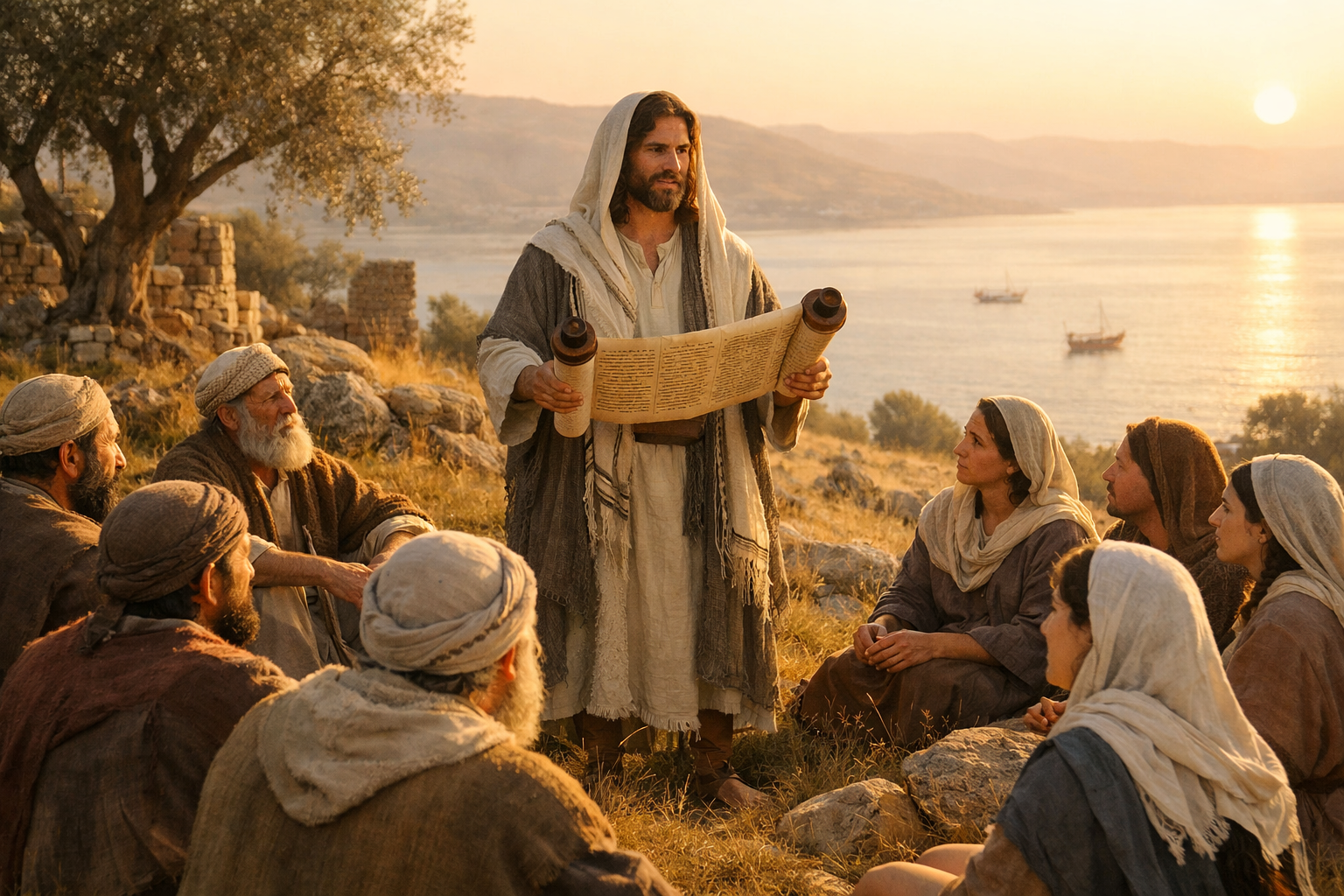
In the quiet hills of Galilee, a teacher of Hebrew religious philosophy gathers crowds by the sea, speaking of a kingdom not built by human hands but breaking forth like dawn within the human heart. He quotes the ancient prophets, restores vision to minds, and challenges the priesthood; not to overthrow the faith of his ancestors, but to awaken it from within.

What if the Jesus we think we understand was not founding a new religion called “Christianity,” but calling his people back to the deepest promise of their own covenant with their Deity?

The imagined historical Jesus was deeply embedded in the age’s Hellenistic Judaism, but what he taught diverged in fascinating ways from the dominant religious currents of his time (and from the Christianity that later falsely developed around his memory). When actually comprehending the character beyond and yet hidden within the Jesus character, one finds that he operated firmly within Hebrew covenantal and Torah frameworks, yet with a distinctive emphasis that prioritized inner transformation over ritualistic debates.

Thomas Kazen carefully traces how Jesus engaged the Torah (the sacred instruction of Israel) not as an unyielding legal code demanding endless refinement, but as living guidance that points toward mercy, justice, and inner rightness (Kazen, n.d.). In the Gospels, Jesus affirms the Torah’s enduring place while consistently elevating its “weightier matters” over ritual details. His disputes with religious leaders were not attempts to abolish the law, but prophetic calls to embody its true spirit in an age when legal interpretation was still fluid and open to renewal.

Tom Holmén sharpens this picture by turning our attention to the covenant itself (the foundational belief in the Hebrew God’s unique relationship with Israel that both unified and divided its communities in the first century) (Holmén, 2004). Across the diverse “Judaisms” of the time, people engaged in fervent “covenant path searching,” debating how best to remain faithful through observance and practice. Strikingly, Jesus stands apart from this anxious quest. He does not join the widespread effort to define covenant loyalty through competing halakic frameworks. Instead, Holmén suggests, Jesus embodies the eschatological vision of prophets like Jeremiah: a coming covenant in which his God’s will is written directly on the heart, making external striving unnecessary; an inner knowing that renders the search for the right path obsolete.

Here the insights of Kazen and Holmén begin to resonate as one voice: the imagined historical Jesus interprets the Torah prophetically and steps back from covenantal debates not out of indifference, but because he lives and teaches as though the promised renewal has already begun.

In my book, “The Dawn of Devotion,” I carry the harmony of Kazen and Holmén into bolder, philosophical territory (Jackson, 2024). I dissect the story of Jesus as the dramatic enactment of a devotional shift: the crucifixion not as a literal payment for sin, but as the symbolic death to an “old conversation” (a mindset chained to external ordinances and handwritten rules). In its place rises “Immanuel,” the philosophy of “God-with-us” as an inward reality, a wisdom that purges the conscience and liberates from the very strength of sin that external law unwittingly amplifies. This, I do argue and prove from the scriptures, fulfills the ancient promise of a law no longer imposed from without, but alive within the personal and the devotional spirit.

When observing the imagined historical Jesus from a purely philosophical point of view, a quiet yet meaningful dialogue emerges. Kazen shows us a Jesus who honors the Torah yet prioritizes its heart. Holmén reveals a teacher who bypasses the era’s covenantal anxieties because he trusts the prophetic future breaking into the present. I dare us to see the cross itself as the sacrifice of an outdated religious mindset, making way for direct, transformative communion with the living God.

The mindful revelation that emerges is both simple and revolutionary: the Jesus we imagine (but are falsely unaware of) was not preaching the birth of Christianity as a separate faith. He was renewing Hebrew religious philosophy from its deepest roots, proclaiming that the long-awaited “kingdom” arrives not through perfected observance or institutional reform, but through hearts transformed by God’s own presence. His message was not “leave the old behind,” but “enter the old more deeply, for its fulfillment is here.”

What if the real revolution was not starting a new religion, but awakening an ancient one to its own radical promise without religion? Maybe perhaps the truest inheritance “Jesus” left is not a new religion to defend, but an ancient invitation renewed: to let go of anxious religious striving and trust the quiet voice writing love, mercy, and justice on the soul of one’s devotional conscience.

References

Holmén, T. (2004). Jesus, Judaism and the covenant. Journal for the Study of the Historical Jesus, 2(1), 3–27.

Jackson, L., Jr. (2024). The Dawn of Devotion: A Sacrifice for Devotional Evolution. Brilliant Publishing, LLC.

Kazen, T. (n.d.). Jesus’ interpretation of the Torah [Pre-publication English version]. Manuscript for Jesus Handbuch.

Embrace Spiritual Fulfillment

Based on Chapter 16 of Dawn of Devotion

To cultivate a deep, spiritually fulfilling life, it is essential to move beyond self-imposed religious structures to embrace the Bible’s core philosophy. This is not just about following religious policies but about seeking a genuine connection with the Bible, as it says in Galatians 2:19, "Live unto God." This transformative path challenges us to align our understanding with the will at the core of the scriptures, allowing its righteousness to permeate our devotional life.

The Bible continually reminds us that true devotion begins with living "according to God in the spirit" (1 Peter 4:6). This means shifting the focus from mere external religious acts to an internal transformation. Our conversation must be centered on the meaning of the Bible’s righteousness, upholding its counsel as our guide. Psalm 119:116 states, "Uphold me according unto thy word, that I may live." By immersing our conversation’s conscience in Scripture, we allow the Bible’s intention to dwell within us, transforming our spirit or mind and leading us to a more fulfilling personal and devotional life.

Understanding the Bible’s philosophy requires us to engage deeply with its “Word.” Our faith’s mind, guided by this Spirit, serves as the instrument for discerning its wisdom. Romans 7:25 affirms, "With the mind I myself serve the law of God." Our mental and spiritual efforts must be aligned with the law of the Bible’s Spirit, where true understanding is manifested. This is the Bible's deeper call: to engage our mind, allowing it to serve and understand its philosophy from a place of love and purpose.

True spiritual wisdom comes from transcending the religious world’s dogmas and misconceptions. The Bible highlights that our belief must leave behind self-centered religious notions to grasp the broader vision of its intended creation. As Romans 7:18 explains, without this wisdom, our devotional experience is bound to an empty practice, disconnected from the true essence of mindful living. The Bible’s call is to experiment with faith, to investigate the Bible’s wisdom, and apply them to our lives through conscious effort.

The Bible’s philosophy centers on the Bible’s righteousness. This righteousness, however, is not limited to ritual or tradition; it must be realized through personal experience and experimentation. The scriptures guide us to pursue the Bible’s commandment with diligence, as only through active faith can we understand and live out the intended experience.

The Bible offers a profound educational journey for our belief’s mind, where wisdom and knowledge of the Bible’s intention lead to its liberation, even like as Proverbs 11:9 asserts, "Through knowledge shall the just be delivered." The pursuit of this wisdom requires us to consistently review and reflect on the Bible’s words, freeing us from false teachings and leading us to fact. This journey involves death to the conversation’s natural constitution, as Romans 6:10 says, so that our understanding may live unto the living God.

The process of sanctification—our belief and its intellect purified—occurs as we engage in the living God’s educational system. This journey leads to the transformation of the mind, allowing us to partake in right wisdom and leaving behind the superficial elements of the religious world. As Colossians 1:13 suggests, our deliverance from earthly concerns happens as we move toward our faith’s higher purposes.

Our faith’s ultimate calling is for us to align it with the Bible’s philosophical intention. The Bible’s philosophy, rooted in a benevolent wisdom, invites us to move beyond mere religious tradition and into a deeper, more meaningful engagement with our understanding. This path is not easy, but it is essential for spiritual growth and enlightenment.

Through this understanding, we move beyond the confines of religious conventions and embrace a higher learning, one that is based upon purpose and guided by wisdom. The Bible’s word’s are a living guide, calling us to live "according to God in the spirit" (1 Peter 4:6), to honor that experience in truth, and to experience the transformative power of those words.

The Myth of the Virgin Birth and Its Allegory Explained

Scene from the Temple of Luxor at ancient Thebes in Egypt, built by Amenhotep III

In the age-old tale of a virgin conceiving a child, lies a captivating allegory transcending popular theology. The Bible (originally Genesis to Malachi) doesn’t talk about or support a miraculous virgin birth. It talks about a profound journey of mental conception through acquiring wisdom. I’ve actually detailed this subject in a presentation.

The origin for the virgin birth is clearly stated, in four separate scenes, within the temple of Luxor built by Amenhotep III, a Pharaoh of the eighteenth dynasty. I will quote a passage from Gerald Massey’s book to give you an idea of what this scene depicts:

“The first scene on the left hand shows the god Talit, the lunar Mercury, the divine Word or Logos. in the act of hailing the virgin queen, announcing to her that she is to give birth to the coming son.

“In the next scene the god Kneph (in conjunction with Hathor) gives life to her. This is the Holy Ghost or Spirit that causes conception; Kneph being the spirit. Impregnation and conception are made apparent in the virgin's fuller form.

“Next the mother is seated on the midwife's stool, and the child is supported in the hands of one of the nurses.

“The fourth scene is that of the adoration. Here the child is enthroned, receiving homage from the gods and gifts from men. Behind the deity Kneph, on the right three men are kneeling and offering gifts with the right hand and life with the left. The child thus announced, incarnated, born, and worshipped was the Pharaonic representative of the Aten sun, the Adon of Syria, and Hebrew Adonai, the child-Christ of the Aten cult, the miraculous conception of the ever-virgin mother personated by Mut-em-Ua.” Massey, G. (1886). The historical Jesus and the mythical Christ, or, Natural genesis and typology of equinoctial Christolatry. (32/33)

In Egypt, before a Pharaoh would impregnate his wife, he would leave the bedroom and go into a secret room. He would wash in “holy water” and anoint his entire body with “holy oil.” After doing so, he would exit this secret chamber, return to his wife, and have intercourse with her.

Pharaoh does this routine because, by washing and anointing himself in the “holy ordinance,” his body becomes a “vessel for God.” “God” now inhabits his body. The seed shooting out of him and into his wife becomes the “seed of God,” hence the wife of Pharaoh is impregnated by “God” and “their child” immaculately conceived. This is the scene depicted at Luxor. The tradition of this mythology was inevitably passed down and adopted by the writers of the gospels.

The Bible doesn’t discuss such a concept of birth, but rather highlights a birth as found in the saying, "That which is born of the Spirit is spirit" (Jn.3:6). This is a concept transcending realms of superstition and religion, representing a deep union of the mind with the scriptures and with its self. The Dawn of Devotion tackles the Bible’s concept of birth, further answering the question: “What exactly does it mean for a ‘virgin’ to ‘conceive’?”

The issue of birth and of conception are issues having to do with the growth and the development of the mind. Only by introducing acquired wisdom and understanding into the mind can one know the intended “birth.” The child of the “Holy Ghost” isn't a mythological product. These terms need to be understood in their philosophical context to grasp the learning experience our belief should have.

Terms mean much to the narrative within the Bible, and concerning this particular subject, The Dawn of Devotion, calling the Bible into action, makes sense of them. Through its narrative, we're invited, as we look at not the experience of the fiction character called “Jesus,” but at the real man, to ponder the nature of mental conception. What is learned is that true understanding emanates from the heart of the mind. The folklore written within Matthew and Luke is supposed to assist their readers in understanding the allegory therein.