
Christology

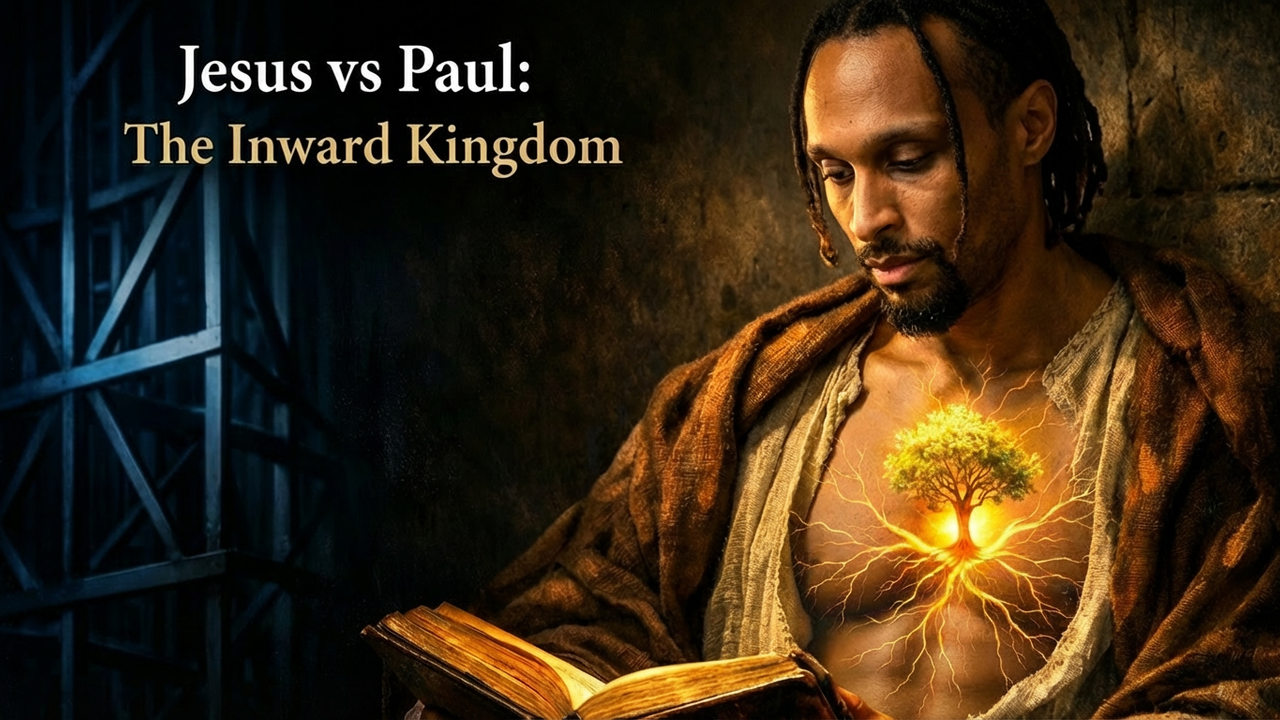
Jesus vs Paul: The Inward Kingdom

The tension at the heart of early Christian thought is not simply historical but ontological: two irreconcilable visions of human transformation and cosmic reign. On one side stands the kingdom proclaimed by the Jesus character as an immediate, inward reality; “within you” (Luke 17:21); a call to devotional repentance, heart renewal, and alignment with the transformative presence of the Hebrew Scriptures. On the other stands Paul’s earlier soteriology, centered on justification by faith in the blood of a cosmic Christ, apart from works of the law (Romans 3:25; 5:9). Evangelical culture has long defaulted to the Pauline lens, rendering inwardness optional and grace primarily forensic. The philosophical question is whether this default can survive scrutiny, or whether centering Jesus’ kingdom philosophy demands a deeper reckoning.

Scot McKnight (2010) correctly frames this crisis in “Jesus vs. Paul.” Any attempt to force Paul’s justification into Jesus’ kingdom mold, or vice versa, requires “bending of corners and squeezing of sides.” Paul barely speaks of the kingdom (fewer than fifteen references), and Jesus barely speaks of justification. The only coherent unity, McKnight argues, lies beneath both: the gospel as Christology, or the saving story of Jesus as the completion of Israel’s narrative. Yet even this harmonization leaves the deeper philosophical divergence untouched.

Barrie Wilson (2014) presses the point further, arguing that the divergence is not interpretive but foundational: two distinct religions. The Jesus Movement (Torah-observant, kingdom-proclaiming, led by James) embodied the religion of the Jesus character—an anti-imperial, messianic Jewish community awaiting the inward and outward breaking in of their God’s reign. Paul’s Christ Movement, born from a private mystical vision rather than historical discipleship, became a religion about the “Christ”: cosmic, dying-and-rising, Torah-free, focused on participation in a savior’s death rather than the teacher’s way of heart renewal. Acts retroactively solders them together; Paul’s own letters reveal the rupture.

The philosophical contradiction becomes sharpest when examined through Paul’s own logic. In 1 Corinthians 15:56 he declares, “The sting of death is sin, and the strength of sin is the law.” Here “sin” is philosophically defined not as moral failure alone but as reliance on any external religious machinery; rituals, ceremonies, traditions, or propositional systems; that claim to produce righteousness. Yet Paul immediately offers precisely such a system: faith in the blood of Christ as the singular transaction granting justification and propitiation. His Christ becomes a new law, a new ritual of mental assent and participatory mysticism. By Paul’s own criterion, this fulfills the definition of “sin” and by nature is wrong to consent to. The strength of this new “law” remains external: belief in a supernatural atonement rather than the internal yielding the Hebrew Scriptures demand.

Contrast this with the prophetic philosophy of the new covenant. Ezekiel 36:26 promises, “A new heart also will I give you, and a new spirit will I put within you: and I will take away the stony heart out of your flesh, and I will give you an heart of flesh.” Jeremiah 31:33 specifies the mechanism: “I will put my law in their inward parts, and write it in their hearts; and will be their God, and they shall be my people.” The newness is not a superior blood ritual or cosmic rescue plan but an inward, relational movement—high inward and mental interaction with Scripture that softens the self from within. This is the philosophical principle of transformation running unbroken from the Hebrew prophets through Jesus’ parables and kingdom proclamation.

If the Jesus character is understood as a historical figure consistent with the Hebrew Scriptures, he cannot coherently preach himself as one’s personal dying-and-rising Savior. Such a message would rupture the very continuity he embodied. The kingdom “within you” (Luke 17:21) and entry through devotional repentance and doing the Father’s will (Matthew 7:21) align perfectly with the inward new covenant. Inserting Paul’s gospel as the interpretive center dissolves that consistency: the new covenant becomes another external law, the reign becomes transactional, and the whisper of ongoing heart renewal is silenced.

Centering Jesus over Paul therefore does not invite legalism; it exposes the deeper grace. When grace is no longer a one-time forensic declaration but the enabling power for the relentless inward work the Jesus character envisioned, transformation becomes essential rather than optional. The kingdom’s demand is more intimate, more demanding, and more truly human precisely because it refuses to let any external religious philosophy—whether Torah, temple, or atonement formula—stand in for the heart’s yielding.

The philosophical path forward is clear: reclaim the new covenant as an enacted philosophy of inwardness. Set aside time to reflect on and retain the character within the Hebrew Scriptures. Open the Hebrew Scriptures and Gospels without systematic overlays. Ask not “What must I believe?” but “What is this doing to my stony places?” Let the words of the scriptures inwardly create you anew. Here grace fuels perseverance, not coverage. Here the reign within bursts outward as justice without ever becoming “works.”

The kingdom of God is within you. The new covenant is written on the heart. Will we dare engage the act that actually fulfills it?

References

McKnight, S. (2010, December). Jesus vs. Paul. Christianity Today.

Wilson, B. (2014). Paul versus Jesus. ResearchGate.

Why Paul’s Christ and the Gospel Jesus Cannot Be Reconciled

The New Testament presents readers with two strikingly distinct portrayals of the Jesus character. On the one hand, the Paul character offers us a cosmic Christ—an eternal, preexistent divine figure, the agent of creation and redemption for all humanity. On the other hand, the Gospels; particularly the Synoptics; paint a picture of a Jewish prophet, a moral Rabbi embedded in the matrix of first-century Judaism, who heals, teaches, and proclaims the imminent “kingdom of God.” These representations are not just different perspectives; they are radically divergent theological constructs.

The question at the heart of Christian theory thus arises: Can Paul’s cosmic Christ and the Jesus character of the Gospels be reconciled? Should we actually look at the New Testament text, the answer appears to be a resolute no.

Paul’s Cosmic Christ: Beyond History and Flesh

Paul’s letters, particularly Colossians 1:13–20, present his Christ as the agent of creation and the sustainer of all things. In this view, his Christ is not merely a moral teacher, but the very Logos, the rational, divine principle that orders the Greek universe. Paul’s Christ is "before all things" and in him "all things hold together" (Col. 1:17). This Cosmic Christ is not merely divine in function but in essence: he is the full embodiment of Deity, through whom the reconciliation of all things, both heavenly and earthly, is achieved by blood on his cross​.

Ebenezer Fai (2022) highlights that Paul’s emphasis in Colossians emerges not from biographical reflection on a historical man named “Jesus,” but from a theological need to combat Gnostic heresies and affirm cosmic supremacy​. Paul’s Jesus is a being whose existence precedes the incarnation, whose work of salvation is only metaphysical, and whose authority is cosmic, universal, and eternal.

The Gospel Jesus: The Scripted Rabbi

In contrast, the Gospels; especially the Synoptics; do not concern themselves with cosmic metaphysics. They present a man situated in a specific cultural and religious context. The Jesus character is of or from Nazareth, a Galilean Jew, engaging with Pharisees, healing lepers, and preaching the ethical imperatives of love, forgiveness, and justice.

Whereas Paul emphasizes the Jesus character’s crucifixion and resurrection as a metaphysical event, the Gospels center on Jesus’ life: his teachings, parables, compassion, and confrontation with religious authorities. This version of Jesus observes Jewish law (albeit sometimes critically), engages with the marginalized, and rarely speaks of himself in cosmic or divine terms. His favorite self-designation, "Son of Man," evokes prophetic imagery of him as a supporter of a remote mythological figure rather than ontological divinity.

The Jesus of the Gospels is particular, for he is bound to the socio-political and religious fabric of Second Temple Judaism. Paul’s Christ, on the other hand, is universal, being a cosmic archetype more reminiscent of a Hellenistic deity than Hebrew prophet.

Philosophical Disparity: Logos vs. Narrative

Philosophically, these two Christ characters appeal to different metaphysical traditions. Paul's Christ emerges from a Platonic schema, aligning with the Logos doctrine who is, in Greek and Hellenistic Judaism’s literature, a preexistent Word mediating between the transcendent God and material creation. This idea would later crystallize in Johannine theology and be formalized in Neoplatonic Christianity, as seen in the works of Augustine and Origen.

In contrast, the Gospel Jesus reflects more of an Aristotelian and ethical tradition, in that he is concerned with praxis, not metaphysics. His parables are moral, his miracles restorative, his teachings embedded in community life which, to the audience, forces a link between notable figures like Elijah and Elisha. His “kingdom” is both near and ethical, not cosmic and absolute.

Gnosticism and the Veiled Christ

Murphy (2011) adds a fascinating layer to this tension, revealing that Paul’s theology fits neatly into the framework of a mystery religion, where his Christ is a symbolic figure guiding initiates into spiritual transformation, not a biographical teacher from Galilee​. Paul’s Christ speaks to inner divinity and mystical rebirth: “We died with Christ... and now our life is hidden with Christ in God” (Colossians 3:3). The supposed Jesus of history is deliberately obscured, even discarded, in favor of a higher, esoteric truth​.

This idea is not foreign to early Christianity. The Gnostic gospels present the Jesus character not as a crucified savior but a revealer of hidden knowledge (gnosis). Gnostic communities viewed the Christ character as an immaterial guide to enlightenment rather than a sacrificial lamb​. This really aligns with Paul’s mystical language and esoteric symbolism.

The Church's Solution: Synthetic Christology

The early Church, recognizing this rift, sought to synthesize the two through creeds and councils. The Council of Nicaea (325 CE) and Chalcedon (451 CE) declared Christ to be fully God and fully man, attempting to harmonize Paul's Logos Christ with the Gospel's version of the Jesus character. But such reconciliation was dogmatic, not organic.

As Murphy (2011) argues, these decisions were less about theological integrity and more about institutional control. The Gospel Jesus, with his ethical teachings and radical inclusivity, was threatening to a budding ecclesiastical hierarchy. The cosmic Christ, distant and abstract, was more malleable and less politically dangerous​.

A Disunion That Challenges Christianity

Theologically, Paul’s Christ and the Gospel Jesus are not just different interpretations of the same figure; they are different figures. One is an eternal metaphysical being; the other is a figure scripted to appear as a human prophet. One is rooted in Hellenistic mysticism; the other in Jewish ethics. One speaks of justification through faith; the other of righteousness through love and mercy.

Thus, the union is impossible, and not for lack of trying, but because the two are fundamentally irreconcilable. Christianity has survived by layering these incompatible Christ characters into one synthetic narrative. Yet this synthesis (if we would just look at the New Testament text) strains under the weight of its contradictions, as evidenced by modern theological fractures between evangelical, mystical, liberal, and historical-critical Christianities.

To ask whether Christianity is about belief in Paul’s cosmic Christ or following the Gospel Jesus is not merely a theological question, but something actually challenging the rationale of the individual asking the question. As we move further into the 21st century, perhaps it's time to stop forcing a reconciliation and start telling the truth: Christianity was always a tale of two Jesuses.

 Resources:

Fai, E., Merrill C. Tenney, Mark Allan Powel, Carson, D. A., Dunnett, W. M., McCain, D., Gundry, R., Keener, C. S., Hendricksen, W., Falwell, J., Brown, R. E., Akintola, S. O., & Guthrie, D. (2022). The Cosmic Christ: An Exegesis of Colossians 1:13-20 and its implications for the Twenty-First Century Church. In The American Journal of Biblical Theology (Vol. 23, Issue 33).

Loubser, J. A. (1993). Orality and Pauline ‘Christology’: Some Hermeneutical Implications. Scriptura: Journal for Biblical, Theological and Contextual Hermeneutics47, 25-51. 

Murphy, D. (2011). Jesus Potter Harry Christ. Holyblasphemy press

Reclaiming One's Heart: How Christology Lost Its Devotional Core

“Create in me a clean heart, O God; and renew a right spirit within me.” — Psalm 51:10

This cry, manifesting in the poetic layers of the psalmist’s soul, is the revelation of the Bible’s underlying philosophy. At its core, the Hebrew Scriptures call for inward transformation through a sincere acquaintance with its words: “Acquaint now thyself with him, and be at peace... lay up his words in thine heart” (Job 22:21–22). Knowledge, to the Bible’s mind, is not propositional or metaphysical. It is personal, reflective, and intimate: “...through knowledge shall the just be delivered” (Proverbs 11:9).

But what became of this simple, yet meaningful devotional experience, in early Christianity?

Paul and the Early Shift Toward Metaphysics

According to Marshall (1967), Paul's writings represent a critical theological shift. While Paul's letters include moral exhortations and personal struggles, his Christology primarily conceptualizes the Jesus character as a supramundane figure (p. 78), a being of divine essence who stands in metaphysical proximity to his God. In Galatians 4:4, Paul refers to his Christ as being sent from God, implying a preexistent, divine being rather than a prophetic teacher rooted in human history.

Marshall shows that by the time Paul writes, within only two decades of the Jesus character’s supposed crucifixion, a Hellenistic ontology begins to dominate, even an abstract framework emphasizing this figure’s divinity in cosmic, rather than existential, terms (pp. 86–88). This early Christian turn was not accidental; it was fueled by contact with Greek ideas of the “divine man” and Gnostic notions of a descending redeemer. Jesus was no longer merely to be thought of a real and living man, one who taught his hearers to be clean-minded before God, but a metaphysical solution to “sin”— a celestial ransom.

From Jesus’ Simplicity to Council Complexity

Zachhuber (2021) highlights how this metaphysical focus deepened as Christianity moved into the fourth and fifth centuries. The Church councils, particularly Chalcedon (451 CE), did not just define who the Jesus character was—they codified him into philosophical categories derived from Greek metaphysics, such as physis, ousia, and hypostasis (Zachhuber, 2021, pp. 209–211).

As Zachhuber (2021) laments, Christology became so scholastic and technical that it lost the organic vitality of earlier Jewish spirituality. What once was a moral and relational appeal for a “renewed spirit” became a debate over whether “Jesus” had one nature or two, or whether his hypostasis aligned with divine or human substance. The devotional conversation had been colonized by the conceptual tools of Stoicism and Middle Platonism, not by the philosophy within the Psalms or the Proverbs.

Hellenistic Philosophy and the Loss of Hebrew Intimacy

The shift wasn't merely theological; it was philosophical. Zachhuber (2021) notes how later theologians like Gregory of Nyssa or Cyril of Alexandria absorbed and restructured Christian thought to mirror Platonic and Neoplatonic metaphysics (pp. 212–214). In doing so, the Jesus character was no longer primarily a teacher of the inward way but became the cosmic Logos—the rational principle of the universe.

This is a far cry from the personal yearning of the Hebrew Bible, where true knowledge is internalized in the heart and mind. As Psalm 51 indicates, devotion was never about metaphysical comprehension, but ethical devotional sincerity and inner transformation.

The False Images: Paul's Cosmic Christ and the Gospel Jesus

Both Marshall and Zachhuber help us see that the Christ of Paul—and even the progressively mythologized Jesus of the Gospels—represent a theological departure. As the church absorbed Greek categories, it replaced the Hebrew notion of “acquaintance with God” with allegiance to a doctrinal system.

Jesus becomes functionally divine in Paul’s letters, but that functionality is tied to sacrificial substitution rather than the transformation of character. In the Gospels, Jesus is slowly mythologized as a miracle-working demigod, drawing from Hellenistic Jewish and pagan traditions. The result: the devotional emphasis on the heart and spirit gives way to belief in personhood and doctrine.

Marshall (1967) warns us not to overlook this subtle but powerful transition. He writes, “It would be most curious if the early church had proceeded to use this title [Son of God] in a purely functional manner,” and yet this is precisely what occurred in both Pauline and post-Pauline theology (Marshall, 1967, p. 84).

The Way Back: Knowledge That Delivers

The Bible’s spirituality, as Proverbs teaches, rests on the deliverance brought through knowledge, not metaphysical speculation, but knowing in the Hebrew sense: encountering, internalizing, and embodying. “Acquaint now thyself with Him…” (Job 22:21) is not a call to creeds, but to presence.

Christian theology has spent centuries drifting from this central point. Zachhuber is keenly aware of this when he observes that the technical debates of the fourth century often "exact a real loss of religious meaning as the price for doctrinal sophistication" (Zachhuber, 2021, p. 216). The church may have constructed cathedrals of logic, but it did so on the ruins of Hebrew philosophical devotion.

To reclaim one’s clean heart, the devotional conversation must step away from the illusion of Christological precision and return to the raw, honest prayer of the psalmist’s soul. Not a metaphysical Jesus, nor a politicized Gospel Jesus—but a conversation with the living God, the one whose words renews and delivers.

Let the Heart Speak Again

Christians must reckon with the fact that what has been handed down to them (in their religious theory) is a compromised inheritance—one shaped more by Plato and Philo than by Moses and the Prophets. Paul's Jesus, and also the Gospel Jesus, have been so layered with foreign philosophy that one’s original devotional experience and conscience has been obscured.

But the Psalms still call. The Proverbs still promise deliverance through knowledge. Nothing has changed. And Job still reminds us that peace comes not through theology, but through acquaintance with the Bible’s words. The time has come to let our devotional heart speak again—unmediated, unencumbered, and undistracted by the philosophical scaffolding of a church that forgot how to pray, learn, and reflect.

References

Marshall, I. H. (1967). The Development of Christology in the Early Church. Tyndale Bulletin18(1), 77-93.

Zachhuber, J. (2021). Christology in the fourth century: a response.