
New Testament theology

Was Jesus a Rewritten Egyptian Savior?

The story of Jesus in the New Testament does oddly capture attention—a man of compassion, who heals, teaches, dies, and rises again, bringing a message of hope and renewal. Yet older writings from over a century ago reveal something intriguing: many elements in this account seem to mirror ideas and images from Egyptian mythology, as if the Gospel writers drew from a much older stream of human imagination about its divine figure and salvation.

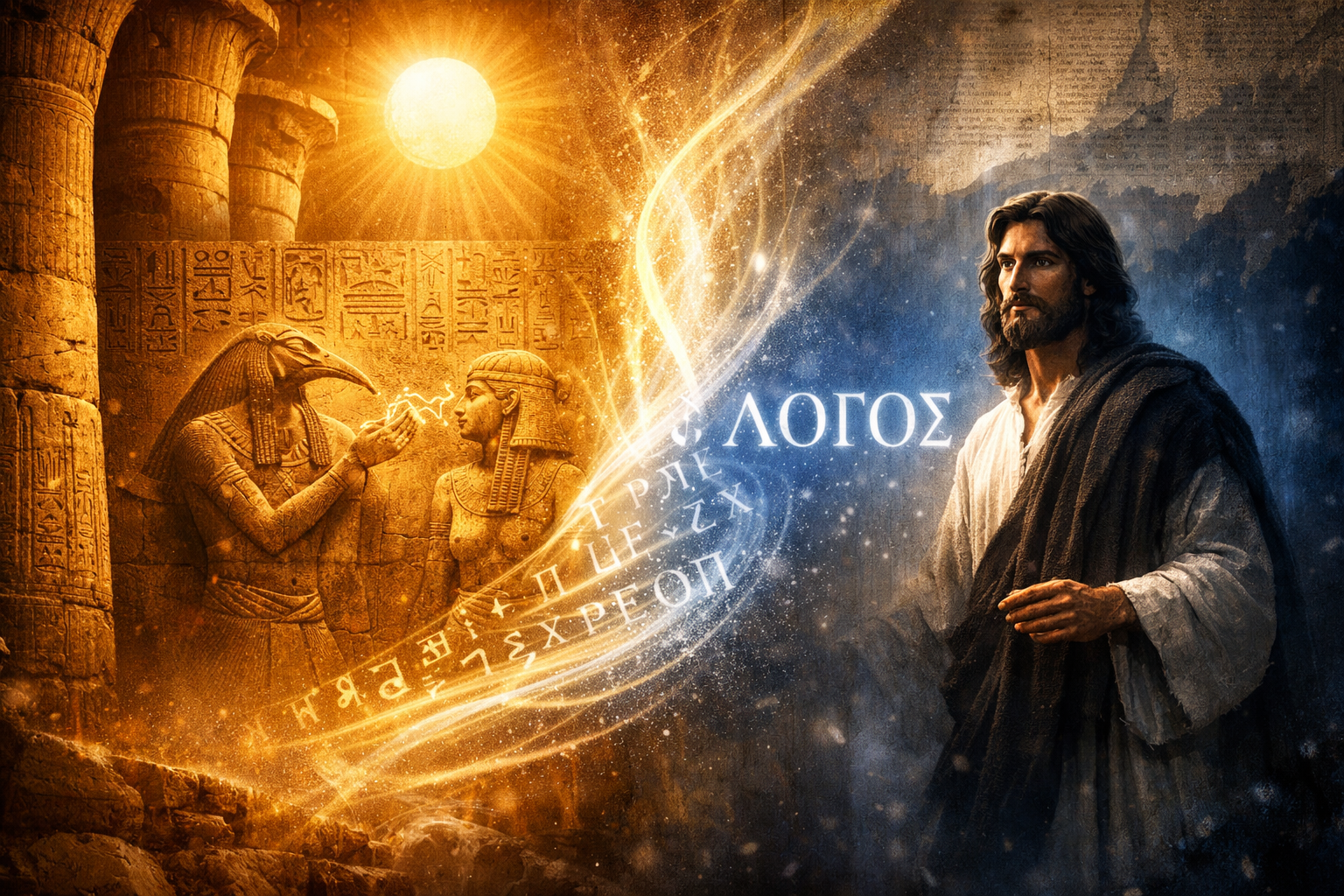
Gerald Massey, in The Historical Jesus and the Mythical-Christ, carefully laid out his case. He separated a possible real person—Jehoshua Ben-Pandira, a teacher mentioned in the Talmud, executed as a sorcerer around 70 BCE or earlier—from the "mythical Christ" described in the Gospels. Massey focused on the virgin birth as one clear link. In Egyptian tradition, this idea appears in temple art long before Christianity. At the Temple of Luxor, built under Pharaoh Amenhotep III in the 18th Dynasty (around 1400 BCE), wall reliefs show a divine conception and birth (something I have already blogged about). The maiden queen Mut-em-ua receives an announcement from the god Thoth (the ibis-headed scribe and herald), then conceives a child who becomes the divine king. These scenes include an annunciation, a miraculous union involving the god Amun, the shaping of the child on a potter's wheel by Khnum, and the birth itself, attended by protective deities.

Massey saw this sequence—annunciation, divine impregnation without ordinary means, shaping of the child, and sacred birth—as a longstanding pattern and blueprint for how the eternal child enters the world through a virgin-like mother (a pattern that cannot arise from ordinary human events but lives in myth and symbol). He argued that the Gospel virgin birth echoes this ancient motif, where the divine enters the world through a pure vessel, untouched by ordinary generation.

Alice Grenfell, in her article "Egyptian Mythology and the Bible" in The Monist, explored other connections, especially around creation and the power of speech. In Genesis, God creates by speaking: "Let there be light," and it happens. Grenfell connected this to the Egyptian idea of maat kheru (or maa kheru), the "true voice" or creative utterance. Gods and the blessed dead wield this power to bring things into existence—light from their eyes, reality from their words. She noted how the goddess Maat, linked to light and truth, represents this creative force. The offering of Maat to a god becomes a ritual of returning reality to its source.

This idea surfaces again in the Gospel of John: "In the beginning was the Word, and the Word was with God... All things were made by him." The Logos as creator through speech feels oddly close to the Egyptian view that naming and speaking aloud turns potential into being. Grenfell even pointed to Joseph's Egyptian name, Zaphnath-paaneah ("The god spoke, and he lives"), as carrying the same tradition of divine voice granting life.

These parallels do not erase the uniqueness of the New Testament account; all of these myths and their sayings carry their own unique essence. Instead, they suggest that when early Christians shaped their story of the Jesus character, they reached for symbols that already carried deep meaning for people familiar with older traditions. The virgin birth, the divine word bringing life, the savior who overcomes death—these motifs had circulated for centuries along the Nile, expressing humanity's hope for something greater than ordinary existence. To re-hash the same mythology in a new way doesn’t make it any more valid or historical, but serves to open our mind to the allegory that has been passed down.

What emerges is a sense of continuity: ancient Egyptians carved their longing for “divine intervention” into stone, and later writers found ways to express a similar longing through the character of Jesus. The story feels both ancient and fresh, rooted in shared human questions about birth, light, and renewal.

Yet these parallels refuse to sit quietly. To what extent did earlier myths shape the telling of the Jesus narrative? If the story emerged from a distinctly Hebrew or Hellenistic Jewish setting, why does it resonate so strongly with motifs far older and geographically distant? What additional strands from Egypt—or other ancient cultures—remain tied to the New Testament? Looking into these questions invites us to see the Gospels not as literal historical reports, but as participants in a much older allegorical dialogue stretching across civilizations. In that light, the Jesus character may function less as a purely biographical construction and more as a literary embodiment of symbolic truths, crafted to convey meaning through the language of myth, theology, and cultural memory.

CLICK: The Myth of the Virgin Birth and Its Allegory Explained

 References

Grenfell, A. (1906). EGYPTIAN MYTHOLOGY AND THE BIBLE. The Monist16(2), 169–200.

Massey, G. (1900). The Historical Jesus and Mythical-Christ.

Sharpe, S. (1863). EGYPTIAN MYTHOLOGY AND EGYPTIAN CHRISTIANITY. In JOHN RUSSELL SMITH. JOHN RUSSELL SMITH.

The Evolution of Jesus: Did the Gospels Alter Paul’s Original Christ?

Paul’s writings were the first to introduce Jesus to the mainstream, predating the Gospels by decades. His letters present a cosmic Christ, emphasizing salvation through faith in his death and resurrection. In contrast, the Gospel Jesus is depicted as a Jewish teacher proclaiming the Kingdom of God. This raises the critical question: Did the Gospel writers reshape Paul’s Jesus, or did they seek to reclaim a more authentic version of the historical figure?

Who Was the Real Jesus?

Paul’s letters, written between 50-60 CE, present a Jesus as a divine figure whose crucifixion and resurrection define the Christian faith. Paul speaks little of Jesus' earthly ministry or ethical teachings, focusing instead on his role as a risen Lord. The Gospels, appearing later, ground Jesus in Jewish tradition, portraying him as a prophet and moral teacher. The shift in emphasis suggests that either the Gospel writers were correcting Paul’s theological vision, or that Paul’s Jesus was already a theological innovation distinct from a historical figure.

Paul’s Jesus is fundamentally theological. He emphasizes justification by faith and salvation through grace, a departure from the Gospel Jesus, who calls for repentance and righteousness in preparation for the Kingdom of God. While Jesus in the Gospels preaches ethical living and social justice, Paul frames faith in his Christ’s death as the sole path to salvation. This distinction highlights the possibility that the Gospels sought to counterbalance or reinterpret Paul’s influence.

Theological vs. Narrative Jesus: A Major Shift

Ethical teachings play a significant role in the Gospels but are largely absent from Paul’s letters. Jesus' Sermon on the Mount advocates love, humility, and nonviolence, while Paul constructs a Christ-centered theology with little reference to these teachings. Scholars like N.T. Wright argue that Paul’s vision of Jesus shaped early Christian doctrine, setting the foundation upon which Gospel writers later built. The work of Oropeza further emphasizes that Paul’s use of the term “gospel” (euangelion) was influenced by Roman imperial and Jewish traditions, reinforcing the idea that Paul’s portrayal was already a reinterpretation of either an already familiar Jesus character or figure.

Despite these differences, both Paul and the Gospels emphasize the death and resurrection of Jesus. Paul’s writings insist that without the resurrection, faith is meaningless, making it the cornerstone of Christian belief. The Gospels also build toward this climax, portraying the crucifixion as a fulfillment of prophecy. However, because Paul’s letters predate the Gospel accounts, it is possible that the Gospel writers adapted their narratives to align with the theology Paul had already established.

Did the Gospel Writers Correct Paul’s Theology?

If Paul’s letters represent the earliest theological reflections on Jesus, the Gospels may have been an attempt to reshape or refine his vision. It is academically suggest that Paul’s Jesus came first as a cosmic savior, and the Gospel writers later grounded him in history. Others propose that the Gospels intentionally corrected Paul’s theology, reestablishing the Jesus character as a Jewish messiah rather than the universal figure Paul preached. Paul himself claims in Galatians that his gospel was received through revelation, rather than human tradition, reinforcing the idea that his Jesus was the first “official” Jesus, later modified by Gospel writers. This would actually mean that no actual “Jesus” existed, as Paul only refers to his Jesus in theological terms.

Rather than Paul deviating from Jesus, it may be that the Gospel Jesus deviated from Paul’s theological framework. If Paul’s Jesus was the first to dominate Christian thought, then the Gospel narratives represent an evolution—whether to align with Jewish traditions, expand Christian theory’s appeal, or clarify aspects of Jesus’ life that Paul had not defined. The contrast between Paul’s cosmic Christ and the Gospel’s moral teacher reflects either a dynamic or divergent development of early Christian belief.

Did Paul Invent Christianity?

The question of whether Paul invented Christianity remains a topic of debate. His letters set the foundation for Christian theology, and the Gospel writers may have responded by creating a narrative to go along with it. Yet, the apparent deviation in the Gospel Jesus from Paul’s Jesus might also show a shift in understanding. The gospels don’t really portray the Jesus character as a cosmic figure; such perceptions exist due to a carrying over of Paul’s insights into those narrative. If Paul’s Jesus never existed, and if letters of more anonymous writers surfaced, breaking own to gospel Jesus as Paul breaks down his cosmic Christ, would we even think of the Jesus character in the way that Paul does? Whether Paul’s Jesus was the first true version or the Gospel Jesus was a necessary re-write, their relationship remains one of the most intriguing aspects of early Christian history.

References:

Oropeza, B. J. (2024). The Gospel according to Paul: over a hundred years of interpretation. Religions, 15(12), 1566. https://doi.org/10.3390/rel15121566

Wright, N. T. (1978). The Tyndale New Testament Lecture, 1978. TYNDALE BULLETIN, 29, 62–64. https://tyndalebulletin.org