
Egyptian mythology

Was Jesus a Rewritten Egyptian Savior?

The story of Jesus in the New Testament does oddly capture attention—a man of compassion, who heals, teaches, dies, and rises again, bringing a message of hope and renewal. Yet older writings from over a century ago reveal something intriguing: many elements in this account seem to mirror ideas and images from Egyptian mythology, as if the Gospel writers drew from a much older stream of human imagination about its divine figure and salvation.

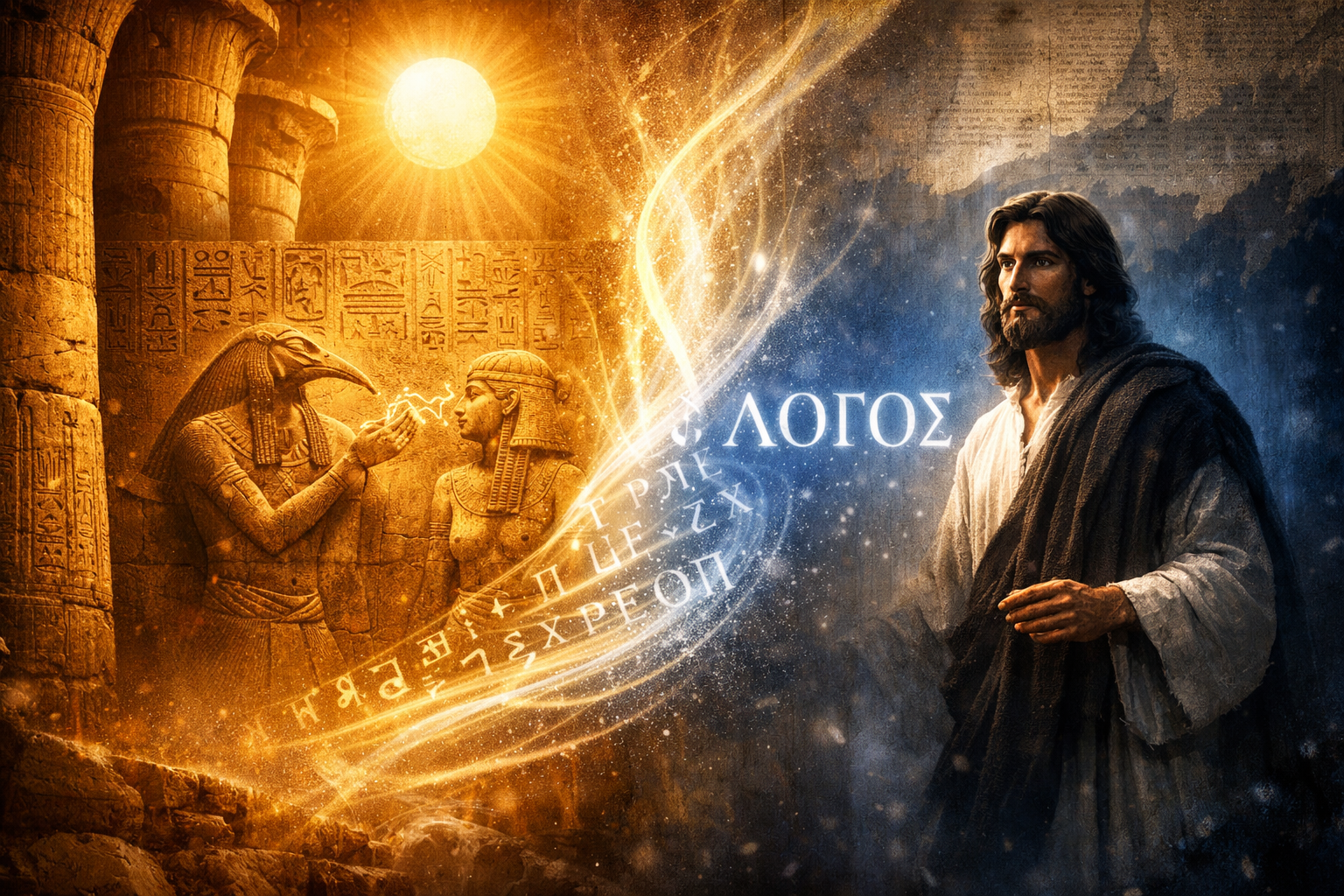
Gerald Massey, in The Historical Jesus and the Mythical-Christ, carefully laid out his case. He separated a possible real person—Jehoshua Ben-Pandira, a teacher mentioned in the Talmud, executed as a sorcerer around 70 BCE or earlier—from the "mythical Christ" described in the Gospels. Massey focused on the virgin birth as one clear link. In Egyptian tradition, this idea appears in temple art long before Christianity. At the Temple of Luxor, built under Pharaoh Amenhotep III in the 18th Dynasty (around 1400 BCE), wall reliefs show a divine conception and birth (something I have already blogged about). The maiden queen Mut-em-ua receives an announcement from the god Thoth (the ibis-headed scribe and herald), then conceives a child who becomes the divine king. These scenes include an annunciation, a miraculous union involving the god Amun, the shaping of the child on a potter's wheel by Khnum, and the birth itself, attended by protective deities.

Massey saw this sequence—annunciation, divine impregnation without ordinary means, shaping of the child, and sacred birth—as a longstanding pattern and blueprint for how the eternal child enters the world through a virgin-like mother (a pattern that cannot arise from ordinary human events but lives in myth and symbol). He argued that the Gospel virgin birth echoes this ancient motif, where the divine enters the world through a pure vessel, untouched by ordinary generation.

Alice Grenfell, in her article "Egyptian Mythology and the Bible" in The Monist, explored other connections, especially around creation and the power of speech. In Genesis, God creates by speaking: "Let there be light," and it happens. Grenfell connected this to the Egyptian idea of maat kheru (or maa kheru), the "true voice" or creative utterance. Gods and the blessed dead wield this power to bring things into existence—light from their eyes, reality from their words. She noted how the goddess Maat, linked to light and truth, represents this creative force. The offering of Maat to a god becomes a ritual of returning reality to its source.

This idea surfaces again in the Gospel of John: "In the beginning was the Word, and the Word was with God... All things were made by him." The Logos as creator through speech feels oddly close to the Egyptian view that naming and speaking aloud turns potential into being. Grenfell even pointed to Joseph's Egyptian name, Zaphnath-paaneah ("The god spoke, and he lives"), as carrying the same tradition of divine voice granting life.

These parallels do not erase the uniqueness of the New Testament account; all of these myths and their sayings carry their own unique essence. Instead, they suggest that when early Christians shaped their story of the Jesus character, they reached for symbols that already carried deep meaning for people familiar with older traditions. The virgin birth, the divine word bringing life, the savior who overcomes death—these motifs had circulated for centuries along the Nile, expressing humanity's hope for something greater than ordinary existence. To re-hash the same mythology in a new way doesn’t make it any more valid or historical, but serves to open our mind to the allegory that has been passed down.

What emerges is a sense of continuity: ancient Egyptians carved their longing for “divine intervention” into stone, and later writers found ways to express a similar longing through the character of Jesus. The story feels both ancient and fresh, rooted in shared human questions about birth, light, and renewal.

Yet these parallels refuse to sit quietly. To what extent did earlier myths shape the telling of the Jesus narrative? If the story emerged from a distinctly Hebrew or Hellenistic Jewish setting, why does it resonate so strongly with motifs far older and geographically distant? What additional strands from Egypt—or other ancient cultures—remain tied to the New Testament? Looking into these questions invites us to see the Gospels not as literal historical reports, but as participants in a much older allegorical dialogue stretching across civilizations. In that light, the Jesus character may function less as a purely biographical construction and more as a literary embodiment of symbolic truths, crafted to convey meaning through the language of myth, theology, and cultural memory.

CLICK: The Myth of the Virgin Birth and Its Allegory Explained

 References

Grenfell, A. (1906). EGYPTIAN MYTHOLOGY AND THE BIBLE. The Monist16(2), 169–200.

Massey, G. (1900). The Historical Jesus and Mythical-Christ.

Sharpe, S. (1863). EGYPTIAN MYTHOLOGY AND EGYPTIAN CHRISTIANITY. In JOHN RUSSELL SMITH. JOHN RUSSELL SMITH.

From Vision to Victory: How Gods Become Kings of Empires

In October 312 AD, Constantine stood before the Milvian Bridge and gazed into the noonday sun. He claimed to see a fiery cross superimposed upon it, bearing the words, “In hoc signo vinces” —“By this sign, conquer.” That night, he was said to have received a dream instructing him to mark his soldiers’ shields with the Chi-Rho, the emblem of Christ, and march on Rome (Odahl, 2010). He did so, transforming a minority faith’s symbol into an imperial standard and securing victory. Later coinage even depicted an angel placing a crown on his head as he clutched that same standard, proclaiming divine legitimacy for his rule.

This moment marked more than a military triumph; it signaled a radical reimagining of sovereignty. Jesus, once supposedly thought of as a Galilean preacher who refused earthly crowns, but more recently classed as a demigod within the Greco-Roman religious world, had now entered the command structure of the Roman army, and not just metaphorically, but structurally. In doing so, Constantine followed a pattern deeply embedded in the ancient world: the transformation of supposedly divine figures into cosmic sovereigns whose will shaped the laws of empire.

This phenomenon finds a striking parallel in the earlier reign of Ptolemy I Soter, ruler of Hellenistic Egypt. Ptolemy sought to unify Greek and Egyptian populations under a single imperial cult, introducing Serapis (a syncretic deity merging Greek and Egyptian traditions) as the divine patron of the Ptolemaic state (Pfeiffer, 2008). Serapis was not merely a god of healing or the underworld; he became the celestial counterpart to the ruling royal pair, Isis being his mythological consort. By aligning the king with this newly crafted divine figure, Ptolemy ensured that the monarchy could be worshipped as a living embodiment of cosmic order—a model later echoed by Constantine.

Like Constantine, Ptolemy understood that the fusion of religion and statecraft was not simply a matter of political convenience; it was a philosophical necessity. Just as Constantine saw in Christianity a unifying force capable of binding together a fractured empire, Ptolemy saw in Serapis a symbolic bridge between cultures. Both leaders recognized that gods must become kings, and kings must become gods, if they were to hold together the vast, diverse populations under their rule.

The establishment of the ruler cult under Ptolemy I was not just an extension of Pharaonic tradition, where the office of the king was divine, but the individual was not. Rather, it was a deliberate Hellenistic innovation that deified the living monarch, aligning him with the pantheon itself.

Similarly, Constantine positioned himself not just as a Christian emperor, but as a new kind of ruler, one who mediated between the divine and the temporal. His alliance with Licinius in 313 AD produced what we now call the Edict of Milan, granting legal recognition to Christian worship across the empire. Yet Constantine’s deeper strategy was theological as much as political. By convening the Council of Nicaea in 325 AD, he sought to forge a creedal unity that would serve both as spiritual doctrine and civic glue. Heresy was no longer just doctrinal error – it became a form of sedition against the cosmic order.

Just as Ptolemy I elevated Serapis above local deities to create a universal divine figure for a multicultural empire, Constantine elevated the Jesus character above all other gods. He did not “invent” orthodoxy, but he nationalized it. Through basilicas built at imperial expense, judicial privileges granted to bishops, and tax exemptions codified into law, Constantine wove the Church into the very fabric of imperial governance. The crucified Lord, once a symbol of suffering and humility, was now enthroned on the emperor’s seal, flanked by angels.

Yet both emperors understood that such transformations required careful calibration. Ptolemy’s integration of Egyptian gods like Isis and Anubis into the broader framework of Serapis-worship allowed him to maintain cultural legitimacy without erasing indigenous belief systems (Pfeiffer, 2008). Likewise, Constantine refrained from immediate theocratic dominance. Though urged by some Christian advisors to outlaw animal sacrifice outright, he instead chose selective pressure; closing temples linked to immorality, stripping others of wealth, but allowing pagan shrines to remain so long as public order was preserved (Errington, 1988). He honored his title of Pontifex Maximus, chief priest of traditional Roman religion, while posing as “God’s” chosen friend, a balancing act between majority pagan constituencies and an ascendant Christian (pagan Hellenistic Jews) elite.

The result was a new ontology of power. For Constantine, as for Ptolemy, victory and order no longer came from the capricious gods of old, but from a singular divine source whose will was interpreted through imperial decree. Just as Ptolemaic propaganda portrayed the monarch as a “god-king” embodying both Greek ideals and Egyptian symbolism, Constantine recast himself as the earthly executor of the Jesus character’s cosmic kingship.

This transformation was irreversible. Even later emperors who flirted with reviving paganism found the machinery of the state already speaking the language of the Nicene Creed. As Pfeiffer notes, once a divine figure is enshrined within the imperial apparatus, it becomes nearly impossible to disentangle theology from politics. The god has become king, not only in heaven, but on earth.

Thus, Constantine did not merely adopt a religion, he crowned its Jesus (or its Serapis) as king of an empire. And in doing so, he fulfilled ancient imperial logic: the fusion of professed divine sovereignty and worldly dominion, a vision as old as Ptolemy’s Serapis and as enduring as the pagan cross on the imperial banner.


References

Errington, R. M. (1988). "Constantine as Pontifex Maximus." Greece & Rome , 35(2), 165–180.

Humphries, M. (forthcoming). Constantine and the Conversion of Europe . Oxford University Press.

Odahl, C. M. (2010). Constantine and the Christian Empire . Routledge.

Pfeiffer, S. (2008). The God Serapis, His Cult and the Beginnings of Ruler Worship in Ptolemaic Egypt . Unpublished manuscript.