
myth

Was Jesus a Rewritten Egyptian Savior?

The story of Jesus in the New Testament does oddly capture attention—a man of compassion, who heals, teaches, dies, and rises again, bringing a message of hope and renewal. Yet older writings from over a century ago reveal something intriguing: many elements in this account seem to mirror ideas and images from Egyptian mythology, as if the Gospel writers drew from a much older stream of human imagination about its divine figure and salvation.

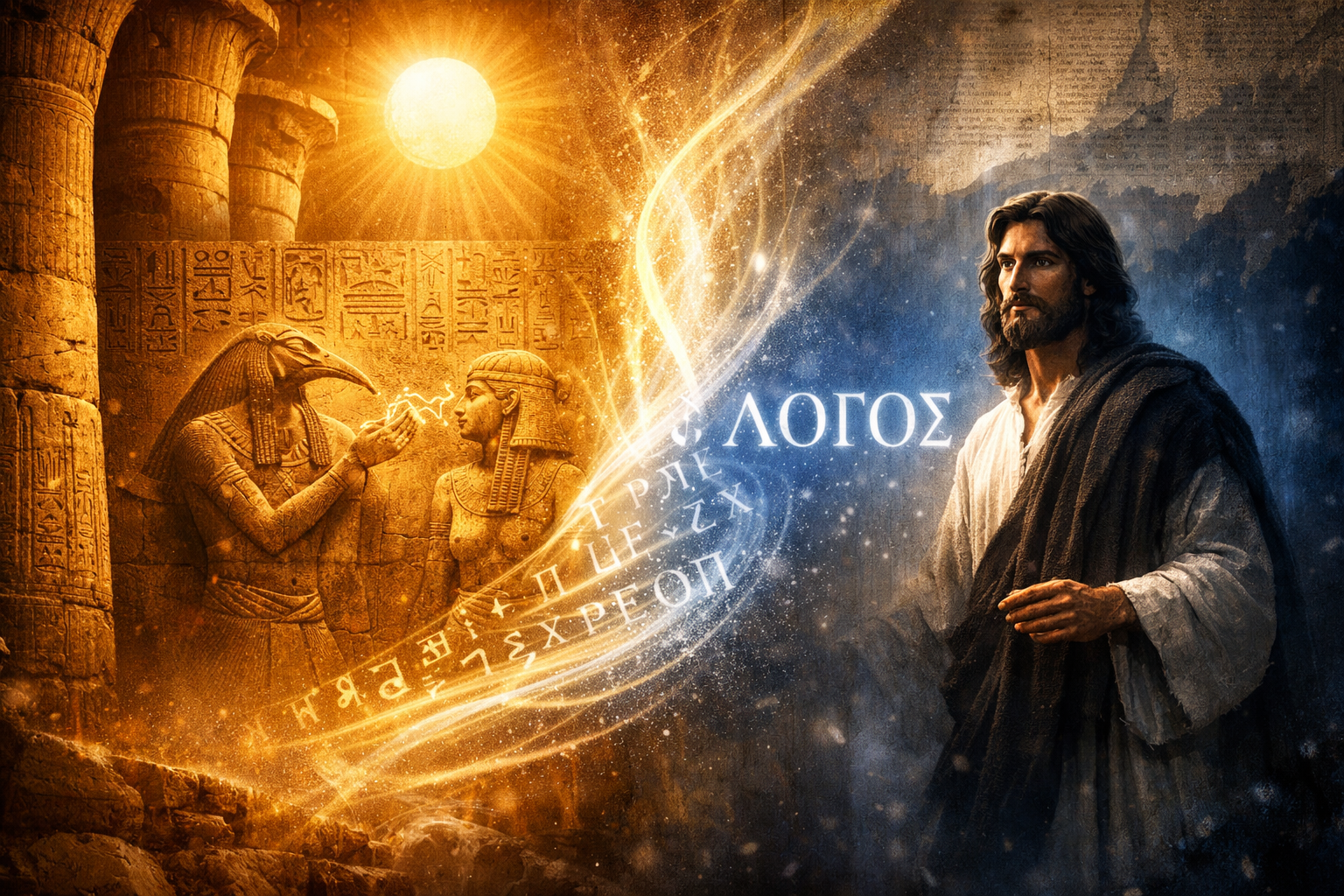
Gerald Massey, in The Historical Jesus and the Mythical-Christ, carefully laid out his case. He separated a possible real person—Jehoshua Ben-Pandira, a teacher mentioned in the Talmud, executed as a sorcerer around 70 BCE or earlier—from the "mythical Christ" described in the Gospels. Massey focused on the virgin birth as one clear link. In Egyptian tradition, this idea appears in temple art long before Christianity. At the Temple of Luxor, built under Pharaoh Amenhotep III in the 18th Dynasty (around 1400 BCE), wall reliefs show a divine conception and birth (something I have already blogged about). The maiden queen Mut-em-ua receives an announcement from the god Thoth (the ibis-headed scribe and herald), then conceives a child who becomes the divine king. These scenes include an annunciation, a miraculous union involving the god Amun, the shaping of the child on a potter's wheel by Khnum, and the birth itself, attended by protective deities.

Massey saw this sequence—annunciation, divine impregnation without ordinary means, shaping of the child, and sacred birth—as a longstanding pattern and blueprint for how the eternal child enters the world through a virgin-like mother (a pattern that cannot arise from ordinary human events but lives in myth and symbol). He argued that the Gospel virgin birth echoes this ancient motif, where the divine enters the world through a pure vessel, untouched by ordinary generation.

Alice Grenfell, in her article "Egyptian Mythology and the Bible" in The Monist, explored other connections, especially around creation and the power of speech. In Genesis, God creates by speaking: "Let there be light," and it happens. Grenfell connected this to the Egyptian idea of maat kheru (or maa kheru), the "true voice" or creative utterance. Gods and the blessed dead wield this power to bring things into existence—light from their eyes, reality from their words. She noted how the goddess Maat, linked to light and truth, represents this creative force. The offering of Maat to a god becomes a ritual of returning reality to its source.

This idea surfaces again in the Gospel of John: "In the beginning was the Word, and the Word was with God... All things were made by him." The Logos as creator through speech feels oddly close to the Egyptian view that naming and speaking aloud turns potential into being. Grenfell even pointed to Joseph's Egyptian name, Zaphnath-paaneah ("The god spoke, and he lives"), as carrying the same tradition of divine voice granting life.

These parallels do not erase the uniqueness of the New Testament account; all of these myths and their sayings carry their own unique essence. Instead, they suggest that when early Christians shaped their story of the Jesus character, they reached for symbols that already carried deep meaning for people familiar with older traditions. The virgin birth, the divine word bringing life, the savior who overcomes death—these motifs had circulated for centuries along the Nile, expressing humanity's hope for something greater than ordinary existence. To re-hash the same mythology in a new way doesn’t make it any more valid or historical, but serves to open our mind to the allegory that has been passed down.

What emerges is a sense of continuity: ancient Egyptians carved their longing for “divine intervention” into stone, and later writers found ways to express a similar longing through the character of Jesus. The story feels both ancient and fresh, rooted in shared human questions about birth, light, and renewal.

Yet these parallels refuse to sit quietly. To what extent did earlier myths shape the telling of the Jesus narrative? If the story emerged from a distinctly Hebrew or Hellenistic Jewish setting, why does it resonate so strongly with motifs far older and geographically distant? What additional strands from Egypt—or other ancient cultures—remain tied to the New Testament? Looking into these questions invites us to see the Gospels not as literal historical reports, but as participants in a much older allegorical dialogue stretching across civilizations. In that light, the Jesus character may function less as a purely biographical construction and more as a literary embodiment of symbolic truths, crafted to convey meaning through the language of myth, theology, and cultural memory.

CLICK: The Myth of the Virgin Birth and Its Allegory Explained

 References

Grenfell, A. (1906). EGYPTIAN MYTHOLOGY AND THE BIBLE. The Monist16(2), 169–200.

Massey, G. (1900). The Historical Jesus and Mythical-Christ.

Sharpe, S. (1863). EGYPTIAN MYTHOLOGY AND EGYPTIAN CHRISTIANITY. In JOHN RUSSELL SMITH. JOHN RUSSELL SMITH.
Paul’s Celestial Christ: Myth or Visionary Revelation?

Was Paul’s vision on the road to Damascus a genuine encounter or a clever reworking of Hebrew narrative to forge religious authority? I ask this question because beneath the surface of Paul’s dramatic conversion lies a subtle mimicry of the Hebrew Scriptures, most strikingly the story of Balaam and his donkey in Numbers 22. This blog post will look at the symbolic layers beneath Paul’s celestial Christ to explore whether Paul’s visionary religion is rooted in authentic revelation or constructed myth.

The Damascus Drama and Balaam’s Vision: A Curious Parallel

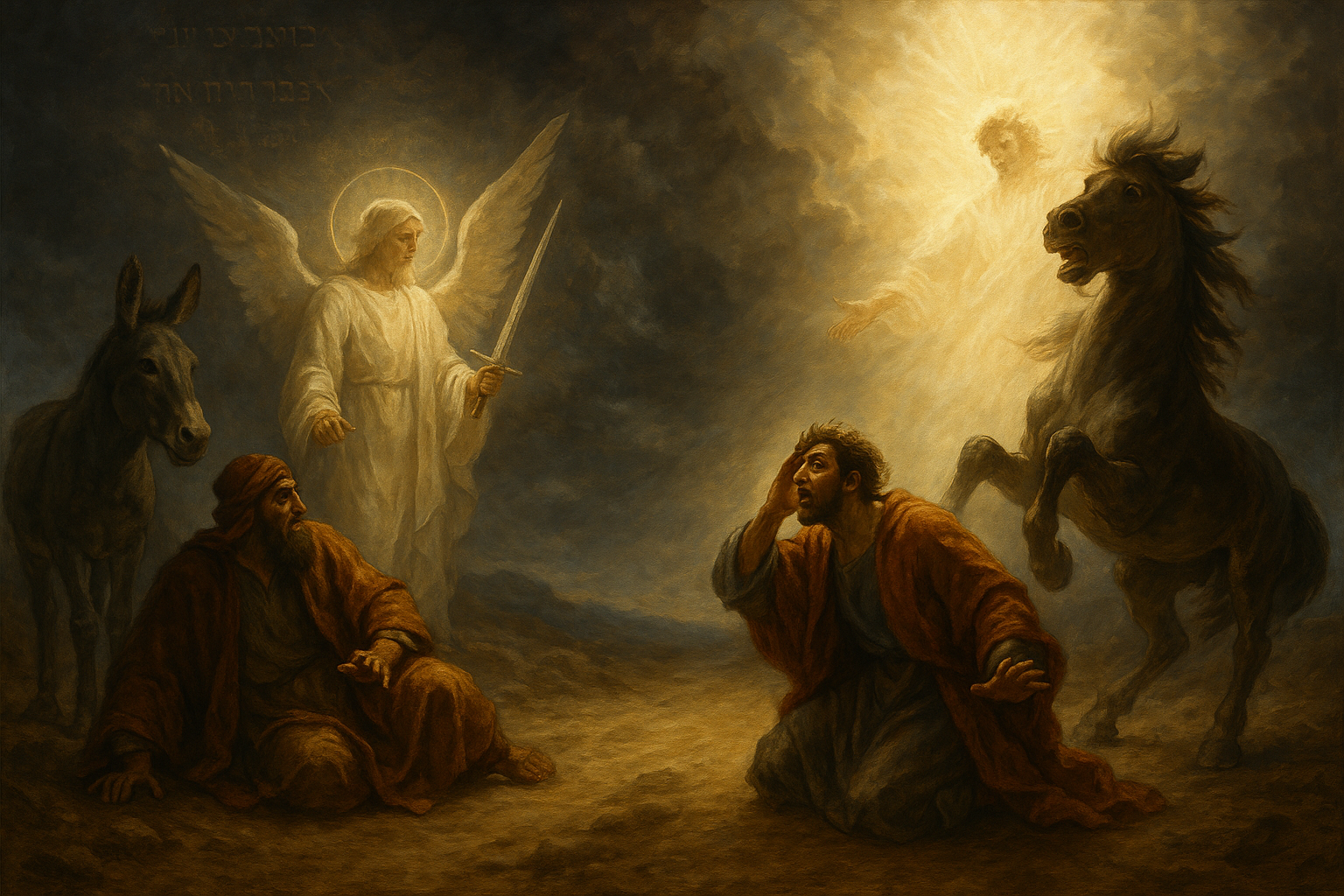
In Acts 9, Saul (later Paul) is dramatically halted while traveling to persecute followers of the Jesus character. He is thrown from his mount, blinded by a celestial light, and hears the voice of a risen Christ (Acts 9:3–5). This foundational story of Paul’s apostleship is eerily reminiscent of Numbers 22, in which Balaam, also journeying on a seemingly divine errand, is stopped by a vision of an angel, unseen by him but visible to his donkey. After being rebuked by both the ass and the angel, Balaam's eyes are opened to the heavenly warning.

What ties these two stories together is not only the structure; a prophetic figure traveling with malicious intent, confronted supernaturally on the road; but also the theological implications. Balaam, though given words from God, is remembered as a false prophet (2 Peter 2:15; Revelation 2:14). If Paul's experience is shaped after Balaam’s (and the author writing the book of Acts does do this), could this be an intentional literary signal suggesting Paul’s revelation is similarly spurious?

Literary Fabrication or Prophetic Fulfillment?

As Maurice Goguel outlines in Jesus the Nazarene: Myth or History?, the early Christian narrative was not formed in a vacuum. Rather, it was steeped in a milieu of prophetic exegesis and creative reworking of Hebrew traditions. The Gospels and Paul’s epistles repeatedly claim that Jesus’ life and death fulfilled Old Testament prophecy, but Goguel cautions that these “fulfillments” may have been discovered after the fact or created to match existing prophetic patterns.

This methodology helps explain the similarities between Paul and Balaam. The author of Acts, likely aiming to authenticate Paul’s apostleship (and to subtly reveal the character of his ministry), mirrors the Balaam narrative, perhaps knowingly. But if Balaam, a non-Israelite seer who sought to curse Israel but was overruled by “divine intervention,” is ultimately judged false, then what does that imply for Paul, whose own vision also contradicts the established leadership of the Jerusalem apostles?

The Celestial Christ: Vision or Invention?

J. Gresham Machen, in The Origin of Paul’s Religion, defends Paul as a genuine recipient of divine revelation. He argues that Paul’s religion was not shaped by paganism or borrowed myth, but by a real encounter with the risen Christ and continuity with the historical Jesus. Yet, Machen concedes that Paul's writings do not focus heavily on Jesus' earthly life, suggesting that Paul's Christ is primarily a celestial being—not a rabbi of Galilee but a divine redeemer whose drama unfolds in the heavens more than on earth.

This celestial emphasis is precisely what gives rise to mythic interpretation. Paul's Christ appears to many as a revealed being, introduced through apocalyptic visions rather than historical witness. There is nothing historical about Paul’s Jesus. Unlike the other apostles who are scripted to have known Jesus in the flesh, Paul boasts, “I did not receive [the gospel] from any man… but by revelation of Jesus Christ” (Galatians 1:12). This bold claim sidesteps the earthly ministry of Jesus and lays apostolic authority on visionary ground alone.

Mythic Constructs and Prophetic Mimicry

There are good reasons to suspect Paul’s Christ is a theological construct more than a historical memory. As Goguel explains, Pauline thought was deeply influenced by mystical concepts of sin, redemption, and divine intermediaries, concepts common not only in Jewish apocalyptic literature but also in surrounding Hellenistic religious thought. His Christ is not merely a messiah; he is a cosmic savior operating beyond time and space.

Goguel identifies the tendency of early Christian authors to create stories that match prophecy, transforming figures like Jesus, and possibly Paul, into eschatological templates. This meshes well with the idea that Paul’s Damascus experience, echoing Balaam’s confrontation, is less about spontaneous revelation and more about literary and theological construction.

Theological Implications: The Mark of a False Prophet?

In Numbers 22, Balaam claims to speak for God, even prophesying truly at times, but his ultimate legacy is one of deceit and seduction. He leads Israel into compromise (Numbers 31:16) and is repeatedly condemned in the New Testament as an archetype of the false teacher.

Why would the author writing the book of Acts have Paul’s conversion echo such a controversial figure?

Some may argue this is coincidental or merely typological. But for those attuned to the literary crafting of biblical narratives, this parallel is troubling. Could Acts be subtly critiquing Paul’s role by embedding him in a Balaam-like framework? Or did later editors overlook the irony, unintentionally exposing the fragility of Paul’s claims?

The Mask Behind the Vision

Paul's celestial Christ, proclaimed through a private vision and divorced from any known “historical Jesus,” bears all the signs of mythic fabrication. When compared to the Old Testament story of Balaam, the similarities are more than poetic; they are prophetic inversions. Balaam was rebuked for claiming divine vision while leading people astray. Paul, claiming his own isolated revelation, introduces a radically new understanding that sidelines the supposed teachings of Jesus and the leadership of those believed to have walked with him.

Whether one sees Paul as a visionary apostle or a reinvented Balaam may depend on one’s theological commitments. But the flow of Numbers 22 within Paul’s narrative should not be ignored. We should be asking whether Paul’s fall from his beast is an act of “divine commissioning,” or a literary confession that, like Balaam, he is a prophet whose mouth may have been opened, but whose message was not rightly “inspired.”

Watch on Youtube

PowerPoint Presentation on the conspiracy behind Paul’s vision (click)

What did Paul actually teach? (click)

Is Paul’s Argument Biblically Legitimate? (click)

References

Goguel, M. (1926). Jesus the Nazarene: Myth or History? New York: D. Appleton & Company.

Machen, J. G. (1925). The Origin of Paul’s Religion. Grand Rapids: Wm. B. Eerdmans Publishing Company.