
Egypt's Influence on Christianity

Was Jesus a Rewritten Egyptian Savior?

The story of Jesus in the New Testament does oddly capture attention—a man of compassion, who heals, teaches, dies, and rises again, bringing a message of hope and renewal. Yet older writings from over a century ago reveal something intriguing: many elements in this account seem to mirror ideas and images from Egyptian mythology, as if the Gospel writers drew from a much older stream of human imagination about its divine figure and salvation.

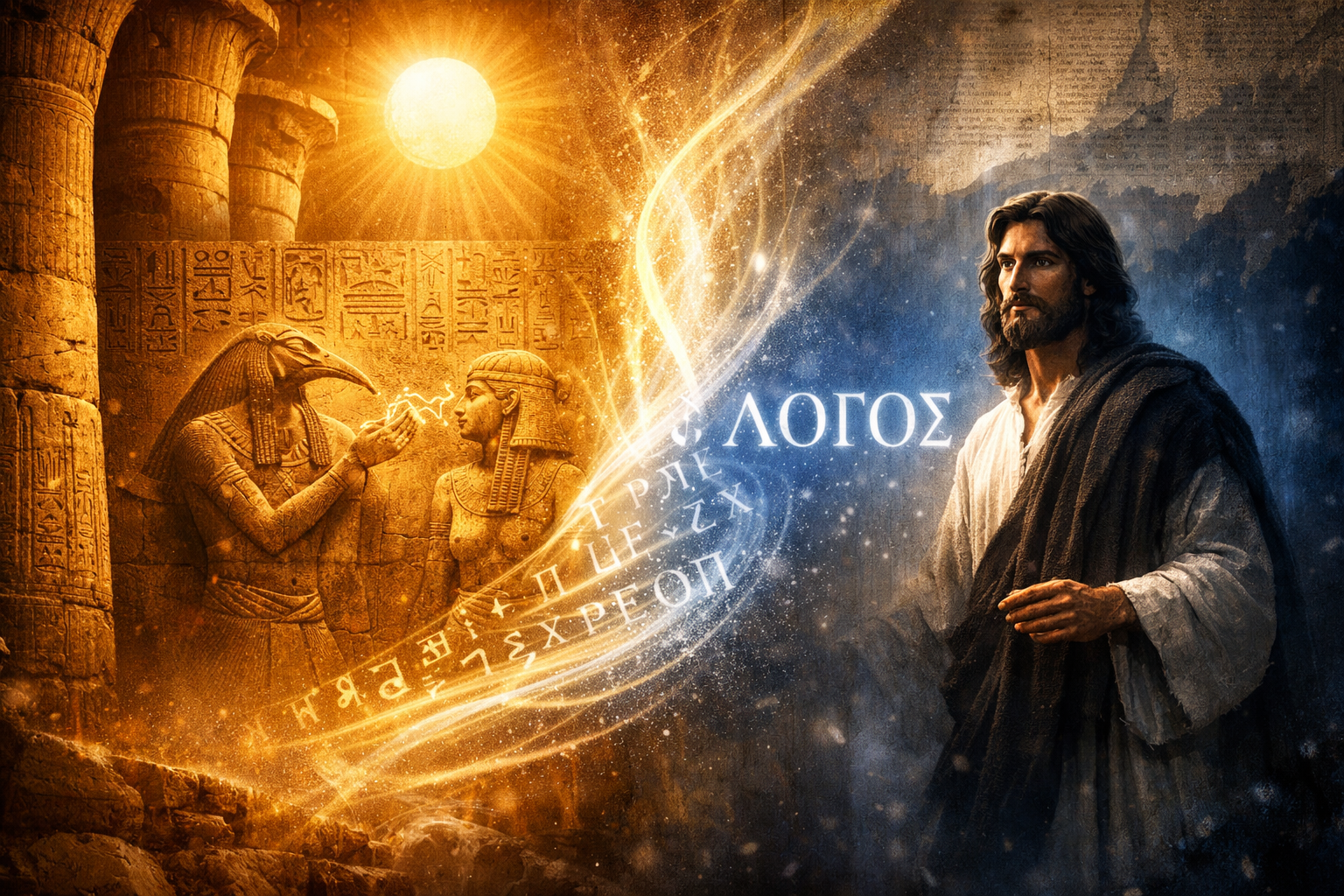
Gerald Massey, in The Historical Jesus and the Mythical-Christ, carefully laid out his case. He separated a possible real person—Jehoshua Ben-Pandira, a teacher mentioned in the Talmud, executed as a sorcerer around 70 BCE or earlier—from the "mythical Christ" described in the Gospels. Massey focused on the virgin birth as one clear link. In Egyptian tradition, this idea appears in temple art long before Christianity. At the Temple of Luxor, built under Pharaoh Amenhotep III in the 18th Dynasty (around 1400 BCE), wall reliefs show a divine conception and birth (something I have already blogged about). The maiden queen Mut-em-ua receives an announcement from the god Thoth (the ibis-headed scribe and herald), then conceives a child who becomes the divine king. These scenes include an annunciation, a miraculous union involving the god Amun, the shaping of the child on a potter's wheel by Khnum, and the birth itself, attended by protective deities.

Massey saw this sequence—annunciation, divine impregnation without ordinary means, shaping of the child, and sacred birth—as a longstanding pattern and blueprint for how the eternal child enters the world through a virgin-like mother (a pattern that cannot arise from ordinary human events but lives in myth and symbol). He argued that the Gospel virgin birth echoes this ancient motif, where the divine enters the world through a pure vessel, untouched by ordinary generation.

Alice Grenfell, in her article "Egyptian Mythology and the Bible" in The Monist, explored other connections, especially around creation and the power of speech. In Genesis, God creates by speaking: "Let there be light," and it happens. Grenfell connected this to the Egyptian idea of maat kheru (or maa kheru), the "true voice" or creative utterance. Gods and the blessed dead wield this power to bring things into existence—light from their eyes, reality from their words. She noted how the goddess Maat, linked to light and truth, represents this creative force. The offering of Maat to a god becomes a ritual of returning reality to its source.

This idea surfaces again in the Gospel of John: "In the beginning was the Word, and the Word was with God... All things were made by him." The Logos as creator through speech feels oddly close to the Egyptian view that naming and speaking aloud turns potential into being. Grenfell even pointed to Joseph's Egyptian name, Zaphnath-paaneah ("The god spoke, and he lives"), as carrying the same tradition of divine voice granting life.

These parallels do not erase the uniqueness of the New Testament account; all of these myths and their sayings carry their own unique essence. Instead, they suggest that when early Christians shaped their story of the Jesus character, they reached for symbols that already carried deep meaning for people familiar with older traditions. The virgin birth, the divine word bringing life, the savior who overcomes death—these motifs had circulated for centuries along the Nile, expressing humanity's hope for something greater than ordinary existence. To re-hash the same mythology in a new way doesn’t make it any more valid or historical, but serves to open our mind to the allegory that has been passed down.

What emerges is a sense of continuity: ancient Egyptians carved their longing for “divine intervention” into stone, and later writers found ways to express a similar longing through the character of Jesus. The story feels both ancient and fresh, rooted in shared human questions about birth, light, and renewal.

Yet these parallels refuse to sit quietly. To what extent did earlier myths shape the telling of the Jesus narrative? If the story emerged from a distinctly Hebrew or Hellenistic Jewish setting, why does it resonate so strongly with motifs far older and geographically distant? What additional strands from Egypt—or other ancient cultures—remain tied to the New Testament? Looking into these questions invites us to see the Gospels not as literal historical reports, but as participants in a much older allegorical dialogue stretching across civilizations. In that light, the Jesus character may function less as a purely biographical construction and more as a literary embodiment of symbolic truths, crafted to convey meaning through the language of myth, theology, and cultural memory.

CLICK: The Myth of the Virgin Birth and Its Allegory Explained

 References

Grenfell, A. (1906). EGYPTIAN MYTHOLOGY AND THE BIBLE. The Monist16(2), 169–200.

Massey, G. (1900). The Historical Jesus and Mythical-Christ.

Sharpe, S. (1863). EGYPTIAN MYTHOLOGY AND EGYPTIAN CHRISTIANITY. In JOHN RUSSELL SMITH. JOHN RUSSELL SMITH.

Shu and the Logos: Ancient Egypt's Influence on Christianity

The idea of a divine mediator—a figure who bridges the gap between God and humanity or between cosmic elements like the sky and earth—has been a cornerstone of spirituality across cultures. From the ancient Egyptian god Shu to the Greek Logos and finally to Jesus Christ in Christianity, this archetype evolves but retains its essence. In this post, we explore how Shu and the Logos fulfill similar roles as divine mediators, tracing their philosophical and theological connections and uncovering Egypt's ultimate influence on Christianity.

What is the Logos?

In Greek philosophy, the Logos (“Word” or “Reason”) is the rational principle that orders the cosmos and connects divine thought to the material world. First introduced by Heraclitus, the Logos was later refined by Stoic philosophers and the Hellenistic tradition. It represents harmony and mediation between extremes, such as unity and multiplicity. Early Christians adopted this concept, most notably in the Gospel of John, where Jesus is described as the Logos: “In the beginning was the Word, and the Word was with God, and the Word was God” (John 1:1).

As the Logos, Jesus is scripted as being more than a teacher or prophet. He embodies divine wisdom and serves as the ultimate bridge between “God” and “humanity,” revealing the spiritual “truth” that underlie the universe.

Shu: The Firstborn Son and Cosmic Mediator of Ancient Egypt

Long before the Logos entered philosophical discourse, the ancient Egyptian god Shu held a strikingly similar role. Shu, the firstborn son of the creator god Atum, is the mediator who separates Nut (the sky) from Geb (the earth). This act of separation creates space for life to flourish, making Shu essential to cosmic order.

According to the Pyramid Texts, Shu embodies the essence (kA) of Atum. He is both the divine extension of his father and the force that sustains harmony in creation. Shu’s creation is steeped in symbolic language; Atum “sneezed” Shu into existence, imbuing him with divine life. This imagery underscores Shu’s intimate connection to his father’s creative power, much like the Logos emanates directly from God.

How Shu and the Logos Compare: The Role of the Divine Son

Both Shu and the Logos fulfill the archetype of the divine mediator, sharing remarkable parallels:

  • Sonship: Shu is the firstborn of Atum, while the Logos is described as the “only begotten Son” of God in Christian theology.

  • Mediation: Shu separates and connects the sky and earth, maintaining cosmic balance. The Logos mediates between God and humanity, bringing divine order to the world.

  • Essence: Shu embodies the kA, or essence, of Atum. Similarly, the Logos is the “Word” of God, embodying divine wisdom and will.

  • Creation and Sustenance: Both figures are integral to the act of creation and its ongoing maintenance. Shu sustains the physical cosmos, while the Logos sustains the spiritual and moral order.

From Shu to the Logos to Jesus: The Origins of the Divine Mediator

The transition from Shu to the Logos highlights how ancient Egyptian theology influenced Greek and early Christian thought. Hellenistic Alexandria, a cultural melting pot, facilitated the synthesis of Egyptian cosmogonies with Greek metaphysical ideas. The result was a more abstract concept of divine mediation that early Christians incorporated into their theology.

Jesus’ identification as the Logos in the Gospel of John echoes Shu’s role in Egyptian mythology. Just as Shu’s essence (kA) flows from Atum, Jesus, as the Logos, proceeds from the Father. Both figures symbolize a “divine” presence that connects heaven and earth, ensuring harmony and balance.

Egypt’s Influence on Christianity and the Logos Concept

The influence of Egyptian thought on Christianity is often overlooked, but its significance is undeniable. Heliopolitan cosmology, with its emphasis on divine mediation, provided a framework that later informed Greek philosophy and, ultimately, Christian theology. The parallels between Shu and the Logos suggest a shared archetype that transcends cultural boundaries, reflecting humanity’s universal quest to understand the supposedly divine.

In adopting the Logos concept, early Christians drew upon an already existing heritage of philosophical and theological ideas. The Logos—as scripted within Jesus Christ—represents a culmination of these traditions, uniting Egyptian, Greek, and Jewish influences into a single, transformative character.

A Universal Archetype of Divine Mediation

Shu and the Logos reveal a shared vision of the divine mediator across cultures. From Shu’s cosmic embrace to Jesus’ incarnation as the Logos, these characters embody humanity’s desire to bridge the gap between the earthly and what is thought to be divine. Their stories remind us that the quest for connection and harmony is as old as civilization itself, or is as the Preacher says, “There’s nothing new under the sun” (Ecclesiastes 1:9).


 References

Popielska-Grzybowska, J. (2013). Atum and Son: Some Remarks on Egyptian Concept of Eternity. Études et Travaux26, 537-546.

Fideler, D. (1993). Jesus Christ, Sun of God: Ancient Cosmology and Early Christian Symbolism. Quest Books.