
Philosophy

If Jesus Was Not Preaching Christianity, What Was He Actually Doing?

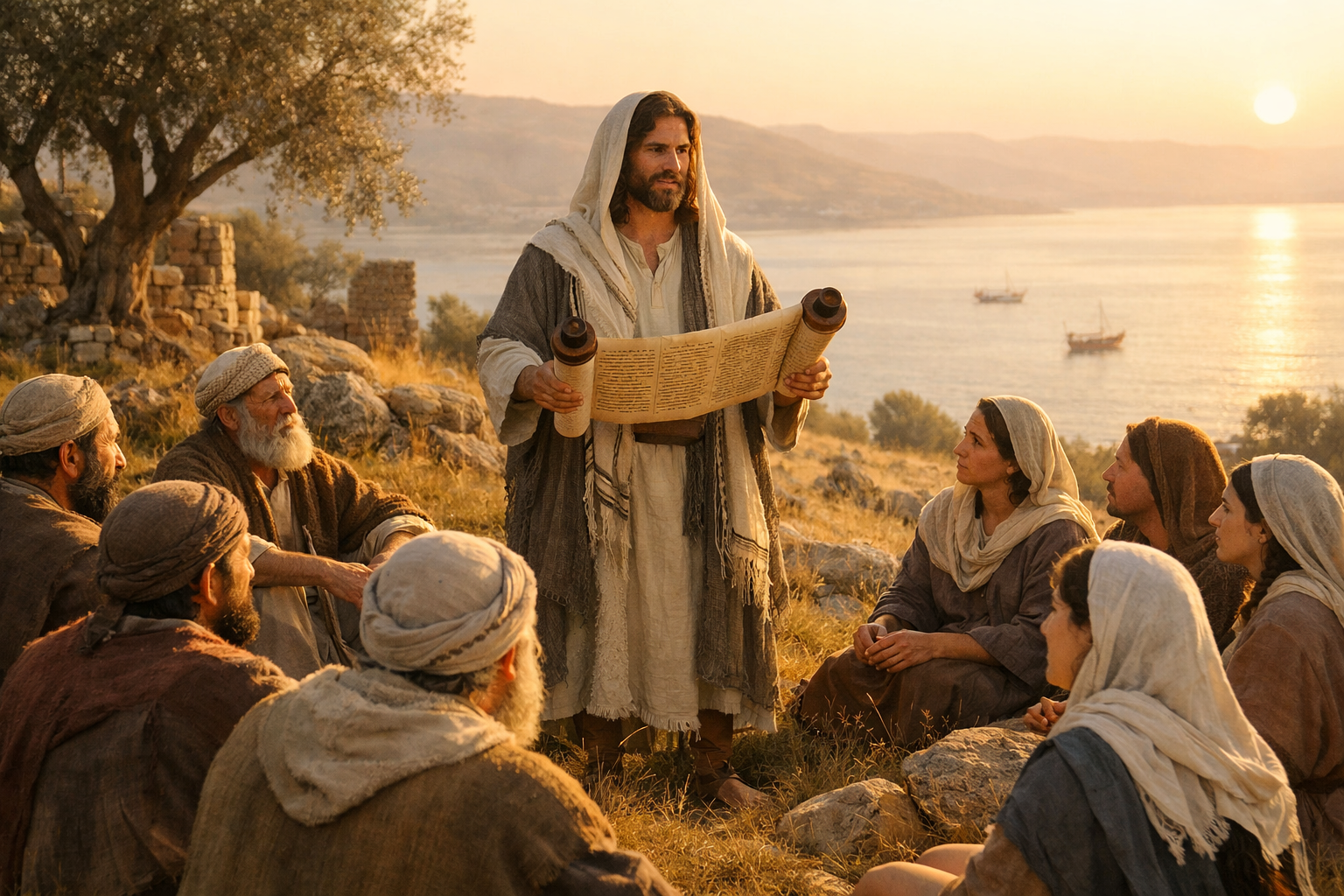
In the quiet hills of Galilee, a teacher of Hebrew religious philosophy gathers crowds by the sea, speaking of a kingdom not built by human hands but breaking forth like dawn within the human heart. He quotes the ancient prophets, restores vision to minds, and challenges the priesthood; not to overthrow the faith of his ancestors, but to awaken it from within.

What if the Jesus we think we understand was not founding a new religion called “Christianity,” but calling his people back to the deepest promise of their own covenant with their Deity?

The imagined historical Jesus was deeply embedded in the age’s Hellenistic Judaism, but what he taught diverged in fascinating ways from the dominant religious currents of his time (and from the Christianity that later falsely developed around his memory). When actually comprehending the character beyond and yet hidden within the Jesus character, one finds that he operated firmly within Hebrew covenantal and Torah frameworks, yet with a distinctive emphasis that prioritized inner transformation over ritualistic debates.

Thomas Kazen carefully traces how Jesus engaged the Torah (the sacred instruction of Israel) not as an unyielding legal code demanding endless refinement, but as living guidance that points toward mercy, justice, and inner rightness (Kazen, n.d.). In the Gospels, Jesus affirms the Torah’s enduring place while consistently elevating its “weightier matters” over ritual details. His disputes with religious leaders were not attempts to abolish the law, but prophetic calls to embody its true spirit in an age when legal interpretation was still fluid and open to renewal.

Tom Holmén sharpens this picture by turning our attention to the covenant itself (the foundational belief in the Hebrew God’s unique relationship with Israel that both unified and divided its communities in the first century) (Holmén, 2004). Across the diverse “Judaisms” of the time, people engaged in fervent “covenant path searching,” debating how best to remain faithful through observance and practice. Strikingly, Jesus stands apart from this anxious quest. He does not join the widespread effort to define covenant loyalty through competing halakic frameworks. Instead, Holmén suggests, Jesus embodies the eschatological vision of prophets like Jeremiah: a coming covenant in which his God’s will is written directly on the heart, making external striving unnecessary; an inner knowing that renders the search for the right path obsolete.

Here the insights of Kazen and Holmén begin to resonate as one voice: the imagined historical Jesus interprets the Torah prophetically and steps back from covenantal debates not out of indifference, but because he lives and teaches as though the promised renewal has already begun.

In my book, “The Dawn of Devotion,” I carry the harmony of Kazen and Holmén into bolder, philosophical territory (Jackson, 2024). I dissect the story of Jesus as the dramatic enactment of a devotional shift: the crucifixion not as a literal payment for sin, but as the symbolic death to an “old conversation” (a mindset chained to external ordinances and handwritten rules). In its place rises “Immanuel,” the philosophy of “God-with-us” as an inward reality, a wisdom that purges the conscience and liberates from the very strength of sin that external law unwittingly amplifies. This, I do argue and prove from the scriptures, fulfills the ancient promise of a law no longer imposed from without, but alive within the personal and the devotional spirit.

When observing the imagined historical Jesus from a purely philosophical point of view, a quiet yet meaningful dialogue emerges. Kazen shows us a Jesus who honors the Torah yet prioritizes its heart. Holmén reveals a teacher who bypasses the era’s covenantal anxieties because he trusts the prophetic future breaking into the present. I dare us to see the cross itself as the sacrifice of an outdated religious mindset, making way for direct, transformative communion with the living God.

The mindful revelation that emerges is both simple and revolutionary: the Jesus we imagine (but are falsely unaware of) was not preaching the birth of Christianity as a separate faith. He was renewing Hebrew religious philosophy from its deepest roots, proclaiming that the long-awaited “kingdom” arrives not through perfected observance or institutional reform, but through hearts transformed by God’s own presence. His message was not “leave the old behind,” but “enter the old more deeply, for its fulfillment is here.”

What if the real revolution was not starting a new religion, but awakening an ancient one to its own radical promise without religion? Maybe perhaps the truest inheritance “Jesus” left is not a new religion to defend, but an ancient invitation renewed: to let go of anxious religious striving and trust the quiet voice writing love, mercy, and justice on the soul of one’s devotional conscience.

References

Holmén, T. (2004). Jesus, Judaism and the covenant. Journal for the Study of the Historical Jesus, 2(1), 3–27.

Jackson, L., Jr. (2024). The Dawn of Devotion: A Sacrifice for Devotional Evolution. Brilliant Publishing, LLC.

Kazen, T. (n.d.). Jesus’ interpretation of the Torah [Pre-publication English version]. Manuscript for Jesus Handbuch.


What Is the Kingdom of God Really Like: An Inner Journey to True Victory

A few months ago, I lightly explored this question, and today I'm returning to it because it still feels absolutely relevant: What is the Kingdom of God?

It's not a literal kingdom with borders and thrones. Instead, it's a living spiritual service—a devotional experience unfolding right now in the quiet space of your inner thoughts, feelings, and prayers. Here, the wisdom found in Scripture takes center stage, guiding you beyond traditional religious ideas and denominational theories into a higher, purely inward experience. You step away from the external world of religion and let the Bible’s Mind speak directly, free from human ego or control.

What does this Kingdom feel like? It's like one person gently consoling another after a profound loss. In that moment of shared grief, empathy flows, healing begins, and strength slowly returns. The Kingdom (a mental experience) meets us in our spiritual losses, like outdated beliefs or empty traditions, and offers the comfort that leads to true devotional recovery.

It's also like a brave warrior stepping out of intense battle, victorious and now bearing a respected new title. Your inner devotional self engages in a real struggle against old religious pride, doubt, and habits. With courage, it fights through, emerges refined and humbled, and receives a fresh name, an identity that truly reflects its individual purpose and character.

This process transforms your entire inner dialogue. Just as a warrior earns a name through victory, your thoughts wrestle with themselves under Scripture's guidance, shedding pride to embrace humility. The result? A regenerated devotional life with clear direction: a personal mission, a unique identity, and a way to benefit others.

Scripture calls us to a more authentic devotional life, one where we personally consecrate ourselves to the Bible’s living wisdom. Only by personally carrying our faith's weaknesses and letting Scripture refine them do we find true blessing. Herein Abraham becomes our example: not literally, but spiritually and psychologically. Stepping away from religious crowds and theories to meet our faith alone shows the highest virtue, because only in that quiet space can the Bible’s wisdom fully impact us.

This solitude feels like a wilderness at first; dry, confusing, even painful. Church no longer satisfies, familiar teachings fall flat, and you might feel lost or angry, wondering if something's gone wrong. You've been let down by human-centered religion, and the loss hurts. But Scripture promises this solitary way is actually the right way (Psalm 107). The wilderness won't stay barren; it will rejoice and bloom if you stay within the Bible’s guiding principle.

With courage; like that victorious warrior; you press on. Confusion turns to clarity as the Bible’s words revive your inner devotional life, regenerating your thoughts and justifying your existence with a new name and purpose. This is the living God’s loving kindness: the ongoing service that resurrects your spirit, matures your humanity, and orders your inner world. As Psalm 50 says, those who order their conversation rightly will see the intended salvation.

The Kingdom of God is this present reality: a nurturing mental and inward gift through the Bible’s words for any willing heart. It starts with accepting that something feels off in your spiritual life, then courageously turning alone to Scripture for fact. Don't take this seemingly empty period of your life for granted. Embrace the solitude and discover the living, transformative power waiting within your devotional conversation.

How the Bible's Spiritual Kindness Comforts

Scripture offers key promises that invite deep reflection. Luke 2:14 declares, "...and on earth peace, good will toward men," suggesting a peculiar cosmic intent for harmony and benevolence toward humanity.

Jeremiah 29:11 further emphasizes this: "For I know the thoughts that I think toward you, saith the LORD, thoughts of peace, and not of evil, to give you an expected end." This passage highlights a purposeful cosmic plan centered on inward tranquility.

Isaiah 66:13 evokes a nurturing image: "As one whom his mother comforteth, so will I comfort you."

Together, these verses portray a compassionate living Mind over the individual and extending solace when needed.

The Challenge of Understanding Spiritual Fulfillment

While many who study the Bible know these passages, their deeper meaning can be elusive. John 4:24 states that "God is a Spirit," and Luke 24:39 clarifies that "a spirit hath not flesh and bones." This non-physical nature of “God” raises questions: How can an incorporeal Being provide tangible comfort, peace, or good will in a realistic way?

Consider these questions: How does a spirit, without a body, offer consistent human-like comfort? What kind of good will comes from an entity outside of humanity? Can peace stem from a source that doesn’t ultimately experience it physically? What thoughts can a non-physical being have for those bound by flesh?  

Often, interpretations lean on inherited teachings or cultural assumptions rather than the Bible’s own logic. Without grounding in its context, one might drift into speculation, forming beliefs that stray from its intent. This risks misrepresenting the "peace" and "good will" a spiritual (no-flesh-having) “God” provides.

How Does Such a God Provide Comfort?

This leads to a central question: If God is Spirit, and if a spirit does not have flesh and bones, how can or does a spirit comfort? Without a physical form, this Being’s comfort cannot rely on physical means. While traditional theology offers various answers drawn from various ecclesiastical perspectives, the Bible itself points to one solution.

 The answer is "righteousness"; not ritualistic practice, but a certain type of kindness. Titus 3:4 describes this as "the kindness and love of God our Saviour toward man." Titus 3:5 elaborates: "Not by works of righteousness which we have done, but according to his mercy he saved us, by the washing of regeneration, and renewing of the Holy Ghost."

It is through the regenerating of what is within, or the cleansing of what is within, that this living Mind comforts. In other words, that comfort is manifested as one executes the saying, “Acquaint now thyself with him, and be at peace...Receive...from his mouth, and lay up his words in thine heart” (Job 22:21,22).

Two Forms of Righteousness in Scripture

The Bible presents "righteousness" in two contrasting ways, each with significant implications for spiritual or devotional freedom.

The first is a rigid adherence to handwritten religious rules. This form of righteousness binds individuals to external dictates, suppressing genuine devotion and personal freedom. We learn about this from how it says, “That except your righteousness shall exceed the righteousness of the scribes and Pharisees, ye shall in no case enter into the kingdom of heaven” (Matthew 5:20). Beauty from religious law is the first form of “righteousness,” and this form is false.

In contrast, the manner of righteousness within the Hebrew Scriptures restores freedom. It liberates the conversation’s inner dialogue from external constraints, granting autonomy in thought, emotion, action, and behavior. This aligns with Isaiah 61:1: "To proclaim liberty to the captives." Here, “righteousness” is not obligation but emancipating grace, in that one says, “Create in me a clean heart, O God; and renew a right spirit within me” (Psalm 51:10).

The Gospel: Liberty Through Kindness

The gospel, or "good news," is often misunderstood as a call to emulate, whether by ritual or by religious law, a divine literary figure’s nature. Instead, Scripture frames it as a "good will,” a kindness aimed not really at individuals, but at their inner devotional culture. This liberation from false devotion is the essence of the Bible’s philosophy, which consistently states, “...through knowledge shall the just be delivered” (Proverbs 11:9).

By viewing the Bible in its cultural and philosophical context, one can pursue its intended peace, comfort, and good will. Our experiences extend beyond traditional teachings or assumed knowledge. Religious systems often shape our spiritual lens, obscuring the deeper reality. The "expected end" promised in Jeremiah 29:11 is freedom from these doctrinal constraints to personally know the character of the Bible’s Mind, encouraging a devotion reflecting its kind will for our personal and devotional self. When studying Scripture, this pursuit of authentic “righteousness” should guide our focus, leading to true spiritual fulfillment.