In the previous post we stepped into “the experiment”: what happens when we let the Scriptures themselves do the primary work of softening without the dominant “work” of a completed cosmic transaction? The inquiry lingers because the voices do not easily harmonize. Beneath the surface piety lies a real philosophical fork in the road regarding the nature of grace, the human self, and the location of the kingdom.
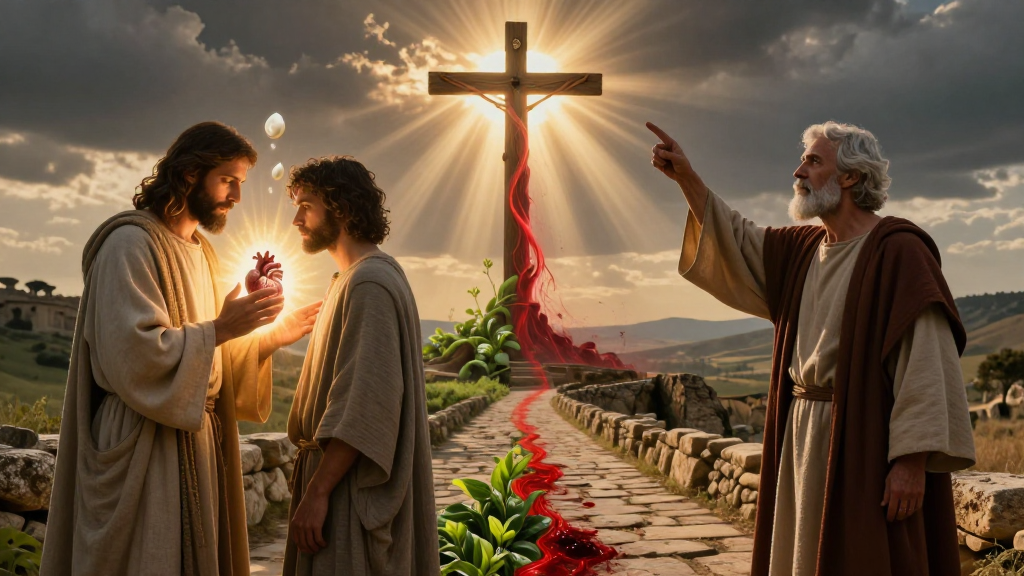
At the center stands a stark difference in how the Jesus character and the character Paul locate the path into “life” and “the kingdom.”
Jesus insists: “Not everyone who says to Me, ‘Lord, Lord,’ will enter the kingdom of heaven, but he who does the will of My Father in heaven” (Matthew 7:21). When asked directly about inheriting eternal life, the response is unadorned: “If you want to enter into life, keep the commandments” (Matthew 19:17).
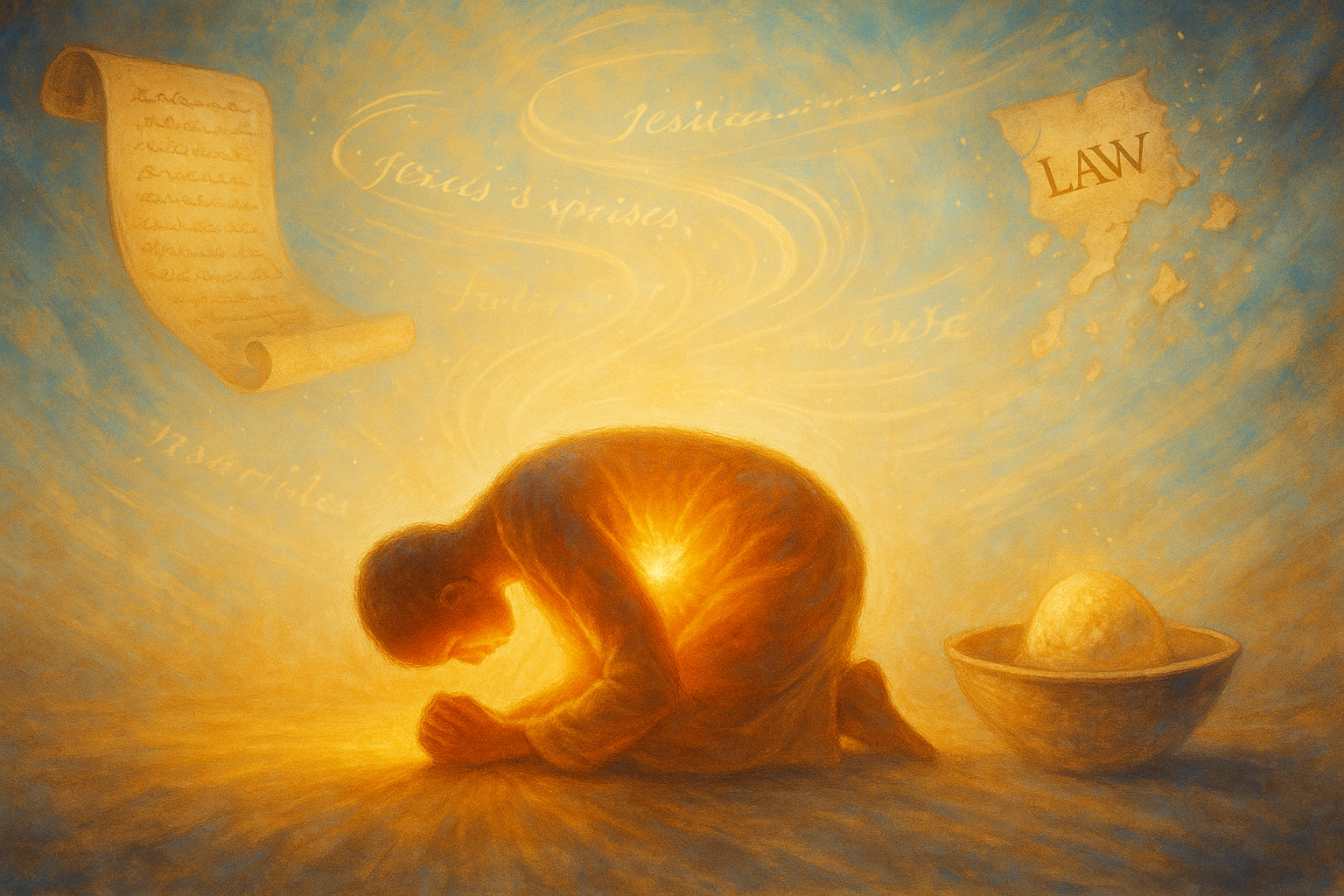
Faith appears as, “Have faith in God” (Mark 11:22), a trust that orients the whole self toward this Father’s character. The will of the Father is not framed as intellectual assent to a dying-and-rising transaction. It is active alignment that cultivates inward growth, higher spiritual consciousness, and the betterment of the devotional self. The kingdom is yeast, seed, light, something that operates presently within surrendered reality. Commands are not a trapdoor to despair; they are the shaping mirror or instruments of a heart being rewritten.
Paul charts a different course. Justification comes to the one who “does not work but believes in him who justifies the ungodly” (Romans 4:5). “By the works of the law no one will be justified” (Romans 3:20; Galatians 2:16). The drama centers on an external, forensic reality: a righteousness not our own, secured by a cosmic transaction. The self finds rest outside itself, in the accepted sacrifice rather than in the gradual congruence of its own transformed desires.
This is not a minor interpretive disagreement. It is a philosophical divergence about the mechanics of redemption and the nature of the self before “God.”
The Anthropology at Stake
The Jesus character’s emphasis implies a higher view of human participatory capacity under divine tutelage. The self is not irreparably helpless in its stony condition; the inscription of the law on the heart (Jeremiah 31, Ezekiel 36) envisions genuine internal renovation. Commandment-keeping and faith in God become synergistic forces that develop spiritual consciousness. The self can; slowly, painfully, honestly; become more. The goal is not just pardon but likeness. The Beatitudes and Sermon on the Mount read as descriptive of a heart already under transformation rather than an impossible bar set to drive us elsewhere.
Paul’s framework, by contrast, protects the self from any illusion of self-contribution by locating righteousness entirely outside. The human agent is declared whole while remaining, in a fundamental sense, the ungodly one. This offers powerful relief to the tormented conscience but raises questions about the telos of redemption. If the primary good news is a legal verdict (and Paul holds himself to be again any religiously legal thing), does the inward work of becoming remain secondary or even optional? Does the philosophical weight placed on “apart from works” subtly devalue the very transformation the prophets placed at the center of the new covenant?
Grace: Gift as Transaction or Gift as Inscription?
Philosophically, both claim grace, yet the shape differs. In the Jesus trajectory, grace is the Father’s willingness to write, teach, and indwell through the words and Spirit of Scripture. It empowers participation. The self is not bypassed but engaged, judged, healed, and elevated. Obedience is not the enemy of grace but the evidence that grace is successfully rewriting desire.
In the Pauline system, grace is most purely seen in the unmerited cosmic transaction. Any subsequent transformation risks threatening the purity of “faith apart from works.” The gravitational pull of this logic has proven powerful in Western Christianity: it provides immediate assurance untethered from messy interiority. Yet it can also externalize the kingdom, tilting heavily toward “not yet,” with the cross as down-payment on a ledger in heaven rather than a present, growing reality within.
The Jesus character refuses this postponement. The kingdom is “within you.” The words themselves are “spirit and life.” Transformation is not a secondary fruit but the very substance of salvation as presented in the Gospels.
The Deeper Tension
We must ask uncomfortable questions. If Jesus consistently points to doing the Father’s will as the decisive factor, and defines that will in terms of a commandment-shaped life rather than reliance on a blood transaction centered on himself, what does this reveal about the later apostolic reframing? Is Paul’s genius a necessary pastoral accommodation for tormented consciences, or does it represent a philosophical shift toward a more Hellenistic, transactional cosmology, one that imports categories of cosmic law-court and substitution that the Hebrew Scriptures and the Jesus character himself foreground less prominently?
Conversely, does the inward path risk a naive optimism about human self-deception? The prophets and Jesus certainly warned against it, which is why the words of the Bible themselves remain the relentless examiner, indeed sharper than any external declaration.
The philosophical divide ultimately concerns the character of “God” and the dignity of the self. Is God most glorified by a system that secures a verdict independent of our becoming, or by a process that invites the self into real, participatory congruence with his love and manner of learning? Does “divine love” express itself most fully in a completed external machinery, or in the patient, sometimes agonizing work of making stony hearts flesh?
We do not resolve apostolic tensions by forcing premature harmony. Nor do we honor the Jesus character by domesticating his emphasis to fit later frameworks. The experiment remains: what fruit emerges when we let the clearer voice of the Scriptures set the primary orientation? When the kingdom (a mental and inward experience) is sought first as an internal reality shaped by the Father’s will; commandments internalized, faith in God enacted, spiritual consciousness deepened; does the self become more alive, more compassionate, more whole? Or does the gravitational comfort of external transaction continue to win by default because it asks less of us?
This inquiry does not politely dissolve. It presses deeper: What if the path to life really is narrower and more intimate than a transaction can contain? What if the kingdom has always been closer than we allowed ourselves to believe, even within reach of a heart willing to be rewritten, one honest encounter with the Bible’s words at a time?