
Philosophy

Paul’s Celestial Christ: Myth or Visionary Revelation?

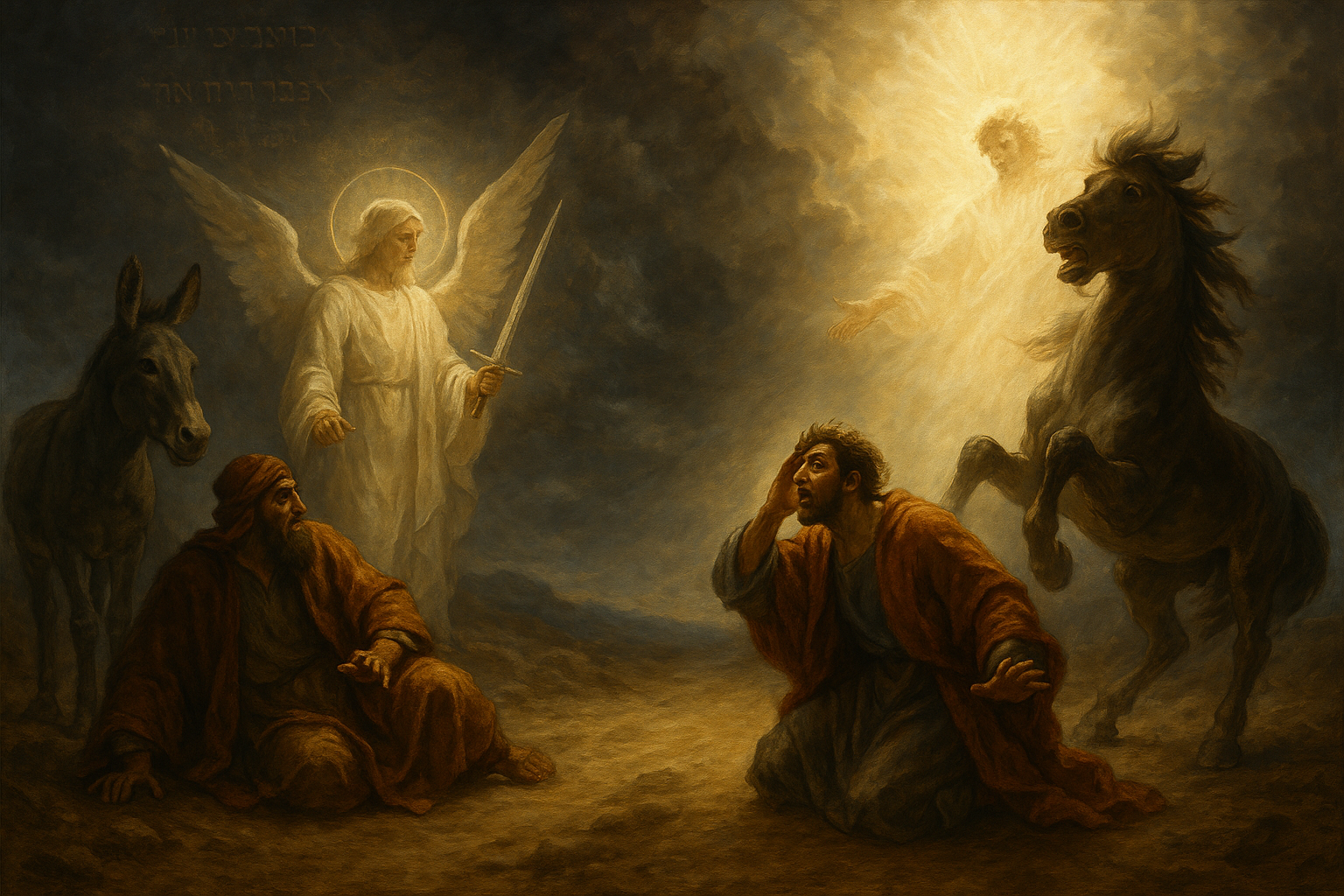
Was Paul’s vision on the road to Damascus a genuine encounter or a clever reworking of Hebrew narrative to forge religious authority? I ask this question because beneath the surface of Paul’s dramatic conversion lies a subtle mimicry of the Hebrew Scriptures, most strikingly the story of Balaam and his donkey in Numbers 22. This blog post will look at the symbolic layers beneath Paul’s celestial Christ to explore whether Paul’s visionary religion is rooted in authentic revelation or constructed myth.

The Damascus Drama and Balaam’s Vision: A Curious Parallel

In Acts 9, Saul (later Paul) is dramatically halted while traveling to persecute followers of the Jesus character. He is thrown from his mount, blinded by a celestial light, and hears the voice of a risen Christ (Acts 9:3–5). This foundational story of Paul’s apostleship is eerily reminiscent of Numbers 22, in which Balaam, also journeying on a seemingly divine errand, is stopped by a vision of an angel, unseen by him but visible to his donkey. After being rebuked by both the ass and the angel, Balaam's eyes are opened to the heavenly warning.

What ties these two stories together is not only the structure; a prophetic figure traveling with malicious intent, confronted supernaturally on the road; but also the theological implications. Balaam, though given words from God, is remembered as a false prophet (2 Peter 2:15; Revelation 2:14). If Paul's experience is shaped after Balaam’s (and the author writing the book of Acts does do this), could this be an intentional literary signal suggesting Paul’s revelation is similarly spurious?

Literary Fabrication or Prophetic Fulfillment?

As Maurice Goguel outlines in Jesus the Nazarene: Myth or History?, the early Christian narrative was not formed in a vacuum. Rather, it was steeped in a milieu of prophetic exegesis and creative reworking of Hebrew traditions. The Gospels and Paul’s epistles repeatedly claim that Jesus’ life and death fulfilled Old Testament prophecy, but Goguel cautions that these “fulfillments” may have been discovered after the fact or created to match existing prophetic patterns.

This methodology helps explain the similarities between Paul and Balaam. The author of Acts, likely aiming to authenticate Paul’s apostleship (and to subtly reveal the character of his ministry), mirrors the Balaam narrative, perhaps knowingly. But if Balaam, a non-Israelite seer who sought to curse Israel but was overruled by “divine intervention,” is ultimately judged false, then what does that imply for Paul, whose own vision also contradicts the established leadership of the Jerusalem apostles?

The Celestial Christ: Vision or Invention?

J. Gresham Machen, in The Origin of Paul’s Religion, defends Paul as a genuine recipient of divine revelation. He argues that Paul’s religion was not shaped by paganism or borrowed myth, but by a real encounter with the risen Christ and continuity with the historical Jesus. Yet, Machen concedes that Paul's writings do not focus heavily on Jesus' earthly life, suggesting that Paul's Christ is primarily a celestial being—not a rabbi of Galilee but a divine redeemer whose drama unfolds in the heavens more than on earth.

This celestial emphasis is precisely what gives rise to mythic interpretation. Paul's Christ appears to many as a revealed being, introduced through apocalyptic visions rather than historical witness. There is nothing historical about Paul’s Jesus. Unlike the other apostles who are scripted to have known Jesus in the flesh, Paul boasts, “I did not receive [the gospel] from any man… but by revelation of Jesus Christ” (Galatians 1:12). This bold claim sidesteps the earthly ministry of Jesus and lays apostolic authority on visionary ground alone.

Mythic Constructs and Prophetic Mimicry

There are good reasons to suspect Paul’s Christ is a theological construct more than a historical memory. As Goguel explains, Pauline thought was deeply influenced by mystical concepts of sin, redemption, and divine intermediaries, concepts common not only in Jewish apocalyptic literature but also in surrounding Hellenistic religious thought. His Christ is not merely a messiah; he is a cosmic savior operating beyond time and space.

Goguel identifies the tendency of early Christian authors to create stories that match prophecy, transforming figures like Jesus, and possibly Paul, into eschatological templates. This meshes well with the idea that Paul’s Damascus experience, echoing Balaam’s confrontation, is less about spontaneous revelation and more about literary and theological construction.

Theological Implications: The Mark of a False Prophet?

In Numbers 22, Balaam claims to speak for God, even prophesying truly at times, but his ultimate legacy is one of deceit and seduction. He leads Israel into compromise (Numbers 31:16) and is repeatedly condemned in the New Testament as an archetype of the false teacher.

Why would the author writing the book of Acts have Paul’s conversion echo such a controversial figure?

Some may argue this is coincidental or merely typological. But for those attuned to the literary crafting of biblical narratives, this parallel is troubling. Could Acts be subtly critiquing Paul’s role by embedding him in a Balaam-like framework? Or did later editors overlook the irony, unintentionally exposing the fragility of Paul’s claims?

The Mask Behind the Vision

Paul's celestial Christ, proclaimed through a private vision and divorced from any known “historical Jesus,” bears all the signs of mythic fabrication. When compared to the Old Testament story of Balaam, the similarities are more than poetic; they are prophetic inversions. Balaam was rebuked for claiming divine vision while leading people astray. Paul, claiming his own isolated revelation, introduces a radically new understanding that sidelines the supposed teachings of Jesus and the leadership of those believed to have walked with him.

Whether one sees Paul as a visionary apostle or a reinvented Balaam may depend on one’s theological commitments. But the flow of Numbers 22 within Paul’s narrative should not be ignored. We should be asking whether Paul’s fall from his beast is an act of “divine commissioning,” or a literary confession that, like Balaam, he is a prophet whose mouth may have been opened, but whose message was not rightly “inspired.”

Watch on Youtube

PowerPoint Presentation on the conspiracy behind Paul’s vision (click)

What did Paul actually teach? (click)

Is Paul’s Argument Biblically Legitimate? (click)

References

Goguel, M. (1926). Jesus the Nazarene: Myth or History? New York: D. Appleton & Company.

Machen, J. G. (1925). The Origin of Paul’s Religion. Grand Rapids: Wm. B. Eerdmans Publishing Company.
From Serapis to Christ: How Syncretism Shaped Imperial Religion

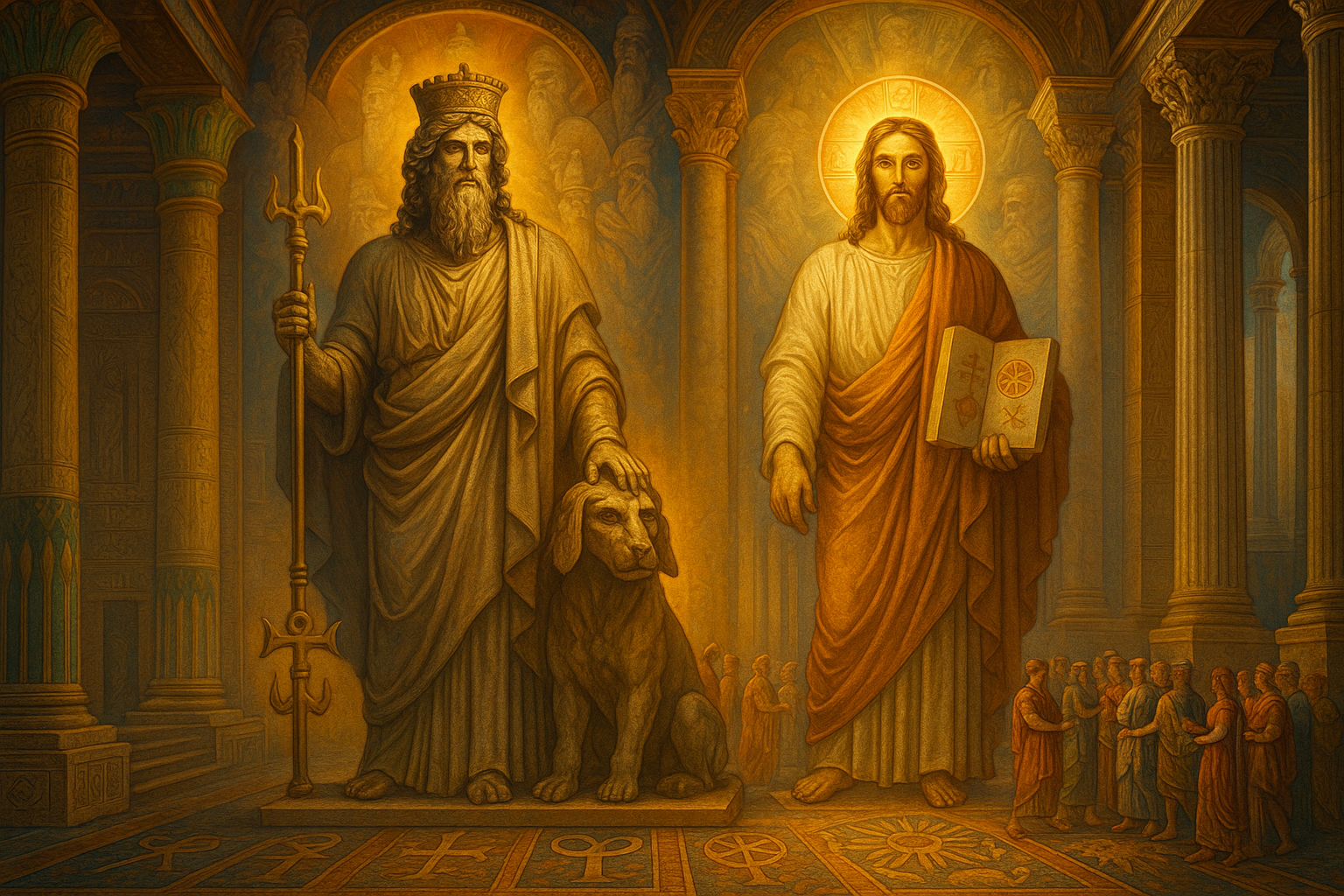
History teaches us that religious identity is never static. It is a fluid negotiation of power, culture, and community. In the ancient world, few examples better illustrate this than the State-sanctioned creation and adaptation of gods like Serapis and Jesus the Christ. These figures did not emerge in cultural vacuums. Rather, they were carefully crafted through syncretism—an intricate blending of belief systems—to unify fractured empires and legitimize rulers.

Serapis: The Politics of Invention

When Ptolemy I Soter, a Macedonian general of Alexander the Great, assumed power in Egypt around 305 BC, he faced a unique dilemma: how to govern an empire split between native Egyptians and Hellenistic (Greek) settlers. His solution was Serapis, a deity forged not from faith, but from political necessity. Serapis was a hybrid god, combining elements of the Egyptian Osiris and Apis with Greek gods such as Zeus, Hades, and Asclepius. He had the appearance of a Greek ruler but bore the attributes of Egyptian underworld gods, complete with a grain basket (modius) atop his head symbolizing abundance and fertility (Murphy, 2021).

Ptolemy introduced Serapis not just to unite religious traditions, but to also reframe the State itself. As Dawson (2014) notes, the cult of Serapis allowed Greeks in Alexandria to claim a spiritual stake in their new home while pacifying Egyptians by linking Serapis with their revered Osiris-Apis tradition. Temples like the Serapeum in Memphis bore dual architecture and symbolism, housing statues of both Greek philosophers and Egyptian sphinxes – visual testaments to a calculated fusion of cultures.

Yet, Serapis was not readily accepted by all. Despite state sponsorship, his cult struggled to win widespread Egyptian devotion. Egyptians often saw him as a “counterfeit” version of their own gods, while Greeks viewed him as a legitimizing tool of Ptolemaic rule (Murphy, 2021). His success lay not in winning hearts, but in stabilizing a divided polity.

Constantine: The Syncretist Emperor

Fast forward to the 4th century AD. Constantine the Great stood atop a similarly divided empire, this time between pagans and a growing Christian (pagan Hellenistic Jew) population. Like Ptolemy before him, Constantine saw in religion a powerful tool for imperial unity. But where Ptolemy invented a god, Constantine rebranded a religion.

Though Constantine is often hailed as Christianity’s champion, his policy was less about theology and more about control. Constantine maintained tolerance toward traditional pagan practices while promoting the Christian religion as the new ideological glue of the empire. His edicts did not immediately ban pagan sacrifices, as some scholars have claimed, but instead reflected a careful balancing act between religious communities (Errington, 1988).

To ease the transition, Constantine employed a similar syncretic strategy. Christian holidays were aligned with pagan festivals; most famously, Christmas with Saturnalia. Temples once dedicated to pagan deities were rededicated to Christian saints. Even the Jesus character’s image gradually took on the visual likeness of Roman gods like Sol Invictus, reinforcing familiarity through resemblance.

Syncretism as Statecraft

Both Ptolemy and Constantine used religious syncretism to perform a crucial function: to unite disparate populations under a single cultural umbrella without resorting to outright repression. Their approach was pragmatic, not pious.

For Ptolemy, Serapis offered a symbolic common ground between colonizers and the colonized. For Constantine, the Christian religion provided a unified moral code and institutional framework adaptable to Roman governance. In both cases, religion was not imposed from below by prophets or mystics, but shaped from above by rulers wielding “divine authority” as an extension of political will.

This strategy resonates with modern attempts at multicultural governance. From India’s policy of religious pluralism to the inclusion of interfaith prayers in U.S. civic ceremonies, states continue to use symbolic fusion to forge unity out of diversity. I suppose it is on us to be on the look out for another Constantine or Ptolemy I, and their new Jesus Serapis.

Learn From History

Religious syncretism in antiquity wasn’t merely theological, it was a form of imperial strategy. Serapis and Jesus, though born of different eras, embody the same impulse: to craft religious meaning in the service of social cohesion. One would then think, for example, that the Jesus character would shriek at such a masterful sociopolitical opportunity to rule an empire, seeing as how in John 6:15, when he “perceived that they would come and take him by force, to make him a king, he departed again into a mountain himself alone.” Why, once Constantine takes office, does Jesus change his mind? Whether through the merging of Isis and Demeter or the transformation of Saturnalia into Christmas, empires have always sought to anchor their authority in what is to be thought of as “sacred.”

I believe that we, as we move through our present world, can learn from this history. The blending of “faiths” is not just a practice of the past, it’s a living process, and one that continues to define how we share space, stories, and ultimately, what we revere as supposedly “divine.”

References

Dawson, D. (2014). A Cult of Fusion. Vulcan Historical Review, 18.

Errington, R. M. (1988). Constantine and the Pagans. Greek, Roman and Byzantine Studies, 29(3), 309–314.

Murphy, L. (2021). Beware Greeks Bearing Gods: Serapis as a Cross-Cultural Deity. Amphora, 2, 29–44.

From Vision to Victory: How Gods Become Kings of Empires

In October 312 AD, Constantine stood before the Milvian Bridge and gazed into the noonday sun. He claimed to see a fiery cross superimposed upon it, bearing the words, “In hoc signo vinces” —“By this sign, conquer.” That night, he was said to have received a dream instructing him to mark his soldiers’ shields with the Chi-Rho, the emblem of Christ, and march on Rome (Odahl, 2010). He did so, transforming a minority faith’s symbol into an imperial standard and securing victory. Later coinage even depicted an angel placing a crown on his head as he clutched that same standard, proclaiming divine legitimacy for his rule.

This moment marked more than a military triumph; it signaled a radical reimagining of sovereignty. Jesus, once supposedly thought of as a Galilean preacher who refused earthly crowns, but more recently classed as a demigod within the Greco-Roman religious world, had now entered the command structure of the Roman army, and not just metaphorically, but structurally. In doing so, Constantine followed a pattern deeply embedded in the ancient world: the transformation of supposedly divine figures into cosmic sovereigns whose will shaped the laws of empire.

This phenomenon finds a striking parallel in the earlier reign of Ptolemy I Soter, ruler of Hellenistic Egypt. Ptolemy sought to unify Greek and Egyptian populations under a single imperial cult, introducing Serapis (a syncretic deity merging Greek and Egyptian traditions) as the divine patron of the Ptolemaic state (Pfeiffer, 2008). Serapis was not merely a god of healing or the underworld; he became the celestial counterpart to the ruling royal pair, Isis being his mythological consort. By aligning the king with this newly crafted divine figure, Ptolemy ensured that the monarchy could be worshipped as a living embodiment of cosmic order—a model later echoed by Constantine.

Like Constantine, Ptolemy understood that the fusion of religion and statecraft was not simply a matter of political convenience; it was a philosophical necessity. Just as Constantine saw in Christianity a unifying force capable of binding together a fractured empire, Ptolemy saw in Serapis a symbolic bridge between cultures. Both leaders recognized that gods must become kings, and kings must become gods, if they were to hold together the vast, diverse populations under their rule.

The establishment of the ruler cult under Ptolemy I was not just an extension of Pharaonic tradition, where the office of the king was divine, but the individual was not. Rather, it was a deliberate Hellenistic innovation that deified the living monarch, aligning him with the pantheon itself.

Similarly, Constantine positioned himself not just as a Christian emperor, but as a new kind of ruler, one who mediated between the divine and the temporal. His alliance with Licinius in 313 AD produced what we now call the Edict of Milan, granting legal recognition to Christian worship across the empire. Yet Constantine’s deeper strategy was theological as much as political. By convening the Council of Nicaea in 325 AD, he sought to forge a creedal unity that would serve both as spiritual doctrine and civic glue. Heresy was no longer just doctrinal error – it became a form of sedition against the cosmic order.

Just as Ptolemy I elevated Serapis above local deities to create a universal divine figure for a multicultural empire, Constantine elevated the Jesus character above all other gods. He did not “invent” orthodoxy, but he nationalized it. Through basilicas built at imperial expense, judicial privileges granted to bishops, and tax exemptions codified into law, Constantine wove the Church into the very fabric of imperial governance. The crucified Lord, once a symbol of suffering and humility, was now enthroned on the emperor’s seal, flanked by angels.

Yet both emperors understood that such transformations required careful calibration. Ptolemy’s integration of Egyptian gods like Isis and Anubis into the broader framework of Serapis-worship allowed him to maintain cultural legitimacy without erasing indigenous belief systems (Pfeiffer, 2008). Likewise, Constantine refrained from immediate theocratic dominance. Though urged by some Christian advisors to outlaw animal sacrifice outright, he instead chose selective pressure; closing temples linked to immorality, stripping others of wealth, but allowing pagan shrines to remain so long as public order was preserved (Errington, 1988). He honored his title of Pontifex Maximus, chief priest of traditional Roman religion, while posing as “God’s” chosen friend, a balancing act between majority pagan constituencies and an ascendant Christian (pagan Hellenistic Jews) elite.

The result was a new ontology of power. For Constantine, as for Ptolemy, victory and order no longer came from the capricious gods of old, but from a singular divine source whose will was interpreted through imperial decree. Just as Ptolemaic propaganda portrayed the monarch as a “god-king” embodying both Greek ideals and Egyptian symbolism, Constantine recast himself as the earthly executor of the Jesus character’s cosmic kingship.

This transformation was irreversible. Even later emperors who flirted with reviving paganism found the machinery of the state already speaking the language of the Nicene Creed. As Pfeiffer notes, once a divine figure is enshrined within the imperial apparatus, it becomes nearly impossible to disentangle theology from politics. The god has become king, not only in heaven, but on earth.

Thus, Constantine did not merely adopt a religion, he crowned its Jesus (or its Serapis) as king of an empire. And in doing so, he fulfilled ancient imperial logic: the fusion of professed divine sovereignty and worldly dominion, a vision as old as Ptolemy’s Serapis and as enduring as the pagan cross on the imperial banner.


References

Errington, R. M. (1988). "Constantine as Pontifex Maximus." Greece & Rome , 35(2), 165–180.

Humphries, M. (forthcoming). Constantine and the Conversion of Europe . Oxford University Press.

Odahl, C. M. (2010). Constantine and the Christian Empire . Routledge.

Pfeiffer, S. (2008). The God Serapis, His Cult and the Beginnings of Ruler Worship in Ptolemaic Egypt . Unpublished manuscript.