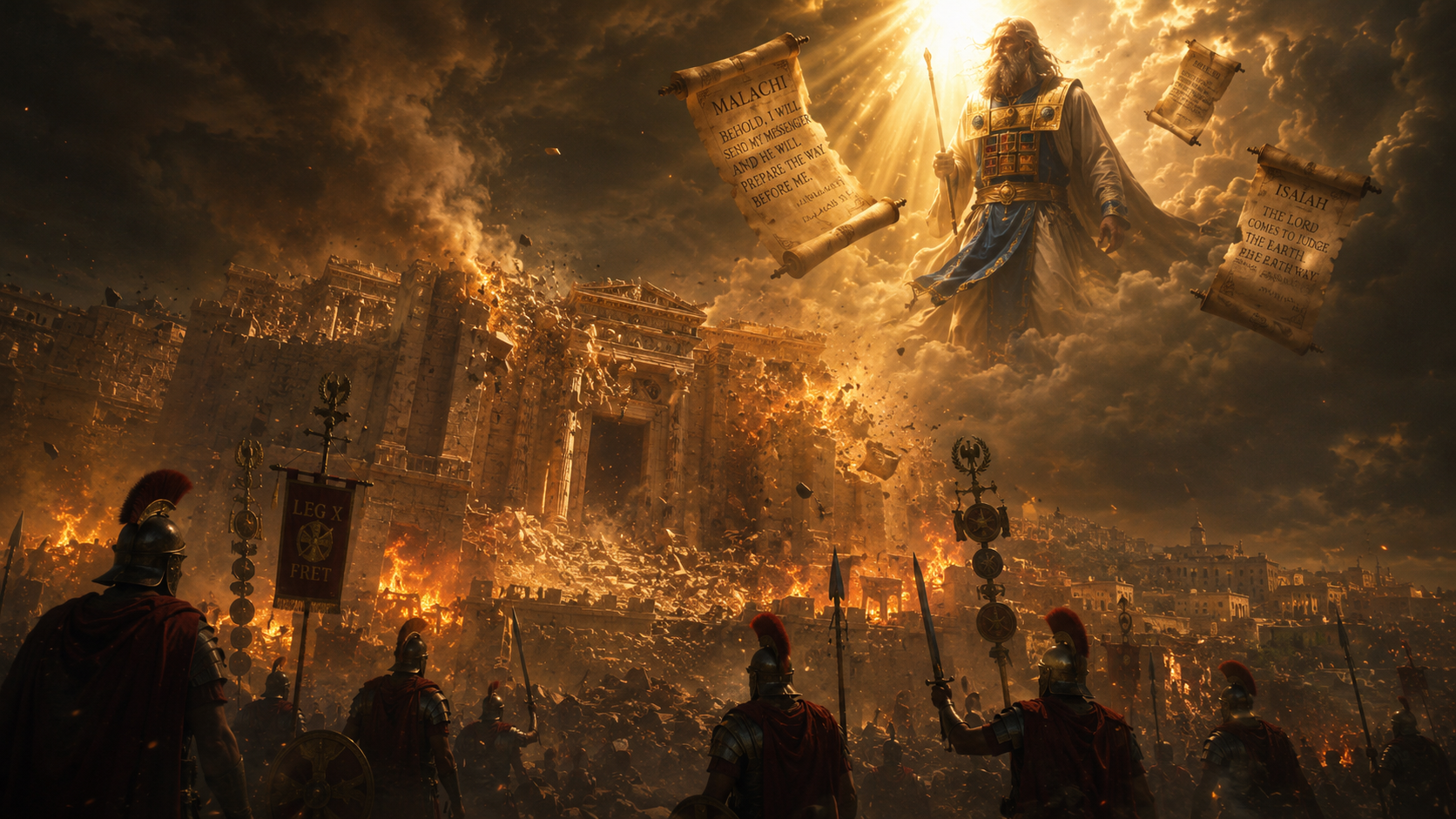
In the Gospel of Mark, the earliest of the canonical narratives, something interesting and unsettling, as we have been finding out in previous blog posts, stirs beneath its surface. While later Gospels and Christian theoretical tradition would emphasize Jesus as the Davidic Messiah (the kingly descendant restoring Israel’s throne) the author of Mark pulls in a radically different direction. Through subtle scriptural allusions, narrative framing, and prophetic rehearsals, this author redefines “Christ” not as a son of David building an earthly kingdom, but as an embodiment of Levi’s purifying destruction. This Christ is no actual historical figure or political liberator. He is an otherworldly force, manifesting through the brutal mechanics of empire, recognized only in the rubble of what was once sacred.
The Davidic Challenge
Consider the pivotal moment in Mark 12:35-37. Jesus poses a riddle to the scribes: How can the Christ be the son of David when David himself, inspired by the Holy Spirit, calls him “Lord” in Psalm 110? It makes absolutely no philosophical or theological sense. “The LORD said to my Lord, ‘Sit at my right hand...’” The implication is deliberate and destabilizing. The expected Messiah, a supposed royal restorer in the line of David, cannot fully capture the figure at the center of this gospel. The author of Mark knows better. He has witnessed, or stands immediately after, the cataclysm of 70 AD. Jerusalem lies in ruins. The Temple, that great symbol of Davidic hopes and priestly power, is gone. No Davidic kingdom has arisen. Instead, something else has occurred: total consumption.
This is not narrative clumsiness. It is philosophical theology sutured directly into story. The Christ of Mark does not descend to reign but to dismantle. His lineage is not literally royal but allegorically priestly-destructive, being Levitical in spirit.
Malachi’s Messenger and the Spirit of Levi
Mark opens by quoting Malachi 3:1 alongside Isaiah: “Behold, I send my messenger before your face, who will prepare your way...” In Malachi, this messenger of the covenant is tied directly to a figure who purifies the sons of Levi. The prophet declares that the LORD will send this “messenger,” and “he will purify the sons of Levi and refine them like gold and silver, till they may offer to the Lord an offering in righteousness” (Malachi 3:3). Yet the same context carries judgment: the messenger arrives like a refiner’s fire, and the day of his coming brings destruction for the unrighteous.
The author of Mark invokes this deliberately. “Levi” here is not the literal tribe or a genealogical claim. It is archetypal, referencing the violent zeal of Levi in Genesis and Exodus, the brother who, with Simeon, slaughtered Shechem’s city to avenge the defilement of their sister and uphold the sanctity of Israel’s God (Genesis 34). Levi is raised up as a force against those who pervert cosmic order. In Malachi, this spirit turns inward: the sons of Levi (the corrupt Jerusalem priesthood) must themselves face refinement or destruction.
To the Markan author, writing in the shadow of Rome’s legions, this is no coincidence. The Christ bears the spirit of Levi. He is the messenger of the covenant who enacts cosmic judgment, not through establishing a throne, but through the annihilation of the old order. Jesus in Mark never explicitly claims the title “Christ” for himself in a straightforward way; he accepts it when others apply it, much as John the Baptist embodies Elijah; not as literal reincarnation, but as fulfillment of role and scripted prophetic pattern. The embodiment is figurative, spiritual, and deeply philosophical: a participation in an eternal archetype that transcends linear time and earthly genealogy.
An Otherworldly Entity, Manifest in Empire
Here the Markan vision grows metaphysical. The true Christ exists outside the ordinary realm of time and space, an agent of the divine will that operates through history’s dominant powers. Scripture itself models this pattern repeatedly.
In Isaiah 10, the Lord GOD declares he will (on behalf of the LORD God) bring consumption upon the land (Isaiah 10:23). Yet the instrument is explicitly the Assyrian king: “O Assyrian, the rod of mine anger... I will send him against a hypocritical nation” (Isaiah 10:5,6). “God” speaks of his own action; history records the empire’s boot. Similarly, Isaiah 45 anoints Cyrus the Persian, a pagan ruler, as God’s “anointed” (Messiah/Christos in Greek translation), the one who will subdue nations and break gates of brass. Daniel 2:37 extends the principle: Nebuchadnezzar of Babylon rules as “king of kings” because “the God of heaven hath given thee a kingdom, power, and strength, and glory.”
The kingdom of God, in this ancient Israelite worldview, is not a theocratic counter-empire. It is the world-ruling power that the Deity cosmically selects and wields as an extension of divine will. The author of Mark, steeped in these texts and living after the fall of Jerusalem, applies the same logic. Rome becomes the rod. The legions that razed the Temple and scattered the priesthood are the manifestation of Levi’s spirit, “the Christ” destroying the sons of Levi who had perverted the covenant.
Mark 13:2 captures the prophecy: “Seest thou these great buildings? There shall not be left one stone upon another, that shall not be thrown down.” How does this occur? Not through a Davidic army or miraculous intervention in the expected sense, but through the impersonal, terrifying machinery of imperial judgment. “The Christ” is and works as and through the empire “God” has anointed for this hour. The destruction is not failure of prophecy but its precise, terrifying fulfillment.
Christ as Cosmic Agency
This reframes everything. “The Christ” in Mark is not a personal savior figure offering individual escape. He is the interface between the transcendent divine and immanent historical forces, the point at which otherworldly judgment irrupts into the material world. The Jesus character serves as the advocating voice and embodied sign of this reality, pointing toward the coming Levi-Rome conflagration. His ministry, parables, and death anticipate the end of the old Temple-based order.
Philosophically, this resonates with deeper patterns in religious thought: the divine does act through what appears secular or even hostile; this is the lesson. History becomes theophany. Empires are not autonomous; they are instruments, however unconscious, of a larger script. The Markan author, witnessing Rome’s victory over the city and sanctuary of Jerusalem, sees not Roman triumph over God but God’s use of Rome to judge and purify. The Christ-spirit of Levi completes what Davidic hopes could not: the radical clearing of the ground for whatever comes next.
This is an absolutely unsettling revelation to later orthodoxy, which harmonized Mark with Davidic genealogies in Matthew and Luke. But the earliest gospel (Mark) resists easy domestication. Its Christ is wilder, more apocalyptic, tied to only the destruction of the priesthood as much as only the redemption of the priesthood. Human beings are not the subjects of its concept of redemption due to the author of Malachi fixing redemption only on the priesthood.
The Stone Not Left Upon Another
Ultimately, the author of Mark invites us to see the Christ not with the eyes of expectation; as in a king on a throne; but with eyes attuned to the patterns of scripture and the convulsions of history. Levi’s spirit, channeled through Rome, did what no Davidic messiah was called to do: it ended an era. The Temple fell. The priesthood was scattered. And in that void, a new understanding of divine power emerged.
What does this mean for us? If “Christ” manifests through the ruling powers of an age to dismantle corrupt religious orders (this is the Bible’s only narrative), where ought we to turn our attention? Are we still awaiting a literal messenger, or do the signs of the times suggest another consumption is prepared?
The Christ of Mark is yet speaking. Not from David’s line, but from the refiner’s fire. Listen closely to the sound of our modern environment. What kingdom will rise from the dust to destroy what priesthood?
Our conversation continues.